The Legacy of the USS Colorado: A Titan of the American Fleet
The USS Colorado (BB-45) stands as a monumental chapter in naval history. As the lead ship of the Colorado class, this battleship represented the pinnacle of the "standard type" of battleship design before the era of rapid technological shifts. From its commissioning in 1923 through its storied service in World War II, the Colorado was a symbol of American maritime power, enduring heavy combat and contributing significantly to the Allied victory in the Pacific.
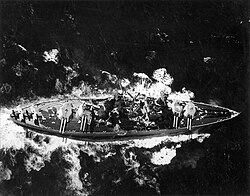
Colorado steams through rough seas, circa 1932
Technical Specifications and Design
Designed in 1916, the Colorado class was a refined evolution of the preceding Tennessee class. While the hull design remained similar, the most significant upgrade was the main battery. Engineers replaced the twelve 14-inch guns of previous models with eight massive 16-inch (406 mm) guns, providing much greater striking power.
The ship was a marvel of early 20th-century engineering, powered by four General Electric turbo-electric drives and eight oil-fired Babcock & Wilcox boilers. This propulsion system allowed the vessel to reach a top speed of 21 knots, though speed trials showed it was capable of even higher velocities. To ensure long-range operations, the ship featured an impressive cruising range that could be extended significantly during wartime by utilizing additional fuel spaces.
Armament and Armor
The Colorado was built to withstand and deliver immense force. Its primary weaponry consisted of four twin-gun turrets mounted on the centerline, allowing for maximum firepower. To defend against aerial threats, the ship's anti-aircraft battery was upgraded over time, eventually featuring 5-inch guns to replace older 3-inch models.
Protection was equally vital. The ship featured a heavy armored belt ranging from 8 to 13.5 inches in thickness, and the main gun turrets were protected by faces up to 18 inches thick. This heavy plating was essential for surviving the intense surface engagements and shore battery fire it would encounter in later years.
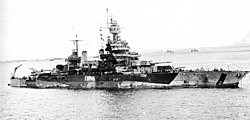
USS Colorado off Tinian, on 24 July 1944, with hull damage, the result of 22 hits from shore batteries
Service History: From Interwar Years to World War II
Following its commissioning on August 30, 1923, the Colorado spent much of its early life conducting training exercises and participating in international naval reviews. During the interwar period, it was a fixture in the Pacific and Caribbean, participating in large-scale "Fleet Problems"—annual training exercises designed to test naval tactics. Notably, in 1937, the ship served as a training vessel for NROTC students and even participated in the search for aviator Amelia Earhart.
With the outbreak of World War II, the Colorado's role shifted from training to active combat. After undergoing refits to increase its anti-aircraft capabilities, the ship was deployed to the Pacific to halt Japanese expansion. Its service record is marked by intense involvement in several major campaigns:
- The Marshall Islands: Provided pre-invasion bombardment for the landings at Kwajalein and Eniwetok.
- The Mariana Islands: Supported the invasions of Saipan, Guam, and Tinian. During the shelling of Tinian in July 1944, the ship survived 22 hits from Japanese shore batteries.
- The Philippines: Supported troops at Leyte Gulf, where it survived two kamikaze strikes, and later participated in the pre-invasion bombardment of Lingayen Gulf in 1945.
- Okinawa and Japan: Provided fire support and anti-aircraft cover during the invasion of Okinawa and eventually participated in the occupation of Japan.
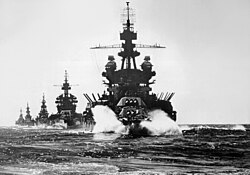
Pennsylvania leading Colorado, Louisville, Portland, and Columbia into Lingayen Gulf in January 1945.
Post-War Decommissioning and Lasting Legacy
After the war, the Colorado participated in Operation Magic Carpet, a massive effort to transport soldiers back home. The ship was placed in reserve in 1947 and was eventually sold for scrap in 1959. However, the ship's physical presence lives on through various artifacts preserved in museums and public spaces across the United States.
Pieces of the Colorado's history can still be visited today, including its bell, helm, and various deck guns. Even the teak wood from its decks has been repurposed, finding new life in university halls and athletic clubs, ensuring that the memory of this great battleship is never truly lost.
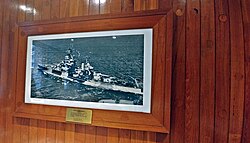
Boards from the deck of USS Colorado form a wall in the Legends Room of the Washington Athletic Club
Key Facts
- Class: Lead ship of the Colorado-class battleships.
- Main Armament: Eight 16-inch (406 mm) guns.
- War Record: Awarded seven battle stars for service during World War II.
- Service Life: Commissioned in 1923 and decommissioned in 1947.
- Notable Incident: Survived 22 hits from shore batteries during the shelling of Tinian in 1944.
Ship Specifications Summary
| Feature | Specification |
|---|---|
| Displacement (Unloaded) | 32,600 long tons |
| Length | 624 ft 3 in |
| Top Speed | 21 knots |
| Main Battery | 8 × 16 in/45 cal Mark 1 guns |
| Secondary Battery | 14 × 5 in/51 cal guns |
| Crew Complement | 64 officers and 1,241 enlisted men |
Frequently Asked Questions
What was the primary difference between the Colorado class and previous battleship classes?
The primary difference was the main battery. While previous classes like the Tennessee class used twelve 14-inch guns, the Colorado class utilized eight larger 16-inch guns.
How did the USS Colorado perform during the invasion of Tinian?
The ship provided critical fire support for invading troops but sustained significant damage, receiving 22 shell hits from Japanese 150mm shore batteries.
Where can I see artifacts from the USS Colorado today?
Artifacts are located in various places, including the University of Colorado (bell and helm), the Veterans Memorial Museum in Chehalis (a 5-inch gun), and the USS Olympia museum ship (several 5-inch guns).
What was Operation Magic Carpet?
Operation Magic Carpet was a post-war mission in which the Colorado helped transport 6,357 soldiers back home after the conclusion of hostilities.
Was the USS Colorado present during the attack on Pearl Harbor?
No. At the time of the attack on December 7, 1941, the Colorado was undergoing an overhaul at the Puget Sound Navy Yard on the West Coast.