Wildlife-Vehicle Collisions: Causes, Impacts, and Prevention
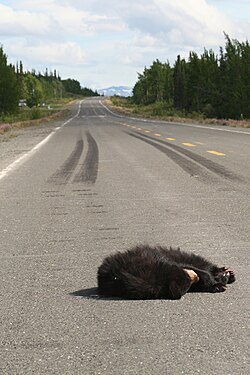
A wildlife-vehicle collision (WVC) occurs when a moving vehicle strikes an animal. When such an encounter results in the death of the animal, the remains are commonly referred to as roadkill. While these incidents may seem like isolated accidents, they have become a significant focus of academic research aimed at understanding the underlying causes and developing effective mitigation strategies to protect both animals and humans.
Historically, roadkill was virtually non-existent before the rise of mechanized transport. The problem emerged alongside the increase in automobile speeds during the early 20th century. As early as 1920, naturalist Joseph Grinnell noted in California that this was a relatively new source of fatality, estimating that mortality rates could reach hundreds or thousands of animals every 24 hours across the state's road network.
Key Facts
- Global Impact: It is estimated that roughly 5.5 million vertebrates are killed on roads daily, totaling over 2 billion annually.
- U.S. Statistics: A 1960s survey estimated one million vertebrate deaths daily in the U.S., while a 2008 report noted 1 to 2 million annual accidents involving large animals.
- Species Vulnerability: Mammals often dominate roadkill reports, though bird and amphibian deaths are likely underestimated due to lower observability.
- Human Factors: Research indicates a small percentage of drivers intentionally target certain animals, such as reptiles.
- Mitigation: Solutions range from wildlife crossings and canopy bridges to vegetation management and warning signs.
Causes of Wildlife-Vehicle Collisions
The drivers of animal mortality on roads are diverse, ranging from biological instincts to human behavior.
Intentional Collisions
While most collisions are accidental, some are deliberate. A 1996 study in Ontario, Canada, observed reptiles killed in areas where tires do not typically pass, suggesting intentional acts. This was supported by 2007 research where 2.7% of drivers intentionally hit reptile decoys. The study found that male drivers were more likely to target these decoys, though a small percentage of both genders stopped to rescue them.
Environmental and Biological Factors
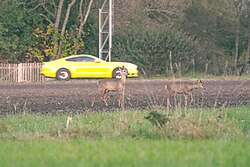
Animals are often drawn to roads for various reasons. In Punjab, India, a study found that granivorous birds (birds that eat seeds) were killed at rates higher than their local availability, likely because they were attracted to spilled grain on the pavement.
Distribution and Species Impact
The scale of roadkill is immense, affecting a wide array of taxa including mammals, birds, reptiles, amphibians, and invertebrates.
Taxonomic Breakdown
A 1993 study in New England involving 1,923 deaths found that 81% of the fatalities were mammals, 15% were birds, and 3% were reptiles and amphibians. Based on this, some estimates suggest annual U.S. losses of 41 million squirrels, 26 million cats, 22 million rats, 19 million Virginia opossums, 15 million raccoons, 6 million dogs, and 350,000 deer.
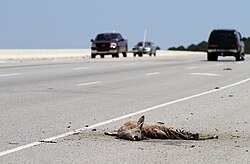
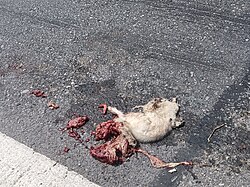
However, researchers caution that these numbers may be skewed by observability—the ease with which a carcass is spotted. For example, a dead raccoon is far more visible than a dead frog, meaning amphibian and bird mortality is likely underreported.
Regional Findings
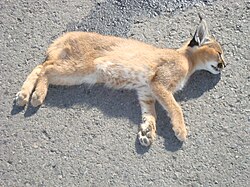
In northern India, a study covering 20 km of agricultural road identified 133 kills across 33 species. The data suggested that traffic killed individuals from 30% of local amphibian species, 27% of mammals, 25% of reptile species, and 16% of bird species.
Research and Observation Projects
To combat this issue, various observation projects have been launched to gather data and raise awareness. In India, the "Provide Animals Safe Transit on Highways" (PATH) project, initiated in 2015, involved a massive expedition covering 17,000 kilometers across 22 states. This effort, along with focused studies in the Western Ghats, has documented the loss of numerous arthropods, amphibians, reptiles, birds, and mammals.
Prevention and Mitigation Strategies
Wildlife-vehicle collisions result in significant negative consequences, including animal suffering, risk of death or injury to vehicle occupants, damage to endangered species, and economic losses related to vehicle repair and cleanup.
Infrastructure Solutions
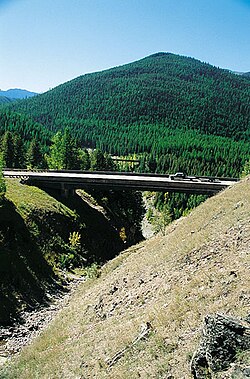
- Wildlife Crossings: Specialized bridges or underpasses allow animals to cross roads safely. For example, mountain goats in the U.S. now use rocky passageways under bridges to reach salt licks.
- Canopy Crossings: Bridges designed for arboreal animals, such as the lion-tailed macaque in the Anamalai Hills.
- Fencing: Used to guide animals toward safe crossing points and away from high-traffic lanes.
![Lion-tailed macaque (Macaca silenus) on the canopy bridge in Anamalai Hills[72]](/images/3d/3e/3d3e45c91c3146f96c1ab14cf24496cfda55ed377b1ebdf1d02da5f169bb1b94.jpg)
Traffic Management
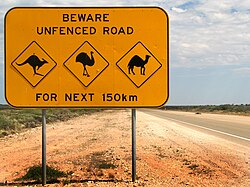
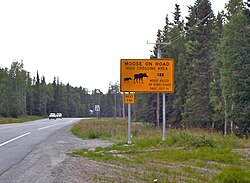
Warning signs are frequently used to alert drivers to animal activity, though their effectiveness varies. Some regions, such as Kenai, Alaska, combine moose crossing signs with "kill counters" and trim back roadside brush to improve visibility of approaching animals.
Future Technology
The advent of self-driving cars is being studied as a potential method to reduce roadkill, as autonomous systems may eventually be better equipped to detect and avoid wildlife than human drivers.
Summary of Roadkill Impacts and Solutions
| Category | Key Data / Method | Primary Goal/Impact |
|---|---|---|
| Global Mortality | ~5.5 million vertebrates/day | Massive biodiversity loss |
| U.S. Large Animals | 1-2 million accidents/year | Vehicle damage & human risk |
| Infrastructure | Underpasses & Canopy bridges | Safe animal transit |
| Management | Vegetation trimming & Signs | Increased driver visibility |
| Human Behavior | Intentional targeting (reptiles) | Direct anthropogenic mortality |
Frequently Asked Questions
Why are mammals more common in roadkill reports?
This is largely due to observability. Larger animals like mammals are much easier for researchers and citizens to spot on the road compared to smaller animals like frogs or small birds, leading to an underestimation of non-mammalian mortality.
Do warning signs effectively reduce animal collisions?
While widely used, they are not always successful. Some evidence shows animals are still killed in areas where warning signs are present, suggesting that signs alone may not be sufficient without physical mitigation like fencing or crossings.
What are canopy crossings?
Canopy crossings are specialized bridges designed for animals that live in trees, such as primates. They allow these species to cross roads without descending to the ground, where they would be vulnerable to vehicles.
Can self-driving cars help reduce roadkill?
It is hypothesized that self-driving cars could reduce collisions because they may be able to detect animals more reliably and react faster than human drivers, although this remains a subject of ongoing study.
What is the impact of roadkill on humans?
Beyond the ethical concern for animals, collisions can cause serious injury or death to vehicle occupants, result in significant vehicle damage, and create economic losses for cleanup and repairs.