Madidi National Park: A Journey Through the World's Most Biodiverse Wilderness
Spanning from the towering peaks of the Andes Mountains to the lush rainforests of the Tuichi River, Madidi National Park represents one of the most ecologically significant landscapes on Earth. Located in the upper Amazon River basin of Bolivia, this vast protected area was recognized in 2018 by the Wildlife Conservation Society as the most biologically diverse national park in the world.
Established on September 21, 1995, the park covers a massive territory that includes parts of the Bolivian Yungas and montane dry forests. When combined with neighboring protected areas like the Manu Biosphere Reserve in Peru, Madidi forms part of one of the largest interconnected protected zones on the planet.
Key Facts
- Location: La Paz Department, Bolivia.
- Total Area: 18,957.5 km², including the Integrated Management Natural Area (IMNA).
- Biodiversity Status: Recognized as the world's most biologically diverse national park.
- Elevation Range: 180 to 5,760 meters above sea level.
- Climate: Varies from alpine cold to tropical lowland heat.
Geography and Climate
Madidi is a land of extreme contrasts. Its geography encompasses a wide range of ecosystems, driven by a dramatic elevation gradient. The park's boundaries stretch between 12°30' and 14°44' southern latitude, covering diverse terrains that support life ranging from high-altitude mountains to lowland jungles.
Weather Patterns
Because of the varying altitudes, the climate changes significantly depending on where you are located. The northern lowlands experience a tropical climate, while mid-level elevations are moderate, and the alpine regions remain cold. The average annual temperature is approximately 26°C, though this fluctuates based on altitude. The region experiences a wet season from October to March and a dry season from May to September, with annual precipitation averaging around 716 mm.
Unrivaled Biodiversity
The sheer volume of life within Madidi is staggering. The park serves as a sanctuary for thousands of species, many of which are found nowhere else on Earth. The flora is equally impressive, with more than 8,000 documented species of vascular plants (plants that possess specialized tissues for conducting water and nutrients).
Wildlife Statistics
Madidi is a haven for fauna, hosting a massive array of mammals, birds, and insects. Notable megafauna include the jaguar, spectacled bear, maned wolf, vicuña, and giant otter. The park is also a critical habitat for avian life, containing 1,254 bird species—roughly 14% of the world's total bird species.
| Category | Estimated Number of Species |
|---|---|
| Arthropods | Over 120,000 |
| Birds | 1,254 |
| Mammals | 272 |
| Fish | 496 |
| Amphibians | 213 |
| Reptiles | 204 |
The Golden Palace Monkey
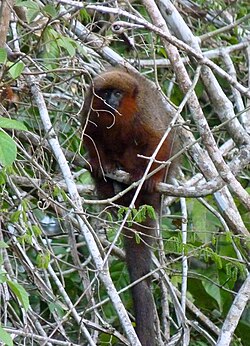
One of the most famous biological discoveries in the park is the Plecturocebus aureipalatii, a species of titi monkey endemic to the region. Discovered by wildlife biologist Dr. Robert Wallace, the naming rights were auctioned to GoldenPalace.com, which contributed US$650,000 to a trust fund that now supports fourteen park guards annually.
Indigenous Culture and Ecotourism
Madidi is not just a wilderness; it is a home. Various indigenous groups inhabit the region, including the Tacana and Ese Ejja (who speak Tacanan languages), the Tsimané and Mosetén, and the voluntarily isolated Toromona. Many local inhabitants also speak Quechua.
To protect this heritage and environment, the region has pioneered community-based ecotourism. These initiatives ensure that tourism profits directly benefit local indigenous communities rather than outside corporations.
Notable Ecolodges
- Chalalan Ecolodge: A well-known community enterprise owned by the San José de Uchupiamonas people. It utilizes solar panels and sustainable waste management.
- Sadiri Lodge: A non-profit initiative managed by the San José De Uchupiamonas to protect 34,000 hectares of forest.
- Berraco del Madidi Amazon Adventure Tour: A remote, community-led project offering traditional Quechua-Takana style accommodations.
- Madidi Jungle Ecolodge: A 100% local initiative operated by indigenous families.
Conservation Challenges
Despite its protected status, Madidi faces significant threats from industrial development. Two major projects have caused concern among conservationists:
- The Bala Dam Project: A proposed hydroelectric dam on the Beni River that could flood approximately 2,000 km², including large portions of the park.
- The Apolo–Ixiamas Road: A proposed road project that studies suggest could lead to significant deforestation and economic instability for the region.
Frequently Asked Questions
How do I get to Madidi National Park?
The park is accessible from San Buenaventura by crossing the Beni River via a passenger ferry from Rurrenabaque.
What makes Madidi so unique?
Madidi is recognized as the most biologically diverse national park in the world, containing a massive variety of ecosystems ranging from the Andes to the Amazon rainforest.
Who manages the park?
The park is governed by SERNAP (Servicio Nacional de Áreas Protegidas), the Bolivian National Protected Area Service.
Is the tourism in Madidi sustainable?
Yes, many of the primary tourism options, such as Chalalan and Sadiri Lodge, are community-owned or managed initiatives designed to provide economic benefits to indigenous groups while minimizing environmental impact.
What kind of wildlife can I see there?
Visitors can find a vast array of wildlife, including jaguars, spectacled bears, giant otters, and over 1,200 species of birds.