White-throated Sparrow
The white-throated sparrow (Zonotrichia albicollis) is a distinctive passerine bird belonging to the New World sparrow family, Passerellidae. Known for its melodic song and striking facial markings, this species breeds across northern North America and spends its winters in the southern United States. While it may appear as a typical garden bird, the white-throated sparrow possesses complex genetic traits and behavioral patterns that fascinate ornithologists.
Key Facts
- Scientific Name: Zonotrichia albicollis
- Conservation Status: Least Concern (IUCN 3.1)
- Distinctive Feature: Exists in two color morphs: white-striped and tan-striped.
- Diet: Primarily seeds, insects, and berries.
- Migration: Differential migration where females typically travel further south than males.
- Threats: Highly susceptible to building collisions due to nocturnal flight calls and light attraction.
Taxonomy and History
The white-throated sparrow was first illustrated and described in 1760 by English naturalist George Edwards, who used a drawing provided by American naturalist William Bartram. In 1789, Johann Friedrich Gmelin formally included the species in the revised Systema Naturae, initially placing it in the genus Fringilla as Fringilla albicollis.
By 1832, William Swainson introduced the genus Zonotrichia. The name is derived from the Ancient Greek words zōnē (band) and thrix (hair), while the specific epithet albicollis combines the Latin albus (white) and collis (necked). The species is monotypic, meaning no recognized subspecies exist.
Physical Description
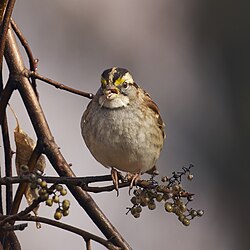
Measuring between 15 and 19 cm in length with a wingspan of 23 cm, the white-throated sparrow typically weighs between 22 and 32 g. They are closely related in appearance to the white-crowned sparrow but are distinguished by their yellow lores (the area between the eye and the bill) and white throat markings.
The species is most famous for its two adult plumage variations:
- White-striped form: Features a black crown with a white central stripe and a white supercilium (the stripe above the eye).
- Tan-striped form: Features a dark brown crown with a tan central stripe and a tan supercilium.
Both forms share dark eyes, a white throat, and rufous wings with two white wing bars. Interestingly, these two morphs occur in roughly equal numbers in the population.
Behavior and Reproductive Strategies
The white-throated sparrow exhibits a rare biological phenomenon where color morphs dictate social and reproductive behavior. This is driven by a supergene—a chromosomal inversion that acts as an extra pair of sex-determining genes, resulting in four distinct phenotypes.
Mating and Aggression
White-striped birds are generally more aggressive than tan-striped birds, a trait linked to higher expression of estrogen receptor alpha. In a pattern known as disassortative mating, birds almost always pair with a partner of the opposite color morph to maintain competitive equilibrium.
Parental Investment
The two morphs employ different strategies: tan males focus on parental care and guarding their mates, while white males spend more energy securing additional mates through song. Similarly, tan females invest more in parental care, whereas white females are more likely to engage in brood parasitism, leaving their eggs in other nests.
Wintering, Migration, and Diet
White-throated sparrows are differential migrants. Females, being smaller and less dominant in winter hierarchies, migrate further south to avoid competition with males and the harsh cold of higher latitudes. This allows males to return to breeding grounds earlier to establish territories.
During the winter, they are among the most abundant native birds in eastern North America, though they are often dominated by other seed-eating species like the song sparrow. This competition sometimes forces them into sub-optimal foraging sites, increasing their vulnerability to predators such as the eastern screech-owl and sharp-shinned hawk.
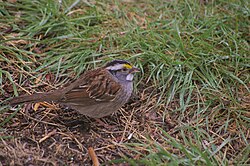
Their diet consists of seeds (particularly millet and black oil sunflower), insects, and berries such as grapes, blackberries, and rose hips. They forage by kicking backward with both feet simultaneously to uncover food in low vegetation.
Song and Communication
The song of the white-throated sparrow is produced primarily through the left side of the syrinx (the avian vocal organ). Their most famous song is often described by the mnemonic "Po-or Sam Peabody, Peabody, Peabody."
Recent ornithological discoveries have identified a new song variation originating in British Columbia. In this version, the repeating triplets (like "Peabody") are replaced by doublets (like "Cherry"), ending in a single tone. This new tune has been spreading eastward across the population.
Conservation and Threats
While listed as "Least Concern" by the IUCN, the species faces significant threats from human infrastructure. A study spanning 1978 to 2016 identified them as "super colliders," with up to 10,000 fatalities recorded in Chicago. This high rate of building collisions is attributed to their attraction to artificial lights and the use of nocturnal flight calls during migration.
| Attribute | Details |
|---|---|
| Average Length | 15–19 cm |
| Average Weight | 26 g |
| Breeding Range | Central Canada and New England |
| Winter Range | Southern and Eastern United States |
| Primary Diet | Seeds, insects, and berries |
| Key Threat | Building collisions (Artificial light) |
Frequently Asked Questions
What is the difference between the tan and white morphs?
The difference is primarily visual (crown and eye-stripe color) and behavioral. White-striped birds are more aggressive and seek more mating partners, while tan-striped birds invest more in parental care.
Why do female white-throated sparrows migrate further than males?
Females migrate further to avoid competition with dominant males in winter hierarchies and because their smaller size makes them less suited for colder, higher latitudes.
What does the white-throated sparrow eat?
They eat a variety of seeds (especially millet), insects, and berries such as rose hips, grapes, and blackberries. They are also frequent visitors to bird feeders.
Why are they called "super colliders"?
They are called super colliders because they are exceptionally susceptible to colliding with buildings, likely due to a combination of nocturnal flight calls and attraction to artificial city lights.
How is the white-throated sparrow's song produced?
The song is produced laterally through the left side of the syrinx, controlled by both the central and peripheral nervous systems.