Northern House Wren: The Feisty Hole-Dweller of North America
The Northern house wren (Troglodytes aedon) is a diminutive yet spirited passerine bird belonging to the wren family, Troglodytidae. Found across southern Canada, the United States, and Mexico, this species is a common sight in suburban areas throughout its range. Its scientific name, troglodytes, literally translates to "hole dweller," a fitting description for a bird known for disappearing into crevices to hunt insects or seek refuge.
Once considered a broad complex including various populations in the Caribbean and South America, the Northern house wren has been refined through genomic research. Modern taxonomy now recognizes several of those former subspecies as distinct species based on differences in morphology, vocalizations, and deep genomic divergence.

Key Facts
- Scientific Name: Troglodytes aedon
- Conservation Status: Least Concern (IUCN 3.1)
- Range: Southern Canada, USA, and Mexico
- Diet: Primarily insects, spiders, and snails
- Defining Trait: A short, cocked tail and a rich, bubbly song
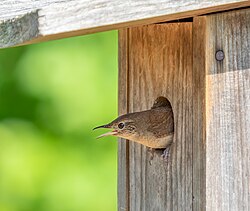
- Nesting: Cavity nesters that often utilize man-made birdhouses
Taxonomy and Classification
Formally described in 1809 by French ornithologist Louis Pierre Vieillot, the Northern house wren's specific epithet, aedon, is derived from the Ancient Greek word for "nightingale." While an earlier name, Sylvia domestica, was introduced by Alexander Wilson in 1808, the International Commission on Zoological Nomenclature suppressed it in 1998 to maintain the widely accepted name aedon.
Currently, four recognized subspecies exist:
- T. a. parkmanii: Found in southwest and central south Canada, and west and central USA to north Mexico.
- T. a. aedon: Found in southeast Canada and the eastern USA.
- T. a. cahooni: Found from southeast Arizona to central Mexico.
- T. a. brunneicollis: Found in central and south Mexico.
Physical Description
The Northern house wren is a very small bird, typically measuring 11 to 13 cm (4.3 to 5.1 in) in length with a wingspan of approximately 15 cm (5.9 in). They are lightweight, weighing between 10 and 12 g (0.35 to 0.42 oz). Their plumage varies by subspecies, with upper parts ranging from dull greyish-brown to a rich rufescent-brown, while underparts can vary from pure white to pale grey or buff.
Key identifying features include blackish barring on the wings and tail, a faint eye-ring, and a long, thin bill. Their legs are typically grey or pinkish, and they are well-known for holding their short tails in a cocked position.
Behavior and Ecology
These birds are active foragers that hunt primarily in vegetation for beetles, bugs, butterfly larvae, spiders, and snails. In the western great plains, they reach their highest densities in floodplain forests, where they frequently utilize old woodpecker holes for nesting.
The Northern house wren is a migratory species. Most populations travel to Mexico and the southern United States for the winter, returning to their breeding grounds between late April and May, and departing again by September or early October.
Breeding and Nesting Habits
Nesting is a meticulous process. The male wren collects small dry sticks to construct a large cup nest within a cavity—which may be a natural hole, a cliff crevice (up to 15 m high), or a man-made birdhouse. The female acts as the quality controller; if she disapproves of the male's construction, she will throw the unwanted sticks to the ground before lining the nest with materials such as hair, wool, feathers, moss, and spider cocoons.
Territorial Aggression
Despite their size, Northern house wrens are pugnacious. They are known to protect their territory by filling the nests of other birds with sticks to make them unusable or by puncturing the eggs of competitors (ovicide). Interestingly, female wrens also sing; research suggests that females who sing more frequently to rivals lose fewer eggs to ovicide, indicating that song serves a competitive function for both sexes.
Raising the Young
A typical clutch consists of two to eight red-blotched cream-white eggs. The female incubates the eggs for 12 to 19 days while the male provides her with food. Once hatched, the altricial (naked and helpless) young take about 15 to 19 days to fledge. Both parents work tirelessly to provide the high volume of food required for the chicks' rapid growth.
Studies in the Washington, D.C. area have shown that while suburban parents make more feeding trips per hour than rural parents, rural nestlings actually grow faster. This suggests that food in suburban backyards may be of lower quality or smaller in size than food found in rural habitats.
Conservation and Culture
The Northern house wren is currently classified as Least Concern by the IUCN. Although the introduction of the house sparrow has displaced them in some northern regions, they remain widespread across North America.
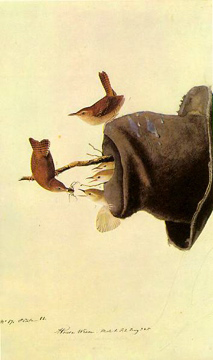
The species has also appeared in art and media, notably in John James Audubon's Birds of America (1827–38) and as a fictional pet named "Trog" in Mister Rogers' Neighborhood.
| Feature | Details |
|---|---|
| Average Length | 11–13 cm |
| Average Weight | 10–12 g |
| Primary Diet | Insects, spiders, snails |
| Incubation Period | 12–19 days |
| Fledging Period | 15–19 days |
| Conservation Status | Least Concern |
Frequently Asked Questions
Why is the Northern house wren called a "hole dweller"?
The name comes from the Greek word troglodytes, referring to the bird's habit of seeking shelter or hunting for insects inside crevices and cavities.
Do female Northern house wrens sing?
Yes, females do sing. In this species, song is not exclusive to males and is believed to play a role in territorial competition and the protection of eggs from other wrens.
What do Northern house wrens eat?
Their diet consists mainly of insects, including beetles, bugs, and butterfly larvae, as well as spiders and snails.
How do they build their nests?
The male gathers dry sticks to build a cup-shaped nest in a cavity. The female then inspects the work, removing any sticks she dislikes, before lining the nest with soft materials like wool, hair, and moss.
Are Northern house wrens endangered?
No, they are classified as Least Concern by the IUCN and remain common and widespread throughout most of North America.