American Herring Gull: A Comprehensive Overview
The American herring gull (Larus smithsonianus), also known as the Arctic herring gull or Smithsonian gull, is a large and resilient seabird native to North America. Often colloquially referred to as a "seagull," this species plays a significant role in coastal and inland ecosystems. While historically grouped with the European herring gull, modern ornithological consensus increasingly recognizes it as a distinct species.
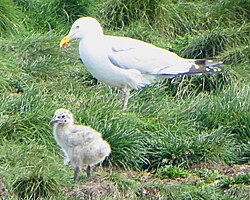
Key Facts
- Scientific Name: Larus smithsonianus
- Conservation Status: Least Concern (IUCN 3.1)
- Primary Habitat: Coasts, lakes, rivers, and urban areas like parking lots
- Diet: Highly varied, including fish, invertebrates, and human refuse
- Lifespan Maturity: Takes approximately four years to reach full adult plumage
Taxonomy and Scientific Classification
The taxonomy of the herring gull group has long been a subject of scientific debate. First described in 1862 by Elliott Coues using specimens from the Smithsonian Institution, the bird was originally classified as a subspecies of the European herring gull. However, recent studies have challenged this relationship.
A 2002 study suggested that the American herring gull belongs to a separate clade—a group of organisms believed to have evolved from a common ancestor—distinct from its European counterparts. In 2025, the American Ornithologists' Union officially adopted the split, recognizing both the American herring gull and the Vega gull (Larus vegae) as separate species.
Scientific Classification
- Kingdom: Animalia
- Phylum: Chordata
- Class: Aves
- Order: Charadriiformes
- Family: Laridae
- Genus: Larus
Physical Description and Identification
The American herring gull is a heavily built bird characterized by a long, powerful bill and a sloping forehead. There is notable sexual dimorphism in size: males typically measure 60–66 cm (24–26 in) and weigh between 1,050–1,650 g, while females are slightly smaller, ranging from 53–62 cm (21–24 in) and weighing 600–900 g.
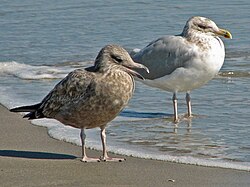
Adult Plumage
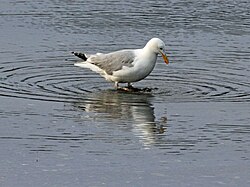
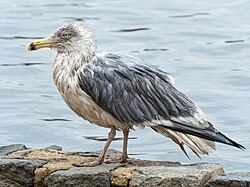
Adults feature a white head, rump, tail, and underparts, contrasted by a pale gray back and upperwings. Their black wingtips are marked with distinctive white spots known as "mirrors." The bill is yellow with a characteristic red spot on the lower mandible, and the legs are typically pink, though they may occasionally show a bluish or yellow tinge.
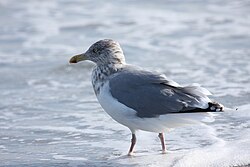
Juvenile Development
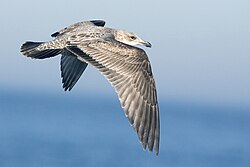
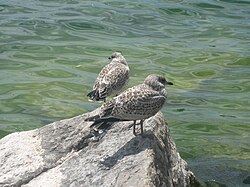
Young birds undergo a multi-year transition to reach adulthood. First-winter birds are gray-brown with dark tails and dark bills. Second-winter birds begin to show gray feathers on the back and possess paler eyes. By their third winter, they closely resemble adults but retain some brown on the body and a black band on the tail.
Habitat and Distribution
The breeding range of the American herring gull is extensive, stretching from central and southern Alaska across Canada to the Great Lakes and the northeastern United States (Maine to North Carolina). While many birds migrate south to Mexico during the winter, some remain in the northern United States and Canada year-round.
These gulls are highly adaptable, nesting in colonies on coasts, islands, and cliffs, or even on urban rooftops. They are frequently found near water sources, including lakes and rivers, as well as human-populated areas like refuse dumps.
Behavior and Diet
The American herring gull is an opportunistic feeder with a broad diet. They consume marine invertebrates such as mussels, crabs, and squid, as well as fish like capelin and smelt. They are also known to eat insects, bird eggs, and carrion.
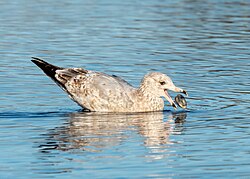
One fascinating behavior is their method of consuming hard-shelled prey. They have been observed dropping clams and mussels from significant heights onto hard surfaces, such as rocks or roads, to crack the shells—a behavior that appears to be learned.
Vocalizations
While they do not sing, they possess a complex repertoire of calls used for communication:
- "Hahaha": A quick response to a perceived threat.
- "Keow": A loud, short alarm call indicating impending danger.
- "Long call": A series of loud notes accompanied by head dipping.
- "Choking" call: Used during courtship or territorial disputes, accompanied by head bobbing.
- "Mew" call: Used to call attention to chicks, mates, or for nest defense.
Conservation History
The species faced significant declines in the 19th century due to hunting for feathers and eggs. While populations rebounded between the 1930s and 1960s due to hunting protections and increased food availability, they were later impacted by high DDT usage. This species was actually central to the scientific study that first linked DDT to the thinning of eggshells in birds.
Summary Table of Species Data
| Feature | Details |
|---|---|
| Wingspan | 120 to 155 cm (47 to 61 in) |
| Egg Incubation | 30–32 days |
| Fledging Period | 6–7 weeks |
| Typical Nest | A scrape on the ground lined with vegetation |
Frequently Asked Questions
How can I tell an American herring gull from a European one?
American herring gulls have long gray tongues on certain primary feathers and solid black markings on the 5th and 6th primaries, which European gulls lack. Additionally, first-winter European birds often have more checkered upperparts.
What do American herring gulls eat?
They have a very diverse diet including fish, marine invertebrates (mussels, crabs, squid), insects, bird eggs, carrion, and human refuse.
How long does it take for a juvenile gull to look like an adult?
It typically takes four years for a young gull to reach its full adult plumage.
Where do they nest?
They usually nest in colonies near water on coasts, islands, and cliffs, though they have also been known to nest on city rooftops.
Are they considered an endangered species?
No, the American herring gull is currently classified as "Least Concern" by the IUCN.