White League: The Paramilitary Terror of Reconstruction
The White League, also known as the White Man's League, was a white supremacist paramilitary terrorist organization that operated in the Southern United States between 1874 and 1876. Formed during the Reconstruction Era—the period of rebuilding and social restructuring following the American Civil War—the group sought to dismantle the political gains made by freedmen (emancipated Black former slaves) and the Republican Party.
Unlike secret societies of the time, the White League operated openly. Its members did not hide their identities and often sought media coverage to amplify their message of intimidation. Supported by regional elements of the Democratic Party, the organization used strategic violence to ensure that Black citizens were too terrified to vote and that Republican political organizing was completely dismantled.
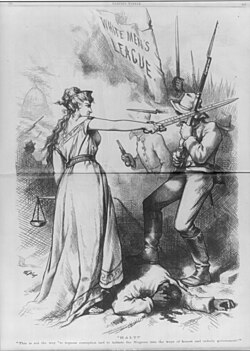
Key Facts
- Active Period: 1874–1876.
- Primary Goal: To overthrow Reconstruction governments and prevent African Americans and Northern Republicans from holding office.
- Composition: Largely comprised of well-armed Confederate veterans.
- Tactics: Open paramilitary operations, assassination, and voter intimidation.
- Key Conflict: The Battle of Liberty Place in New Orleans.
Origins and Ideology
The first chapter of the White League was established in Grant Parish, Louisiana, and neighboring areas. Many of its founding members were Confederate veterans who had previously participated in the Colfax massacre of April 1873. The group's stated purpose was to defend what they termed a "hereditary civilization and Christianity" against "Africanization."
While the White League shared goals with the Ku Klux Klan and the Knights of the White Camelia, it differed in its operational style. Rather than relying on nighttime raids and secrecy, the League functioned as an open militia. Similar groups, such as the Red Shirts in Mississippi and the Carolinas, adopted this same transparent approach to political violence.
Violence and Political Terror
The White League was equipped with modern weaponry for the era, including Colt revolvers, Winchester rifles, and Prussian needle guns, funded by wealthy backers. This firepower was used to execute a campaign of terror across the South.
In 1874, the group's brutality was highlighted by the murder of Julie Hayden, a 17-year-old African American schoolteacher in Hartsville, Tennessee.
![Julie Hayden, a 17-year-old Tennessee schoolteacher who was murdered by the White League in 1874.[2]](/images/35/68/3568420feb1c16516ce0c9449cf5d7a281c44b83c10fc3f5856499779623e108.jpg)
The organization was also responsible for the Coushatta massacre in a Red River Parish. In this instance, the League forced six Republican officeholders to resign and promise to leave the state; however, the League assassinated these men and between five and twenty freedmen witnesses before they could depart.
Federal Response
U.S. President Ulysses S. Grant condemned the organization in his December 1874 State of the Union address. Grant described the White League as "bands of men, masked and armed" who committed murders to spread terror and deprive citizens of their right to vote based on their political opinions.
The Battle of Liberty Place
The most significant escalation occurred in New Orleans in September 1874. Following a disputed 1872 gubernatorial election, the White League attempted to seize the state government. On September 14, 1874, 5,000 members of the League clashed with 3,500 members of the New Orleans Metropolitan Police and state militia in the Battle of Liberty Place.
The White League routed the government forces, resulting in 100 casualties. For three days, the League controlled the State House, City Hall, and the arsenal, demanding the resignation of Republican Governor William Pitt Kellogg in favor of Democratic candidate John McEnery. The coup only ended when Federal troops and ships arrived to reinforce Governor Kellogg and restore him to office.
Legacy and Decline
Despite the failure of the New Orleans coup, the White League's broader strategy of intimidation was effective. Republican voter turnout plummeted, and by 1876, Democrats regained control of the Louisiana state legislature. The organization was eventually succeeded by Louisiana state militias.
The memory of the group's violence was later institutionalized through the Battle of Liberty Place Monument, erected in New Orleans in 1891. This monument stood for over a century until the city council voted for its removal in December 2016, a decision upheld by a federal appeals court in 2017.
| Feature | Details |
|---|---|
| Ideology | White supremacy, Neo-Confederatism, Anti-Reconstruction |
| Primary Region | Southern United States (centered in Louisiana) |
| Key Weaponry | Winchester rifles, Colt revolvers, Prussian needle guns |
| Major Event | Battle of Liberty Place (1874) |
| Outcome | Contributed to the end of Republican control in Louisiana by 1876 |
Frequently Asked Questions
How did the White League differ from the Ku Klux Klan?
While both were white supremacist organizations, the White League operated openly rather than as a secret society. They solicited newspaper coverage and their members' identities were generally known to the public.
What was the goal of the Battle of Liberty Place?
The goal was to overthrow the Reconstruction government of Louisiana and force the resignation of Republican Governor William Pitt Kellogg to install Democratic candidate John McEnery.
Who were the primary members of the White League?
The organization was largely composed of Confederate veterans, including those who had participated in the Colfax massacre.
What was the result of the White League's activities in Louisiana?
Through violence and intimidation, the group successfully decreased Republican voter turnout, allowing Democrats to regain control of the state legislature in 1876.
What happened to the Battle of Liberty Place Monument?
The monument, which celebrated the 1874 coup attempt, was removed by the city of New Orleans following a 2016 city council vote and a 2017 federal appeals court ruling.