Gretna, Louisiana
Situated on the west bank of the Mississippi River, Gretna serves as the parish seat and the second-largest city of Jefferson Parish, Louisiana. Located just east and across the river from uptown New Orleans, Gretna is an integral part of the New Orleans–Metairie–Kenner metropolitan statistical area. With a population of 17,814 as of the 2020 U.S. census, the city blends a rich colonial history with a complex modern identity.
Key Facts
- Role: Parish seat of Jefferson Parish, Louisiana.
- Population: 17,814 (2020 Census).
- Geography: Located on the west bank of the Mississippi River.
- Economy: Home to the famous Zatarain's food and spice company since 1963.
- Land Area: Approximately 4.03 square miles of land.
History and Development
The roots of Gretna date back to 1750 with a plantation established by Jean-Charles de Pradel, featuring the Monplaisir plantation house. By 1815, entrepreneur John McDonogh purchased the estate and founded McDonoghville, which became the first subdivision in Jefferson Parish. McDonogh divided the land into city lots and 30-arpent farming strips, selling or leasing them to free people of color and white laborers.
The city of Gretna itself was settled in 1836 under the name Mechanikham. Its growth was fueled by its strategic location as a station for the Missouri Pacific, Texas and Pacific, and Southern Pacific Railroads, as well as a ferry service connecting it to New Orleans. Gretna was officially incorporated in 1913, absorbing the portion of McDonoghville within the parish boundaries.
Geography and Demographics
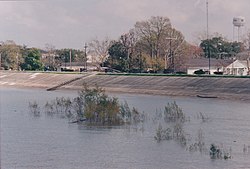
Gretna occupies a total area of 4.49 square miles, with 4.03 square miles of land and 0.46 square miles of water. The city sits at an elevation of 0 feet, making its proximity to the Mississippi River a defining geographic feature.
The city's demographic landscape has evolved significantly. As of 2020, the racial makeup included 41.24% non-Hispanic white, 32.96% Black or African American, and 18.73% Hispanic or Latino residents. The median age in Gretna is 36 years, slightly higher than the Louisiana state median of 34.0 years.
| Census Year | Total Population | Growth/Change (%) |
|---|---|---|
| 1940 | 10,879 | 13.5% |
| 1960 | 21,967 | 59.0% |
| 1980 | 20,615 | -17.1% |
| 2000 | 17,423 | 1.2% |
| 2020 | 17,814 | 0.4% |
Hurricane Katrina Controversy
In the aftermath of Hurricane Katrina on August 29, 2005, Gretna became the center of a significant civil rights controversy. Police and sheriff's deputies established a roadblock on the Crescent City Connection bridge, turning back refugees attempting to flee New Orleans on foot. Eyewitnesses reported that officers used threats, fired warning shots, and utilized police helicopter downdrafts to clear the bridge.
Former Mayor Ronnie Harris defended the actions, stating that Gretna lacked the food, water, and shelter capacity to support refugees and was dealing with its own loss of essential services and reports of looting at the Oakwood Mall. The events led to four federal civil lawsuits; while two were dismissed, the Jefferson Parish Sheriff's Office settled one case for $10,000.
Government, Infrastructure, and Education
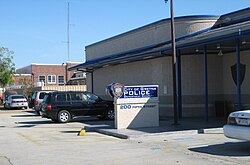
Gretna's local government is led by Mayor Belinda Cambre Constant. In recent years, the Gretna Police Department has faced scrutiny. Reports from 2016 highlighted an exceptionally high arrest rate, and a 2024 investigation by ProPublica and WVUE-TV found that Gretna had the highest number of violations and average fines per case among seven studied municipalities in southeastern Louisiana.
Education in the city has seen recent shifts, including the 2023 closure of Gretna Middle School to make room for Thomas Jefferson High. For public literacy and community resources, the city hosts the Gretna Public Library, which expanded to a 5,800-square-foot facility in 2010.
Culture and Notable Residents
The German American Cultural Center (GACC), founded in 1988, is a cornerstone of local culture. It preserves the history of German immigrants in Louisiana through exhibits and annual events like Maifest and Oktoberfest.
Gretna has been home to a diverse array of notable figures, including:
- Sports: NBA player Greg Monroe, NFL player Ike Taylor, and Baseball Hall of Famer Mel Ott.
- Arts and Entertainment: Drag queen Bianca Del Rio and rockabilly musician Joe Clay.
- Public Service: Former U.S. Representative Joseph Cao and Judge Frederick Jacob Reagan Heebe.
Frequently Asked Questions
What is the historical significance of McDonoghville?
McDonoghville was the first subdivision in Jefferson Parish, established in 1815 by John McDonogh on the site of a former plantation.
Which famous company is headquartered in Gretna?
The renowned food and spice company Zatarain's has been located in Gretna since 1963.
What happened at the Crescent City Connection bridge after Hurricane Katrina?
Police and deputies blocked refugees from New Orleans from crossing into Gretna on foot, leading to allegations of civil rights violations and several lawsuits.
What is the purpose of the German American Cultural Center?
The GACC interprets the contributions of German immigrants to Louisiana's history through educational programs, lectures, and festivals like Oktoberfest.
How has the population of Gretna changed recently?
The population has remained relatively stable over the last two decades, growing slightly from 17,423 in 2000 to 17,814 in 2020.