Westland Wasp: Operational History and Global Naval Service
The Westland Wasp was a pivotal asset in mid-to-late 20th-century naval aviation, designed specifically for the challenging environment of small ship operations. Entering service as a versatile tool for maritime security, it provided navies worldwide with a compact yet potent capability for anti-submarine warfare (ASW)—the practice of detecting and neutralizing enemy submarines.
From its intensive trials in the early 1960s to its final flights in the late 1990s, the Wasp served as a primary deterrent and utility aircraft across several continents, bridging the gap between early naval helicopters and the more advanced platforms that followed.
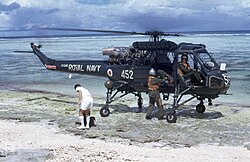
Key Facts
- Primary Role: Small ships operations, specifically anti-submarine warfare (ASW).
- Royal Navy Service: Introduced in 1964; retired in 1988.
- Combat Success: Played a critical role in the disabling of the ARA Santa Fe during the 1982 Falklands conflict.
- Global Reach: Operated by the UK, New Zealand, Netherlands, Malaysia, Brazil, Indonesia, and South Africa.
- Successors: Largely replaced by the Westland Lynx and Kaman SH-2 Seasprite.
Royal Navy Service and Combat History
The Wasp HAS.1 entered service in 1964 following rigorous testing by the 700(W) Intensive Flying Trials Unit. While primarily operated by the 829 Naval Air Squadron, it also supported training units like 706 NAS and 703 NAS. Additionally, the Commando Assault squadrons (845 and 848 NAS) utilized single airframes for light liaison duties until 1973.
In operational terms, the Wasp was most effective when paired with the Wessex HAS.3, which acted as the submarine hunter to the Wasp's role as the killer. By the late 1970s, the Westland Lynx began to phase out the Wasp.
The Engagement of ARA Santa Fe
One of the Wasp's most notable combat achievements occurred on April 25, 1982. After a Wessex helicopter from HMS Antrim spotted the Argentinian submarine ARA Santa Fe, a coordinated attack was launched. While a Wessex and a Lynx HAS.2 used depth charges, torpedoes, and machine guns, Wasps from HMS Plymouth and HMS Endurance delivered the decisive blow using AS.12 anti-ship missiles.
The damage prevented the submarine from submerging, forcing the crew to abandon ship and surrender at a jetty on South Georgia. This marked the first direct engagement and the first sea war casualty of the Royal Navy Task Force.
International Operations
Royal New Zealand Navy (RNZN)
The RNZN purchased 19 Wasps starting in 1966, initially assigning them to the Leander-class frigate HMNZS Waikato. These aircraft were utilized for various tasks, including the Armilla Patrol in the Persian Gulf during the 1980s. The fleet was maintained by No. 3 Squadron RNZAF, with pilots drawn from the RNZN, RN, RAN, and RNZAF to cover shortages.
The Wasp served the RNZN for 32 years, retiring in 1998. They were temporarily replaced by the Kaman SH-2 Seasprite before the arrival of the SH-2G(NZ).
Royal Netherlands Navy
Following a fire on HNLMS Karel Doorman, the Royal Netherlands Navy utilized a squadron of Wasps to meet NATO anti-submarine commitments. Operating from De Kooy Airfield and six Van Speijk-class frigates, the 860 Naval Air Squadron operated 12 AH-12A models from 1966 until their replacement by the Westland Lynx in 1981.
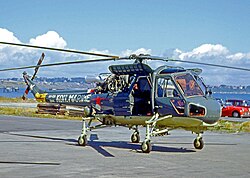
Royal Malaysian Navy
The Royal Malaysian Navy adopted the Wasp relatively late, entering service on April 8, 1988. Its tenure was brief, lasting ten years before being replaced by the Eurocopter Fennec.
Other Global Operators
The Wasp saw service in several other nations, often utilizing refurbished airframes:
- Indonesia: Operated former Dutch aircraft via the 400th Air Squadron (RON 400) from NAS Juanda. These were embarked on Tribal-class and Van Speijk-class frigates; the last was grounded in 1998.
- Brazil: Operated as the UH-2 and UH-2A. The Brazilian Navy used a mix of new-build and ex-Royal Navy aircraft, flying them from Gearing, Allen M. Sumner-class destroyers, and Niterói-class frigates.
- South Africa: Received 16 new-build airframes between 1963 and 1973 (though only six of the second batch arrived due to an international arms embargo). Operated by 22 Flight (later 22 Squadron) from President-class frigates, the last Wasp was withdrawn in 1990.
Summary of Wasp Service by Nation
| Operator | Service Period | Primary Platform/Ship Class | Replacement |
|---|---|---|---|
| Royal Navy (UK) | 1964–1988 | Type 12 Rothesay-class | Westland Lynx |
| Royal New Zealand Navy | 1966–1998 | Leander-class | Kaman SH-2 Seasprite |
| Royal Netherlands Navy | 1966–1981 | Van Speijk-class | Westland Lynx |
| Royal Malaysian Navy | 1988–1998 | Various | Eurocopter Fennec |
| South African Navy | 1963–1990 | President-class | N/A |
Frequently Asked Questions
What was the primary role of the Westland Wasp?
The Westland Wasp was primarily designed for small ships operations, focusing on anti-submarine warfare (ASW) to detect and destroy enemy submarines.
How did the Wasp contribute to the Falklands War?
Wasps from HMS Plymouth and HMS Endurance fired AS.12 anti-ship missiles at the Argentinian submarine ARA Santa Fe, causing severe damage that prevented it from submerging and led to its surrender.
Which aircraft replaced the Wasp in the Royal Navy?
The Westland Lynx began replacing the Wasp in the late 1970s, eventually taking over its operational roles.
Why did South Africa receive fewer aircraft than ordered?
An international arms embargo placed on South Africa during the Apartheid regime resulted in only six of the second batch of eight ordered aircraft being delivered.
Which nation operated the Wasp until the latest date?
The Indonesian Navy operated the last of the type in active service, with the final refurbished Dutch aircraft being grounded in 1998.