VP-8 Patrol Squadron: A Legacy of Maritime Surveillance and ASW
From its origins in the heat of World War II to the cutting-edge capabilities of the modern era, the history of the patrol squadron known today as VP-8 is a chronicle of evolving naval aviation. Specializing in Anti-Submarine Warfare (ASW)—the branch of naval warfare intended to counter enemy submarines—the squadron has transitioned through multiple aircraft generations to maintain global maritime security.
World War II: The Era of the Seaplane
The squadron began its journey as VP-201, established on September 1, 1942, at NAS Norfolk, Virginia. Initially flying the PBM-3 Mariner, a large flying boat designed for long-range patrols, the unit underwent rigorous training at NAS Banana River, Florida.
By 1943, the squadron was operating PBM-3S aircraft equipped with improved radar, conducting grueling patrols of 12 to 18 hours extending 800 miles from Bermuda. These missions were critical for protecting convoys traveling to and from Europe. A notable encounter occurred on July 9, 1943, when a crew led by Lieutenant Soverel attacked the German submarine U-134; the resulting heavy anti-aircraft fire from the submarine forced the aircraft to return to base and led the squadron to adopt pair-patrol tactics for increased safety.
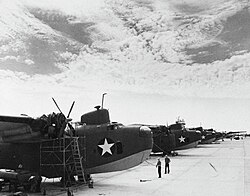
As the war progressed, the squadron moved through various bases, including NAS Key West and NAS Coco Solo in the Panama Canal Zone. In late 1944, the squadron integrated British-designed L-8C Leigh searchlights to enhance night-time ASW capabilities. By April 1945, the unit transitioned to the more advanced PBM-5 seaplanes before the war's conclusion led to a reduction in personnel and aircraft.
The Cold War Transition: From Water to Land
The post-war era marked a fundamental shift in the squadron's operational nature. In December 1947, the unit (then designated VP-ML-8) began transitioning from seaplanes to land-based aircraft with the introduction of the P2V-2 Neptune. This shift required extensive retraining for crews moving from water landings to traditional runways.
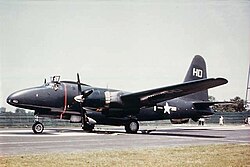
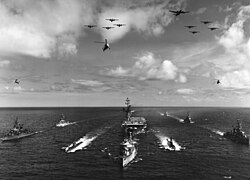
Throughout the 1950s, the squadron operated in extreme environments, testing the P2V in the freezing temperatures of Newfoundland, where temperatures dropped as low as -55°F. By 1958, VP-8 became a core component of Task Force Alfa, a Hunter-Killer (HUK) group. This specialized task force integrated carrier-based aircraft, land-based patrol planes, destroyers, and submarines to pioneer new ASW tactics and technology.
The Orion Era and Global Crisis
In October 1962, VP-8 made history as the first operational P-3A Orion squadron in the U.S. Navy. The timing was critical; during the Cuban Missile Crisis, the squadron deployed a detachment to Bermuda to monitor Soviet submarines in the Caribbean and Eastern Atlantic, supporting the naval quarantine.
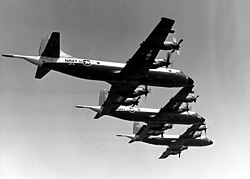
The 1960s saw the squadron expand its reach globally. In March 1963, VP-8 completed the first trans-Atlantic flight by a P-3 Orion, landing in West Malling, England. The squadron also entered combat operations in 1966, deploying to Sangley Point in the Philippines to support the U.S. Seventh Fleet during the Vietnam War.
Late Cold War and Specialized Missions
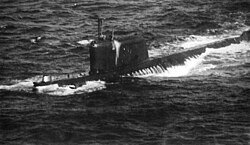
The 1970s and 80s were defined by high-stakes surveillance. In early 1972, VP-8 maintained constant surveillance of the Soviet nuclear-powered ballistic missile submarine K-19 after an onboard fire forced the vessel to the surface.
Throughout the 1980s, the squadron operated the P-3C UII.5, deploying frequently to Rota, Lajes, and Sigonella. Beyond ASW, the squadron began assisting the U.S. Coast Guard in counter-narcotic interdiction operations in the Caribbean, bridging the gap between military surveillance and law enforcement.
Modern Operations and the P-8A Poseidon
Following the Cold War, VP-8 remained active in global stability operations. The squadron supported UN peacekeeping efforts in Bosnia-Herzegovina (Operations Sharp Guard, Decisive Endeavor, and Deliberate Guard) and assisted in the evacuation of 889 civilians from Albania during Operation Silver Wake.
The squadron's versatility was further proven during Operation Unified Assistance in 2004, where it provided the first U.S. military aircraft on station to assist victims of the Indian Ocean earthquake.
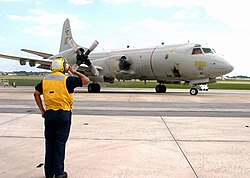
In 2003, during Operation Iraqi Freedom, VP-8 flew nearly 100 overland combat missions. The squadron eventually transitioned from the venerable P-3C to the P-8A Poseidon in July 2014, a transition that culminated in its inaugural P-8A deployment to Kadena AFB, Japan, in 2016. Most recently, in April 2019, the squadron assisted in the search for a crashed Japanese F-35A and its pilot.
Key Facts
- First P-3 Orion Squadron: VP-8 was the first operational P-3A Orion squadron in the U.S. Navy (1962).
- Historic Flight: Conducted the first trans-Atlantic P-3 Orion flight to England in March 1963.
- Drug Interdiction: In 1998, the squadron's surveillance led to the seizure of 11 metric tons of illegal drugs valued at $171.4 million.
- Diverse Fleet: Operated PBM-3, PBM-5, P2V-2, P2V-3, P2V-5F, P-3A, P-3B, P-3C, and P-8A aircraft.
- Humanitarian Aid: Provided critical first-response aircraft for the 2004 Indian Ocean earthquake relief.
| Era | Primary Aircraft | Key Operating Areas | Primary Mission |
|---|---|---|---|
| World War II | PBM-3 / PBM-5 | Atlantic, Caribbean, Panama | Convoy Escort & ASW |
| Early Cold War | P2V Neptune | North Atlantic, Mediterranean | Cold Weather Testing & ASW |
| Mid-Late Cold War | P-3 Orion (A/B/C) | Global (Pacific, Atlantic, Med) | Submarine Surveillance & Combat |
| Modern Era | P-8A Poseidon | Global / Japan | ISR & Maritime Security |
Frequently Asked Questions
What was the original designation of VP-8?
The squadron was originally established as VP-201 on September 1, 1942, at NAS Norfolk, Virginia.
How did the squadron contribute to the Cuban Missile Crisis?
VP-8 deployed a four-aircraft detachment to Bermuda to support the naval quarantine, specifically monitoring Soviet submarines in the Caribbean and Eastern Atlantic.
What is a Hunter-Killer (HUK) group?
A Hunter-Killer group, such as Task Force Alfa which VP-8 joined in 1958, is a specialized structure that integrates carrier-based ASW aircraft, land-based patrol planes, destroyers, and submarines to develop and execute advanced ASW tactics.
What role did VP-8 play in counter-narcotic operations?
The squadron conducted extensive surveillance in the Caribbean, working with the U.S. Coast Guard and U.S. Customs. Their efforts resulted in numerous arrests and the seizure of billions of dollars worth of illegal drugs, including over 28,000 kg of cocaine in one period.
When did the squadron transition to the P-8A Poseidon?
The transition from the P-3C to the P-8A Poseidon began in July 2014, with the first inaugural deployment of the P-8A occurring in March 2016 to Kadena AFB, Japan.