Iraq War: A Comprehensive History of the 2003–2011 Conflict
The Iraq War was a pivotal conflict of the post-Cold War era and a central component of the global "war on terror." Spanning from March 20, 2003, to December 18, 2011, the war began with a large-scale invasion led by the United States and its allies to overthrow the regime of Saddam Hussein. What started as a rapid military campaign evolved into a protracted insurgency and a complex struggle for political stability in the Middle East.
The conflict was characterized by shifting military strategies, significant geopolitical tensions, and a deeply debated justification regarding the presence of weapons of mass destruction (WMD)—chemical, biological, or nuclear weapons capable of causing widespread death and destruction.
![Excerpt from Donald Rumsfeld memo dated 27 November 2001[93]](/images/51/03/5103660064ed13719587d0470ad8f5c23ef91ab5a634112c3f71aebaaa27d29d.jpg)
Key Facts
- Duration: 8 years, 8 months, and 28 days.
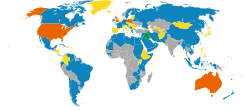
- Primary Belligerents: A "Coalition of the Willing" (led by the US and UK) against Ba'athist Iraq and later various insurgent groups.
- Key Leaders: George W. Bush, Tony Blair, and Donald Rumsfeld (Coalition); Saddam Hussein and Abu Musab al-Zarqawi (Opposing forces).
- Major Outcome: Overthrow of Saddam Hussein's government and the eventual establishment of an Iraqi interim government.
- Controversy: The failure to find WMDs and reports of human rights abuses at Abu Ghraib prison.
The Road to Invasion
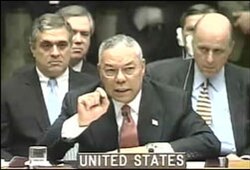
The lead-up to the war was marked by intense diplomatic friction and intelligence reports suggesting that Saddam Hussein possessed WMDs. The United States and United Kingdom argued that Iraq was in violation of UN resolutions and posed a global security threat.
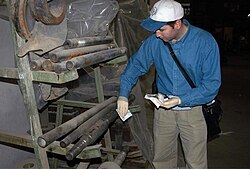
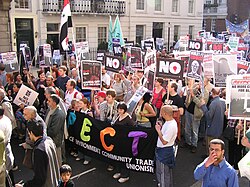
Despite efforts by UN weapons inspectors and significant international opposition, the US administration moved forward with plans for regime change. This period saw massive global protests, with some demonstrations in London alone drawing up to 400,000 participants.
![Anti-war protest in London, September 2002. Organized by the British Stop the War Coalition, up to 400,000 took part in the protest.[133]](/images/37/2e/372e81117a10c308f29ef61555b561c010ab400034b1244eaabf4c9d189ac4b4.jpg)
Course of the War
The 2003 Invasion
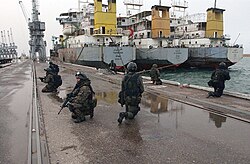
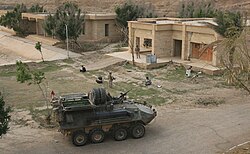
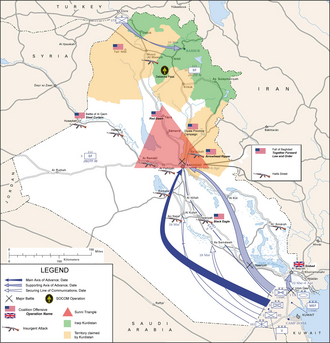
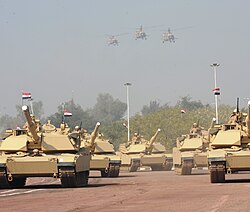
The invasion began in March 2003 with a multi-pronged assault. General Tommy Franks outlined eight primary objectives for the campaign, which focused on the rapid collapse of the Ba'athist regime and the securing of strategic sites.
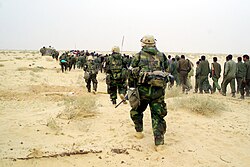
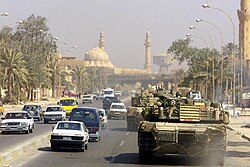
By the time Baghdad fell, the Coalition had successfully dismantled the formal Iraqi military structure, though the transition to a stable occupation proved difficult.
The Rise of the Insurgency (2003–2006)
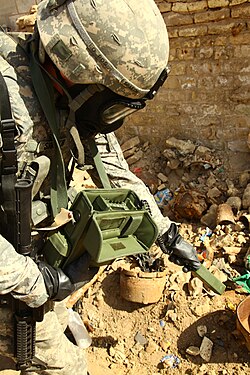
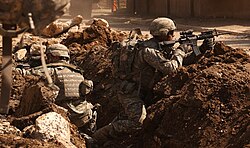
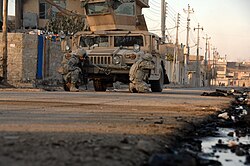
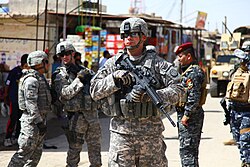
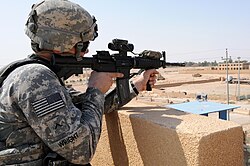
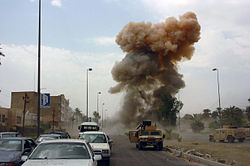
Following the initial victory, a violent insurgency emerged. This period was marked by the use of Improvised Explosive Devices (IEDs)—homemade bombs typically triggered by remote or pressure sensors—and targeted attacks on Coalition forces.
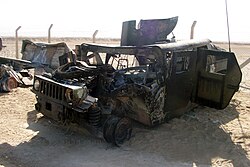
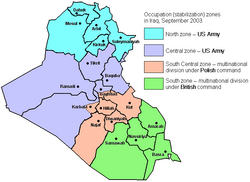
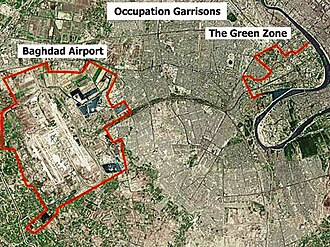
The conflict expanded into a sectarian civil war between Sunni and Shia factions. During this time, the Coalition Provisional Authority (CPA) managed the country until sovereignty was officially transferred to the Iraqi Interim Government on June 28, 2004.

The Search for Saddam Hussein and Political Transition
One of the most high-profile operations was "Operation Red Dawn," which resulted in the capture of Saddam Hussein from a hideout on December 13, 2003. He was later executed by the Iraqi government in December 2006.
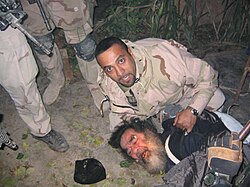
The 2007 Troop Surge
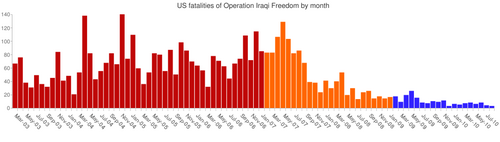
In January 2007, President George W. Bush announced a "surge" of additional US troops to stabilize Baghdad and Al Anbar province. This strategy aimed to reduce violence and provide the Iraqi government the space to make political progress.
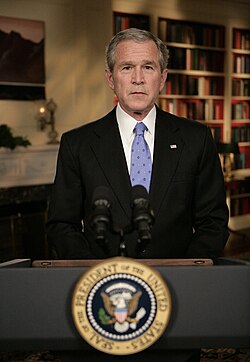
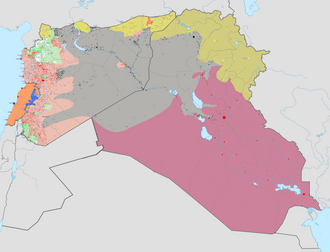
While the surge saw a decrease in some types of violence, it coincided with the rise of the Islamic State of Iraq, a precursor to later extremist movements in the region.
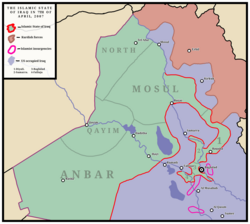
Withdrawal and Aftermath
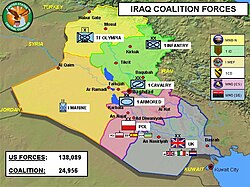
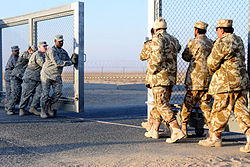
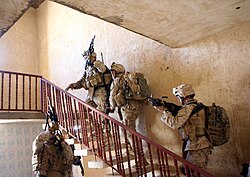
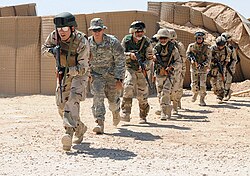
From 2009 to 2011, the US began a phased drawdown of forces. Operation New Dawn shifted the US role from combat operations to advising and assisting Iraqi security forces. The final US troops officially exited Iraq on December 18, 2011.
Humanitarian and Environmental Impact
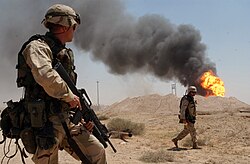
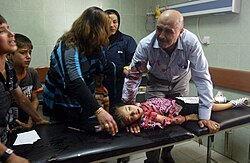
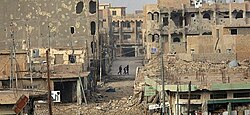
The war left a devastating legacy. Beyond the human toll, the conflict caused severe environmental damage, including oil pollution from burning wells and radioactive contamination in certain regions.
Casualty Estimates
Estimating the death toll remains a subject of intense academic and political debate, with figures varying wildly depending on the source.
| Source | Estimated Deaths | Date of Study/Report |
|---|---|---|
| Iraq Family Health Survey | 151,000 | June 2006 |
| Lancet Survey | 601,027 | June 2006 |
| PLOS Medicine Study | 460,000 (excess deaths) | June 2011 |
| Opinion Research Business | 1,033,000 | August 2007 |
| WikiLeaks (War Logs) | 109,032 | Jan 2004 – Dec 2009 |
Criticisms and Controversies
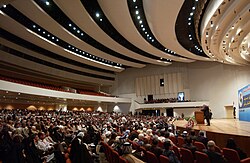
The Iraq War remains one of the most criticized military interventions in history. Primary criticisms include:
- Intelligence Failures: The false allegations that Saddam Hussein possessed WMDs.
- Legality: Arguments that the invasion was illegal under international law.
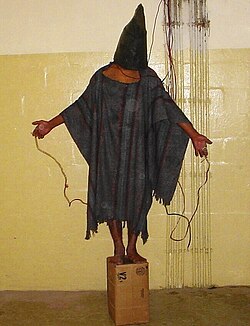
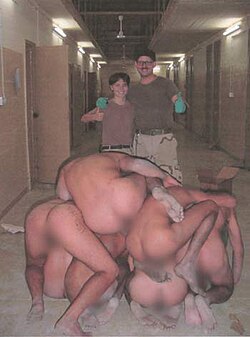
- Human Rights: The Abu Ghraib prison scandal, where prisoners were subjected to physical and psychological torture.
- Geopolitical Stability: The claim that the war destabilized the region and inadvertently aided extremist groups.
Frequently Asked Questions

![A memorial in North Carolina in December 2007; US casualty count can be seen in the background[412]](/images/35/43/3543eae4444b372021b1ad5a903d9d68a9f6195c26f7ac8df395b170d49bdbcb.jpg)
Why did the US invade Iraq in 2003?
The primary justification provided by the US administration was that Saddam Hussein's regime possessed weapons of mass destruction (WMD) and posed a threat to global security.
What was the "Troop Surge" of 2007?
The surge was a military strategy involving the deployment of additional US forces to Iraq to secure Baghdad and other volatile areas, aiming to curb sectarian violence and stabilize the government.
What happened to Saddam Hussein?
Saddam Hussein was captured in December 2003 during Operation Red Dawn. He was subsequently tried by the Iraqi Special Tribunal and executed in December 2006.
What was the Abu Ghraib scandal?
Abu Ghraib was a prison where members of the US Army and CIA were found to have physically, sexually, and psychologically abused and tortured Iraqi detainees.
When did the US officially leave Iraq?
The US military officially ended its presence in Iraq on December 18, 2011, marking the end of the conflict's primary combat phase.