Colin Powell: A Legacy of Military Leadership and Global Diplomacy
Colin Powell was a towering figure in American public service, distinguished by his rare ability to navigate the highest echelons of both military command and civilian diplomacy. From his early days as a commissioned officer in the U.S. Army to his tenure as the 65th United States Secretary of State, Powell's career spanned several decades and multiple presidential administrations, leaving an indelible mark on U.S. national security.
Key Facts
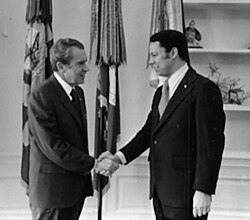
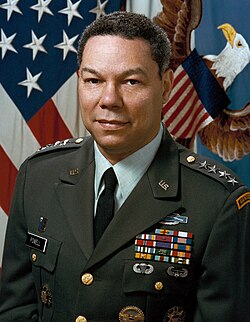
- Highest Military Rank: General, U.S. Army.
- Major Government Roles: Secretary of State, Chairman of the Joint Chiefs of Staff, and National Security Advisor.
- Key Conflicts: Served in the Vietnam War, the Invasion of Panama, and the Gulf War.
- Education: BS from City College of New York and an MBA from George Washington University.
- Death: Passed away on October 18, 2021, at the age of 84 due to COVID-19 complications.
Military Ascent and Command
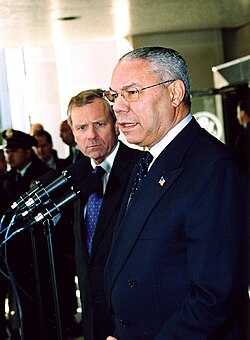
Powell's military career began in 1958 when he was commissioned as a second lieutenant. Over the next 35 years, he rose steadily through the ranks, serving in various capacities including the 3rd Armored Division and the 101st Airborne Division. His experience in the Vietnam War and his subsequent leadership roles prepared him for the highest levels of military strategy.
By 1989, Powell reached the pinnacle of the military hierarchy when he was appointed the 12th Chairman of the Joint Chiefs of Staff—the highest-ranking military officer in the United States. In this role, he served under Presidents George H.W. Bush and Bill Clinton, most notably overseeing the military operations of the Gulf War.
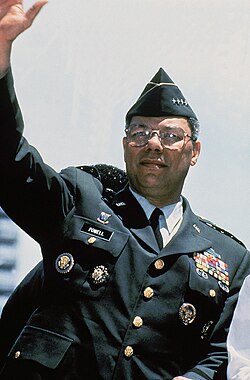
His leadership during the Gulf War was characterized by a commitment to decisive force and clear objectives, a strategy that earned him widespread acclaim and a celebratory welcome home parade in New York City.
Transition to National Security and Diplomacy
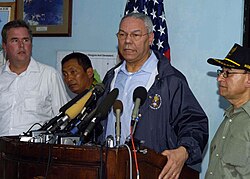
Before becoming Chairman of the Joint Chiefs, Powell served as the National Security Advisor to President Ronald Reagan from 1987 to 1989, having previously served as the Deputy National Security Advisor. This transition from tactical military command to strategic political advising set the stage for his later role as the nation's top diplomat.
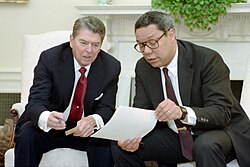
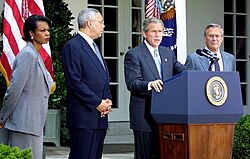
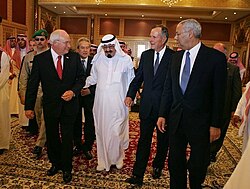
In 2001, President George W. Bush appointed Powell as the 65th U.S. Secretary of State. As the primary architect of American foreign policy, Powell managed complex international relations during a period of intense global instability following the September 11 attacks.
The Iraq War and the UN Presentation
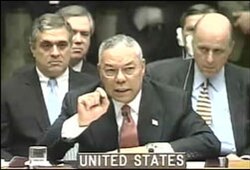
One of the most controversial moments of Powell's career occurred in February 2003, when he addressed the United Nations Security Council to argue for the invasion of Iraq. During this presentation, he presented intelligence suggesting that Iraq possessed weapons of mass destruction (WMDs), including a model vial of anthrax and computer-generated images of alleged biological weapons facilities.
Following the invasion, it was revealed that the intelligence regarding WMDs was flawed. In May 2003, experts declared that the trailers presented as biological weapons facilities had no such purpose. Powell later described this as a "great intelligence failure."
![Computer-generated image of an alleged mobile production facility for biological weapons, presented by Powell at the UN Security Council. On May 27, 2003, U.S. and British experts examined the trailers and declared they had nothing to do with biological weapons.[92]](/images/b3/2a/b32a7e3ca61b8afe0d2149ca8c7c006c75e78121704bb33590f479e2b8dda6af.jpg)
Later Life and Political Evolution
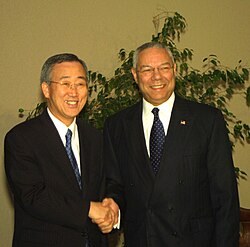
After leaving office in 2005, Powell remained an influential voice in American politics. Though long associated with the Republican Party, his views evolved over time. He notably endorsed Barack Obama for president in 2008 and later expressed strong criticism of the Trump administration, specifically condemning the events of January 6 at the U.S. Capitol and calling for President Trump's resignation in 2021.
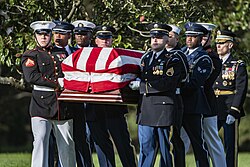
Powell's commitment to public service was recognized with numerous honors, including the Presidential Medal of Freedom with Distinction. He passed away on October 18, 2021, and was laid to rest at Arlington National Cemetery.
Summary of Public Service
| Role | Tenure | President(s) |
|---|---|---|
| National Security Advisor | 1987–1989 | Ronald Reagan |
| Chairman of the Joint Chiefs of Staff | 1989–1993 | George H.W. Bush, Bill Clinton |
| Secretary of State | 2001–2005 | George W. Bush |
Frequently Asked Questions
What was Colin Powell's highest military rank?
Colin Powell achieved the rank of General in the United States Army, reaching this position on April 4, 1989.
Which U.S. Presidents did Colin Powell serve?
Powell served under four different U.S. Presidents: Ronald Reagan, George H.W. Bush, Bill Clinton, and George W. Bush.
What was the controversy surrounding his 2003 UN speech?
Powell presented intelligence to the UN Security Council claiming Iraq had weapons of mass destruction. This intelligence was later proven incorrect, leading Powell to describe the incident as a significant intelligence failure.
Did Colin Powell change his political affiliation?
Yes. While he was a Republican for many years, he later identified as an Independent and expressed strong disagreements with the direction of the Republican Party under Donald Trump.
Where is Colin Powell buried?
General Colin Powell is interred at Arlington National Cemetery.