Jaber Al-Ahmad Al-Sabah: The Architect of Modern Kuwait
Sheikh Jaber Al-Ahmad Al-Jaber Al-Sabah, often referred to as Jaber III, served as the Emir of Kuwait from December 31, 1977, until his passing in 2006. As the 13th ruler of the House of Sabah, his leadership spanned a transformative era, guiding Kuwait from a traditional society into a highly modernized state. His tenure was marked by significant economic development and the resilience required to lead his nation through the turmoil of the Gulf War.
Before ascending to the throne, Jaber held pivotal roles in the government, including serving as the Prime Minister from 1965 to 1978. His early career was defined by a commitment to establishing the financial foundations of the independent state, ensuring that Kuwait's vast oil wealth was managed to benefit both the nation and the wider Arab world.
Key Facts
- Reign: December 31, 1977 – January 15, 2006.
- Role: 13th ruler of the Sabah dynasty and 3rd monarch since independence from Britain.
- Economic Legacy: Established the Kuwaiti dinar and the Kuwaiti Currency Board.
- Global Impact: Founded the Kuwait Fund for Arab Economic Development to assist developing nations.
- Crisis Leadership: Led the exiled government during the Iraqi invasion and oversaw the liberation of Kuwait.
Early Life and Education
Born on June 29, 1926, in Kuwait City, Jaber was the third son of Ahmad Al-Jaber Al-Sabah. His educational journey began at Al-Mubarakiya, Al-Ahmediya, and Al-Sharqiya schools. To prepare for his future leadership roles, he received private tutoring in the sciences, religion, Arabic, and English.
Economic Foundations and Early Career
In 1962, Jaber was appointed as the first Minister of Finance upon the ministry's creation. He was instrumental in the launch of the Kuwaiti dinar and chaired the Kuwaiti Currency Board. During this period, he also established the Kuwait Fund for Arab Economic Development (1962–1964), a vehicle designed to provide technical and financial aid to developing countries using oil revenues.
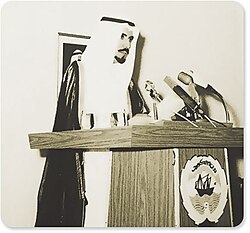
Beyond economics, Jaber was active in diplomacy. Following Kuwait's independence from Great Britain in 1961, he led a delegation to the Arab League to address sovereignty claims made by Iraq. This diplomatic effort, supported by British military deterrence via Operation Vantage, eventually led Iraq to recognize Kuwait's independence in 1963.
Navigating Regional Conflict
The Iran–Iraq War
From 1980 to 1988, Kuwait's geographic position placed it in the crossfire of the Iran–Iraq War. The nation faced numerous security threats, including bombings. In 1984, Jaber's own motorcade was targeted, and a 1986 attack on an oil installation nearly crippled the country's oil industry.
The Gulf War and Exile
The most defining challenge of Jaber's reign was the Iraqi invasion of 1990. To ensure the continuity of the state, Jaber and his government went into exile in Ta'if, Saudi Arabia. From this exiled government, he coordinated with an underground resistance of military and civilian forces within Kuwait and utilized oil reserves to provide emergency care to the citizens remaining under occupation.
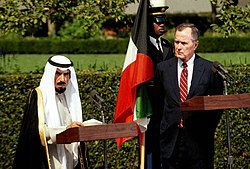
Following the liberation of Kuwait on February 28, 1991, Jaber declared three months of martial law to ensure the removal of remaining Iraqi forces and secure the country for the government's return. He officially returned to Kuwait City on March 15, 1991, where he was greeted by cheering crowds despite the destruction of his palace.
Later Years and Legacy
In the years following the Gulf War, Jaber continued to strengthen international ties, notably allowing the United States to use Kuwait as a base during the 2003 invasion of Iraq. His personal life was expansive; by 1997, he had four wives and approximately 70 children.
In September 2001, Jaber suffered a stroke and sought medical treatment in the United Kingdom. He passed away on January 15, 2006, at the age of 79, due to a cerebral hemorrhage. His death prompted mourning periods across the globe, with Bahrain and Jordan declaring several days of mourning, and other nations including India, Egypt, and Pakistan observing official mourning periods.
| Category | Details |
|---|---|
| Full Name | Sheikh Jaber Al-Ahmad Al-Jaber Al-Sabah |
| Tenure as Emir | 1977 – 2006 |
| Tenure as Prime Minister | 1965 – 1978 |
| Key Achievement | Modernization of Kuwait and establishment of the Kuwaiti dinar |
| Major Conflict | Gulf War (1990–1991) |
| Successor | Saad Al-Abdullah Al-Salim Al-Sabah |
Frequently Asked Questions
What was Jaber Al-Ahmad Al-Sabah's role in Kuwait's economy?
He served as the first Minister of Finance, where he introduced the Kuwaiti dinar, established the Kuwaiti Currency Board, and founded the Kuwait Fund for Arab Economic Development to aid other developing nations.
How did the Emir handle the Iraqi invasion of 1990?
He established a government-in-exile in Ta'if, Saudi Arabia, from which he lobbied for international military support and directed an underground resistance within Kuwait until the country was liberated in 1991.
What was the purpose of the martial law declared in 1991?
Martial law was imposed for three months following the liberation to ensure that all Iraqi forces were removed and that the country was safe for the return of the Emir and his government.
Who succeeded Jaber Al-Ahmad Al-Sabah as Emir?
Upon his death on January 15, 2006, he was succeeded by the Crown Prince, Saad Al-Abdullah Al-Salim Al-Sabah.
What were the circumstances of his death?
Sheikh Jaber died at age 79 from a cerebral hemorrhage, following a stroke he had suffered in September 2001 for which he had received treatment in the United Kingdom.