Operation Market Time: Securing the South Vietnamese Coastline
Launched officially on March 11, 1965, Operation Market Time was a massive maritime interdiction effort designed to stop communist ships from infiltrating the South Vietnamese coast. The primary objective was to prevent the resupply of People's Army of Vietnam (PAVN) and Viet Cong (VC) forces via sea routes.
The operation established a comprehensive picket line spanning over 1,000 miles (1,600 km) of coastline. This effort required the seamless coordination of the United States Navy, the United States Coast Guard, and the Republic of Vietnam Navy (RVNN).
Key Facts
- Primary Goal: Prevent communist infiltration and resupply of PAVN/VC forces.
- Timeline: Officially began March 11, 1965.
- Scope: Monitored over 1,000 miles of coastline and later expanded to include Cambodian traffic.
- Command: Originally under Vietnam Patrol Force (Task Force 71), shifting to Naval Forces Vietnam (Task Force 115) on July 31, 1965.
- Key Assets: Swift boats, P-5 Marlin seaplanes, P-3 Orions, and Coast Guard cutters.
Coastal Surveillance and Coordination
To manage the complex task of coastal interdiction, the allies established Coastal Surveillance Centers (CSC). These centers were located at Da Nang, Qui Nhon, Nha Trang, Vung Tau, and An Thoi. Manned by both RVNN and U.S. Navy watchstanders, the CSCs acted as the central nervous system for the operation.
When aircraft or watercraft spotted suspect vessels, they reported the sightings to the CSC. Personnel at these centers then dispatched the most appropriate response vessels or aircraft to intercept the target.
Naval Assets and Watercraft
The naval component of Market Time utilized a diverse array of vessels to maintain the picket line. A critical element was the deployment of Swift boats (PCFs). While originally planned for 54 boats, the number increased to 84 by September 1965 to ensure thorough coverage. These were organized into five divisions:
- Division 101: An Thoi (working with Coast Guard Division 11)
- Division 102: Da Nang (working with Coast Guard Division 12)
- Division 103: Cat Lo (working with Coast Guard Division 13)
- Division 104: Cam Ranh Bay
- Division 105: Qui Nhon
The operation also employed destroyers, ocean minesweepers, and U.S. Coast Guard cutters. Notably, the Navy's patrol gunboats (PGs) were highly effective due to their ability to switch from diesel to turboshaft (gas turbine) propulsion within minutes. These aluminum and fiberglass ships featured variable-pitch propellers, making them fast and highly maneuverable.
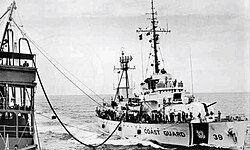
Logistical support was provided by seaplane tenders—the USS Currituck, USS Pine Island, and USS Salisbury Sound—which served as flagships. Additionally, Service Force supply ships, including oilers, provided essential fuel, mail, and entertainment to the crews.
Notable Naval Engagements
On March 1, 1968, allied forces intercepted a coordinated infiltration attempt by four gun-running trawlers. The engagement resulted in two trawlers being destroyed by allied ships, one crew detonating their own vessel to avoid capture, and one retreating into the South China Sea. LT Norm Cook, commanding a VP-17 P-2H Neptune patrol aircraft, received a Distinguished Flying Cross for his role in tracking two of these vessels.
The operation also saw tragedies, such as the "blue-on-blue" (friendly fire) incident on August 11, 1966, where the USCGC Point Welcome was fired upon by U.S. Air Force aircraft, resulting in two deaths, including the commanding officer.
Aerial Reconnaissance and Tracking
Air power provided the broad reconnaissance necessary to monitor vast expanses of water. Long-range patrol aircraft could track suspicious vessels lingering in international waters before they attempted to dash toward the coast. Initially, SP-5B seaplanes were used, later replaced or supplemented by P-2 Neptunes and Lockheed P-3 Orions, some of which were armed with Bullpup air-to-surface missiles.
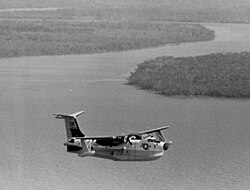
These aircraft flew monotonous patrols along 1,200 miles (1,900 km) of coast, operating from bases in Vietnam (Tan Son Nhut Airbase and Cam Ranh Bay), the Philippines (Sangley Point), and Thailand (Utapao Airbase). A wide array of squadrons participated, including VP-1, VP-2, VP-4, VP-6, VP-8, VP-9, VP-16, VP-17, VP-19, VP-22, VP-26, VP-28, VP-40, VP-42, VP-45, VP-46, VP-47, VP-48, VP-49, and VP-50.
By October 1967, the mission expanded to monitor traffic to and from Cambodia. This shift occurred after intelligence revealed that communist supplies were being shipped to Sihanoukville and then transported to the South Vietnamese border via truck convoys.
Operation Market Time Summary
| Category | Details |
|---|---|
| Command Structure | Task Force 71 (Initial) → Task Force 115 (after July 31, 1965) |
| Coastal Surveillance Centers | Da Nang, Qui Nhon, Nha Trang, Vung Tau, An Thoi |
| Primary Watercraft | Swift boats (84 total), PGs, Destroyers, Minesweepers, USCG Cutters |
| Primary Aircraft | SP-5B Marlin, P-2 Neptune, P-3 Orion |
| Operational Range | 1,000+ miles of coast; extended to Cambodian waters in 1967 |
Frequently Asked Questions
What was the primary purpose of Operation Market Time?
The operation aimed to prevent communist forces from using the sea to infiltrate the South Vietnamese coast and resupply PAVN and Viet Cong forces.
How did the Coastal Surveillance Centers (CSC) function?
The CSCs acted as coordination hubs where reports of suspect vessels from aircraft and ships were received and used to dispatch the appropriate response units to the scene.
Why were the patrol gunboats (PGs) particularly effective?
PGs were highly maneuverable and fast due to their variable-pitch propellers and their ability to switch from diesel to gas turbine (turboshaft) propulsion in a few minutes.
Which aircraft were used for long-range reconnaissance?
The operation utilized SP-5B seaplanes, P-2 Neptunes, and Lockheed P-3 Orions, some of which were equipped with Bullpup air-to-surface missiles.
How did the operation change in October 1967?
Surveillance was expanded to monitor maritime traffic bound for and from Cambodia, as it was discovered that supplies were being shipped to Sihanoukville and then trucked into South Vietnam.