Western Desert Campaign: The Struggle for North Africa
The Western Desert Campaign was a pivotal theater of World War II, characterized by sweeping maneuvers across the arid landscapes of Libya and Egypt. What began as a regional conflict involving Italian ambitions quickly escalated into a high-stakes clash between the Axis powers—led by Germany and Italy—and the British Commonwealth forces. The struggle centered on control of the Mediterranean coast, strategic ports, and the vital supply lines connecting Europe to Africa.
The Outbreak of Conflict in North Africa
Following the fall of France in June 1940, the Vichy government maintained control over French North Africa. On June 10, Italy aligned with Nazi Germany and declared war on France and the United Kingdom. Although Italian leader Benito Mussolini initially claimed he did not intend to involve peoples bordering Italy on land or sea, the British—supported by Indian and Rhodesian troops—began launching raids against Italian positions in Libya on June 11.
By August 1940, Mussolini ordered the Italian Tenth Army to invade Egypt. However, the advance was plagued by poor officer training, inadequate transport, and failing equipment. The Italian forces eventually halted at Sidi Barrani, establishing a series of fortified camps.
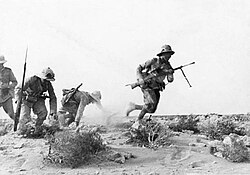
Operation Compass and the Collapse of the Tenth Army
In response to the Italian advance, General Archibald Wavell launched Operation Compass on December 9, 1940. A Commonwealth force of 36,000 men struck the dispersed Italian camps, initiating a rapid pursuit of the retreating enemy. The British successfully captured the ports of Bardia and Tobruk, taking approximately 40,000 prisoners.
The campaign culminated at the Battle of Beda Fomm, where the British 7th Armoured Division cut off the Italian retreat. By the end of the ten-week operation, the Italian Tenth Army was destroyed, with 130,000 prisoners of war captured as Allied forces reached El Agheila.
The Arrival of the Afrika Korps
To prevent the total loss of their North African colonies, Mussolini requested German assistance. In February 1941, Adolf Hitler dispatched a motorized force known as the Afrika Korps under the command of Erwin Rommel. While the bulk of the reinforcements remained Italian—including the Ariete Armoured Division—Rommel's leadership transformed the Axis posture from defensive to offensive.
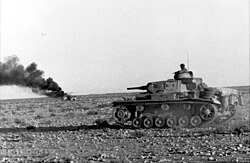
By March and April 1941, Rommel launched a full-scale offensive, pushing Allied forces back to the Libyan-Egyptian border. The Australian 9th Infantry Division retreated to the fortress port of Tobruk, which became a critical stronghold. Because the Axis forces lacked the strength to capture Tobruk, the port remained a thorn in Rommel's side, forcing his supply lines to bypass the city and stretching his logistics back to Tripoli.
The See-Saw War: From Operation Crusader to El Alamein
The Allies attempted to relieve Tobruk through Operation Brevity and Operation Battleaxe, both of which failed. Following these setbacks, General Claude Auchinleck replaced Wavell and formed the Eighth Army, a multinational force comprising troops from Britain, Australia, India, New Zealand, South Africa, Sudan, and a brigade of Free French forces.
In November 1941, the Eighth Army launched Operation Crusader, successfully relieving the siege of Tobruk and pushing Axis forces back to El Agheila by January 1942.
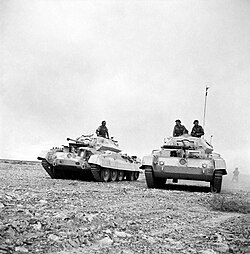
The momentum shifted again in June 1942 during the Battle of Gazala, where the Axis recaptured Tobruk and drove the Eighth Army back into Egypt. The advance was finally halted in July at the First Battle of El Alamein, just 90 miles from Alexandria.
The Turning Point and Final Victory
A critical intelligence shift occurred on June 29, when the British stopped using the compromised "Black Code," preventing the Axis from reading reports on British strengths and plans. Under the new leadership of Lieutenant-General Bernard Montgomery, the Eighth Army underwent rigorous training and build-up.
After a failed Axis attempt to break through at Alam Halfa, Montgomery launched a massive offensive in late October 1942. The Second Battle of El Alamein resulted in a decisive Allied victory, driving the Axis forces west. By mid-January 1943, Tripoli was captured, and the Eighth Army moved toward the Mareth Line, merging with the 18th Army Group for the final Tunisia campaign.
Key Facts
- Operation Compass: The initial British offensive that destroyed the Italian Tenth Army and captured 130,000 prisoners.
- The Afrika Korps: The German expeditionary force led by Erwin Rommel to reinforce Italian positions.
- Tobruk: A strategic fortress port that resisted Axis capture for months, disrupting German supply lines.
- The Eighth Army: A diverse Commonwealth force including British, Australian, Indian, New Zealand, South African, and Sudanese troops.
- Second Battle of El Alamein: The decisive turning point in late 1942 that ended Axis hopes of conquering Egypt.
| Operation/Battle | Date | Primary Outcome | Key Commander(s) |
|---|---|---|---|
| Operation Compass | Dec 1940 - Feb 1941 | Destruction of Italian Tenth Army | Archibald Wavell |
| Rommel's First Offensive | March - April 1941 | Allies pushed back to Egyptian border | Erwin Rommel |
| Operation Crusader | Nov 1941 - Jan 1942 | Relief of Tobruk; Axis retreat | Claude Auchinleck |
| Battle of Gazala | June 1942 | Axis victory; Tobruk captured | Erwin Rommel |
| Second Battle of El Alamein | Oct 1942 | Decisive Allied victory | Bernard Montgomery |
Frequently Asked Questions
Why was the port of Tobruk so important?
Tobruk served as a critical supply hub. Because the Allies held the fortress, the Axis forces could not use the coastal road for logistics, forcing them to use extended, vulnerable supply lines stretching back to Tripoli.
Who was the Afrika Korps?
The Afrika Korps was a German expeditionary force sent by Adolf Hitler and commanded by Erwin Rommel to reinforce the struggling Italian army and block Allied advances in North Africa.
What was the significance of the "Black Code"?
The Black Code was a compromised British military code that the Axis had been reading since 1940. Once the British stopped using it in June 1942, the Axis lost access to vital intelligence regarding Allied positions, reinforcements, and plans.
Which nations contributed to the Eighth Army?
The Eighth Army was a Commonwealth force consisting of the British, Australian, Indian, New Zealand, and South African armies, the Sudan Defence Force, and a brigade of Free French forces.
What marked the end of the Western Desert Campaign?
The decisive victory at the Second Battle of El Alamein and the subsequent capture of Tripoli in January 1943 led to the final phase of the North African war, known as the Tunisia campaign.