West Pakistan: The Rise and Fall of the One Unit Policy
From 1955 to 1970, the administrative landscape of Pakistan was defined by a unique political experiment known as West Pakistan. Established as a single administrative unit, it merged several provinces and princely states into one entity to create a geopolitical balance with East Pakistan. This era, marked by shifts between parliamentary democracy and military rule, fundamentally reshaped the region's demographics and governance before its eventual dissolution.
The creation of West Pakistan was not merely a bureaucratic change but a strategic move under the One Unit policy. By consolidating the western wing, the federal government sought to streamline administration and counter the demographic weight of the East. However, this consolidation often clashed with the diverse ethnic and linguistic identities of the region.
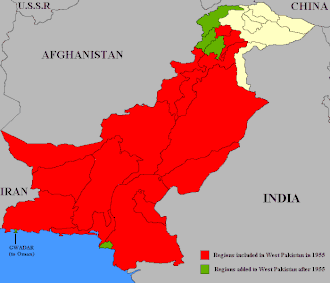
Key Facts
- Existence: Established on October 14, 1955, and dissolved on July 1, 1970.
- Total Area: 796,096 square kilometers.
- Capitals: Initially Karachi, later moving to Lahore, and finally Islamabad in 1965.
- Demographics: Population of approximately 42.8 million by 1961.
- Governance: A self-governing wing subject to the federal government of Pakistan.
- Dissolution: Abolished by General Yahya Khan under the Legal Framework Order of 1970.
Political Evolution and Governance
The One Unit Policy
Announced by Prime Minister Muhammad Ali Bogra on November 22, 1954, the One Unit policy integrated the four western provinces and various territories into a single province. This merger included West Punjab, Sind Province, the North-West Frontier Province, and Baluchistan Province, along with several states such as Bahawalpur, Khairpur, and Kalat. The goal was to mirror the single-province structure of East Pakistan (formerly East Bengal).
From Democracy to Military Rule
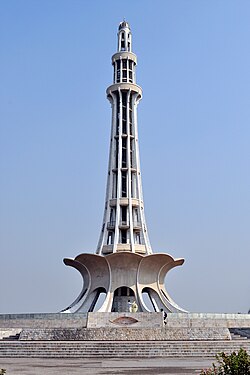
The early years of West Pakistan were characterized by political instability. Between 1947 and 1959, the nation saw a rapid succession of seven prime ministers and four governors-general. This instability culminated in a US-backed military coup in 1958 led by General Ayub Khan. Under martial law, the center of power shifted; the state capital moved from Karachi to the Army General Combatant Headquarters (GHQ) in Rawalpindi in 1959, before the purpose-built city of Islamabad was completed in 1965.
Administrative Structure
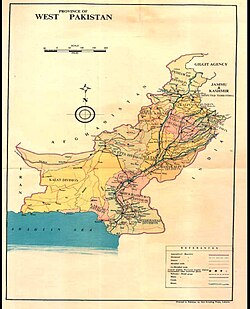
West Pakistan was organized into twelve divisions, including Lahore, Rawalpindi, Multan, and Quetta. The province also expanded to include the Omani enclave of Gwadar in 1958. Governance was managed through a Legislative Assembly, with leadership alternating between Governors and Chief Ministers.
Demographics and Society
Population and Literacy
By 1961, West Pakistan housed 42.8 million people, representing roughly 45% of the total population of undivided Pakistan. While the population grew slightly faster than in the East, literacy rates lagged behind; West Pakistan had a literacy rate of 16.9%, compared to 21.5% in East Pakistan.
Ethnic and Religious Composition
The region was a mosaic of ethnicities and languages, including Punjabi, Pashto, Sindhi, Balochi, Brahui, Khowar, and Kohistani. Following the partition of British India, the region saw massive migration, with 8.6 million Muslims moving into West Punjab. Religiously, the 1961 census indicated that Muslims made up 97.2% of the population, with Christians at 1.4% and other minority faiths making up the remainder.
| Religious Group | Total Population | Percentage |
|---|---|---|
| Islam | 21,113,214 | 77.43% |
| Hinduism | 3,981,565 | 14.6% |
| Sikhism | 1,672,753 | 6.13% |
| Christianity | 432,724 | 1.59% |
| Others | 53,244 | 0.65% |
The Path to Dissolution
The tension between the two wings of Pakistan reached a breaking point following the 1970 general elections. The Bengali Awami League, led by Mujibur Rahman, won an overall majority in Parliament, but the military government refused to allow him to form a government. This political deadlock, combined with long-standing grievances over autonomy, led to the collapse of the union.
On July 1, 1970, President General Yahya Khan enacted the Legal Framework Order, which dissolved the One Unit policy. This restored the four original provinces: Punjab, Sindh, North-West Frontier Province (now Khyber Pakhtunkhwa), and Balochistan. Shortly thereafter, the conflict between West Pakistan and Bengali nationalists, supported by Indian military intervention, led to the secession of East Pakistan and the creation of the People's Republic of Bangladesh in 1971.
Frequently Asked Questions
What was the One Unit policy?
The One Unit policy was an administrative initiative that merged the provinces and states of western Pakistan into a single province called West Pakistan to balance the political power of East Pakistan.
When was West Pakistan dissolved?
West Pakistan was abolished on July 1, 1970, under the Legal Framework Order enacted by General Yahya Khan.
Which cities served as the capital of West Pakistan?
The capital was initially Karachi, then moved to Lahore, and was finally established in Islamabad in 1965.
How did the 1970 elections contribute to the end of West Pakistan?
The Awami League won a majority of seats in the 1970 elections, but the military government's refusal to transfer power to Mujibur Rahman fueled the movement for autonomy and the eventual secession of East Pakistan.
What were the primary languages spoken in West Pakistan?
While Urdu and English were the official languages, the native languages included Punjabi, Pashto, Sindhi, Balochi, Brahui, Khowar, and Kohistani.