Pakistan: A Comprehensive Overview of History, Geography, and Culture
The Islamic Republic of Pakistan is a sovereign state in South Asia, characterized by a rich tapestry of ancient civilizations, diverse landscapes, and a complex political history. From the peaks of the Karakoram to the shores of the Arabian Sea, Pakistan serves as a critical geopolitical bridge between the Middle East, Central Asia, and the Indian subcontinent.
With a population exceeding 241 million, it is the fifth most populous country in the world. Its identity is deeply rooted in its faith, unity, and discipline—the national motto Īmān, Ittihād, Nazam.
![A satellite image showing the topography of Pakistan[178]](/images/f3/56/f356350bc39ded0a597e8d3e2f34de6088bbcab7ca341e6ac95e0bc499189a55.jpg)
Key Facts
![Signing of the Tashkent Declaration to end hostilities with India in 1965 in Tashkent, USSR, by President Ayub alongside Bhutto (centre) and Aziz Ahmed (left)[125]](/images/7a/23/7a238b5a8b35dad5da349ebbbadb5c0d037e7c118f85b19edc291e3fd6a36943.jpg)
- Capital: Islamabad
- Largest City: Karachi
- Official Languages: Urdu and English
- Government: Federal parliamentary Islamic republic
- Population: 241,499,431 (2023 Census)
- Currency: Pakistani rupee (PKR)
- National Animal: Markhor
History and Evolution
![President Musharraf meets with Indian Prime Minister Vajpayee in Islamabad at the sidelines of the 12th SAARC summit in 2004.[146]](/images/f3/6f/f36ff729fbc0c03a79a5240252edd9857726da23d36c36affbf3d1523f956b46.jpg)
Ancient and Medieval Eras
The region has been a center of human civilization for millennia. In the classical period, the University of Taxila emerged as a premier center for Buddhist scholarship.
![Standing Buddha from Gandhara (1st–2nd century CE)[38]](/images/3a/99/3a990e99528298886ee4547412b9c9dc90bc42e038b4974ef26713edbcc6984f.webp)
The medieval period saw the rise of various dynasties, including the Samma dynasty, which contributed to the development of major funerary sites like the Makli Necropolis, now a UNESCO World Heritage Site.
![Makli Necropolis, a UNESCO World Heritage Site rose to prominence as a major funerary site during the Samma dynasty.[60]](/images/dd/78/dd78a9000764f1d39cbbca9ccbd2f755dfdf5fcaf3c696728c3a7565bac43be0.jpg)
Independence and the Modern State
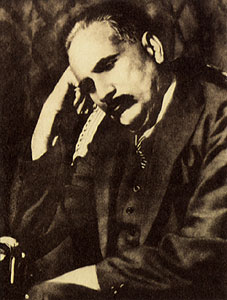
Pakistan's path to statehood was defined by the Two-Nation Theory, conceived by the national poet Muhammad Iqbal. The country gained independence from the United Kingdom on August 14, 1947, following the partition of British India.
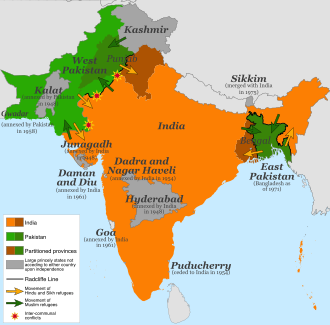
Liaquat Ali Khan served as the first prime minister, helping to establish the foundations of the new republic. Over the decades, the nation has navigated various constitutional changes, culminating in the current constitution adopted on August 14, 1973.
![Liaquat Ali Khan was elected the first prime minister of Pakistan.[108][109]](/images/3a/44/3a441558336b4c11d89d3f73552ce385535d2089d7b4080ffe75f881e8371154.webp)
Geography and Environment
![Markhor is the national animal of Pakistan.[199]](/images/b0/9f/b09f37dd7d83601203de5598a5e41bf3de458555d119ae4a871e18e2f375d57e.jpg)
Topography and Climate
Pakistan's geography is incredibly varied, ranging from the high-altitude mountains of the north to the fertile plains of the Punjab and the arid deserts of Sindh and Balochistan. The country's climate is categorized by the Köppen climate classification system, reflecting its diverse ecological zones.
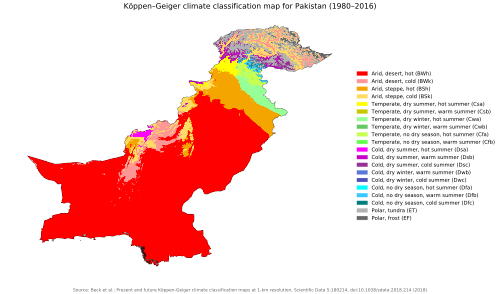
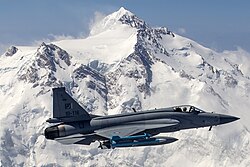
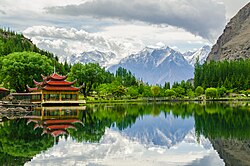
The northern regions are home to some of the world's highest peaks, including Nanga Parbat, and the stunning Shangrila Lake in Gilgit-Baltistan.
Natural Resources and Infrastructure
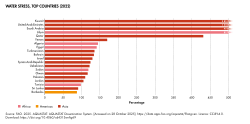
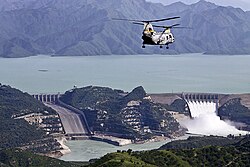
The nation relies heavily on its water resources, though it was ranked as the sixteenth most water-stressed country globally in 2022. To manage this, the Tarbela Dam—the world's largest earth-filled dam—was constructed in 1968.
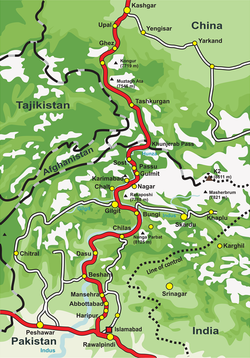
Infrastructure is highlighted by the Karakoram Highway, one of the highest paved roads in the world, which provides a vital link to China.
Government and Political Structure
Administrative Framework
Pakistan is a federal parliamentary republic. The government is divided into a legislature (Parliament), consisting of the Senate (Upper House) and the National Assembly (Lower House), and an executive branch led by the President and Prime Minister.
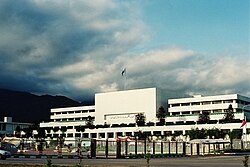
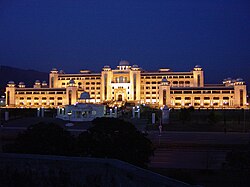
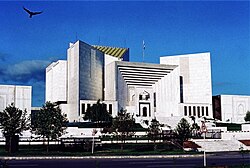
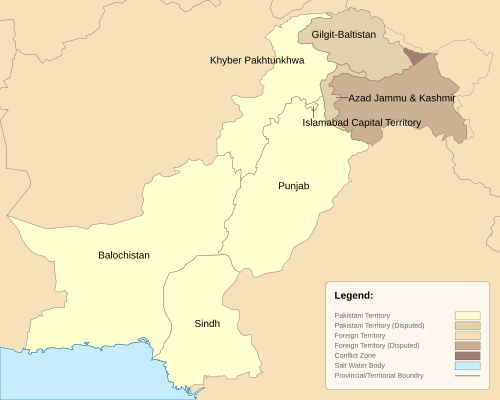
The country is divided into several administrative units, including the provinces of Punjab, Sindh, Khyber Pakhtunkhwa, and Balochistan, as well as Gilgit-Baltistan, Azad Kashmir, and the Islamabad Capital Territory.
Foreign Relations
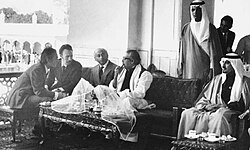
Pakistan maintains strategic partnerships globally, most notably with China, hosting China's largest embassy. It also plays a significant role in the Muslim world, having hosted the Second Islamic Summit of the Organisation of Islamic Cooperation in 1974.
![Pakistani Prime Minister Huseyn Shaheed Suhrawardy with Chinese Premier Zhou Enlai signing the Treaty of Friendship Between China and Pakistan.[308] Pakistan is host to China's largest embassy.[309]](/images/78/af/78afe7058458945da0a4349823cd63237faf1b8ae00f1d09c4fd4c9911583fc3.jpg)
Economy and Development
![President Ayub Khan meeting with U.S. President John F. Kennedy in 1961[286]](/images/0a/90/0a90b6357dc2a9012841fdcc135cc8676df87035b03b65a12b5a908ba689d3c7.jpg)
Economic Indicators
Pakistan possesses a significant economy with a GDP (PPP) estimated at $1.8 trillion for 2026. However, the nation faces challenges with poverty, as approximately 44.7% of the population lives below the international poverty line.
| Indicator | Value/Estimate | Year/Period |
|---|---|---|
| GDP (PPP) Total | $1.8 trillion | 2026 |
| GDP (Nominal) Total | $407.79 billion | 2025 |
| Real GDP Growth | 3.6% | 2026 |
| CPI Inflation | 4.5% | 2025 |
| Unemployment Rate | 8% | 2025 |
Key Industries
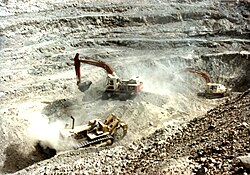
Agriculture remains a cornerstone of the economy; notably, Pakistan is the 6th largest producer of dates globally. The industrial sector includes significant surface mining operations, particularly in Sindh.
![Pakistan is the 6th largest producer of dates in the world[433]](/images/be/ae/beae2365dac0fbf7686e8264c26d419b9a3f486a9cb539b90c380d7f7e0a0c70.jpg)
Society and Culture
![Prime Minister Shehbaz Sharif at the 2022 Shanghai Cooperation Organisation summit[294]](/images/77/d4/77d412269bfcc68e162e467042a3e8399f63f268f663602b84656da15df977fb.jpg)
Demographics and Religion
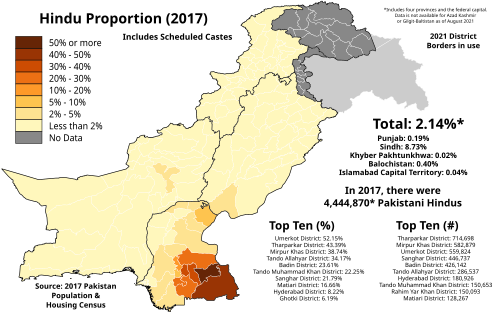
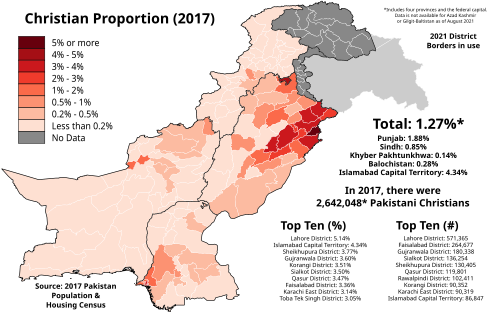
The population is predominantly Muslim (96.3%), with significant minorities of Hindus (2.2%) and Christians (1.4%). The country is linguistically diverse, with over 77 native languages spoken across its territories.
Arts, Education, and Heritage
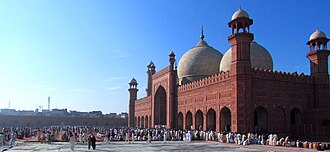
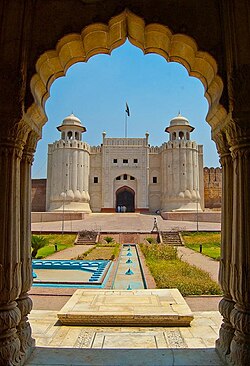
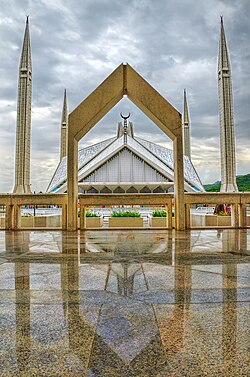
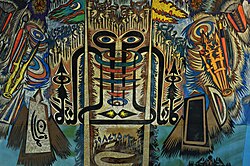
Pakistan's cultural heritage is evident in its architecture, from the Mughal-era Lahore Fort to the modern Faisal Mosque. The arts have been shaped by figures like Sadequain, one of the nation's finest calligraphers and painters.
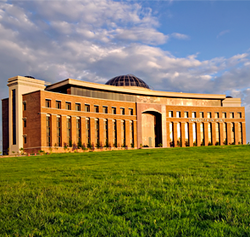
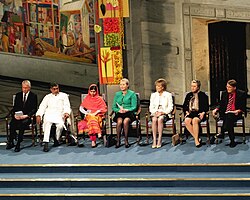
In education, institutions like NUST in Islamabad are top-ranked for engineering. The nation has also produced global figures such as Malala Yousafzai, the youngest Nobel Peace Prize laureate, recognized for her advocacy for girls' education.
Daily Life and Cuisine
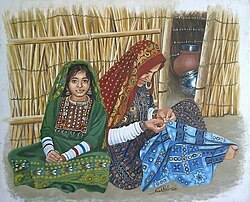
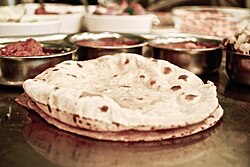
Traditional clothing varies by region, such as the distinct styles found in Sindh. The staple diet centers around Roti, typically served with various side dishes.
Frequently Asked Questions
![The areas shown in green are the Pakistani-controlled areas.[345]](/images/63/aa/63aaf6e37881206d9b53535747f83416fcc2975ca858ecdce35c98b87e733e8f.jpg)
![Afghan children near Islamabad fetching water from water pump. (Pakistan once held the second largest refugee population globally after Turkey.[537])](/images/b3/e2/b3e2dc3268b8531702cf1d52fd7d3a01657817b42530a5d26fd5699989599903.jpg)
What are the official languages of Pakistan?
The official languages of Pakistan are Urdu and English, although there are over 77 native languages spoken throughout the country.
Which city is the largest in Pakistan?
Karachi is the largest city in Pakistan, while Islamabad serves as the national capital.
What is the significance of the Karakoram Highway?
The Karakoram Highway is one of the highest paved roads in the world and serves as a critical transport link connecting Pakistan to China.
What is the primary religion in Pakistan?
Islam is the official and primary religion, practiced by 96.3% of the population, followed by minority communities of Hindus and Christians.
Who is the national poet of Pakistan?
Muhammad Iqbal is the national poet of Pakistan and is credited with conceiving the original idea of a separate state for Muslims in the region.