East Pakistan: The History and Evolution of a Lost Province
From 1956 to 1971, East Pakistan served as the eastern administrative wing of Pakistan. Covering the territory of what is now the sovereign nation of Bangladesh, this region was often referred to as "Pakistani Bengal" to distinguish it from the Indian state of West Bengal. Bound by India and Burma (now Myanmar) and opening to the Bay of Bengal, East Pakistan was a land of immense cultural richness and growing political tension.
The region's journey from a province of Pakistan to an independent state is a complex narrative of linguistic pride, economic struggle, and a relentless drive for self-determination.
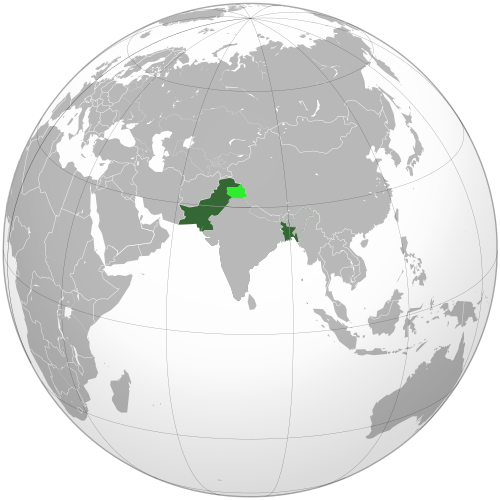
Key Facts
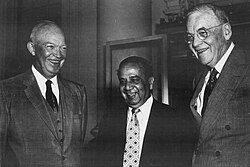
- Duration: Existed as East Pakistan from February 29, 1956, to December 16, 1971.
- Capital: Dacca (now Dhaka), the largest city in the region.
- Population: Approximately 44.25 million people according to the 1951 census.
- Official Languages: Bengali and English.
- Outcome: Became the independent state of Bangladesh in 1971.
Political Foundations and the One Unit Scheme
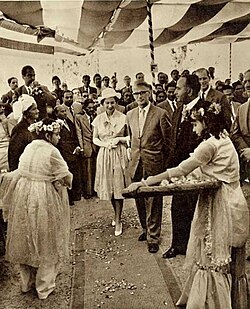
The administrative structure of the region shifted significantly in 1955. Prime Minister Mohammad Ali Bogra implemented the One Unit scheme, which merged four western provinces into a single entity known as West Pakistan. Simultaneously, the province of East Bengal was renamed East Pakistan under the 1956 Constitution of Pakistan.
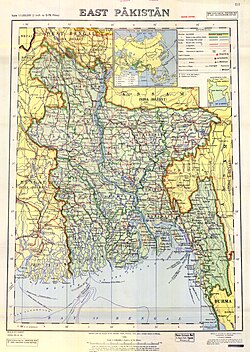
The region was governed by a Provincial Assembly, the largest legislature in Pakistan. However, democratic processes were infrequent, with elections held only twice—in 1954 and 1970. This lack of consistent representation contributed to the growing friction between the eastern wing and the federal government in the west.
The Era of Ayub Khan and the Six Point Movement
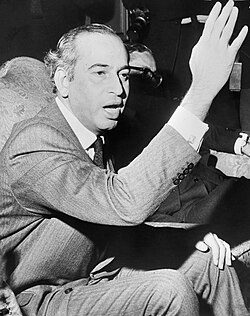
Under the leadership of President Ayub Khan, tensions escalated as Bengali leaders sought greater autonomy. In 1966, Awami League leader Sheikh Mujibur Rahman announced the Six Point movement in Lahore. This manifesto demanded the restoration of democracy and significant provincial autonomy to protect the interests of the Bengali people.
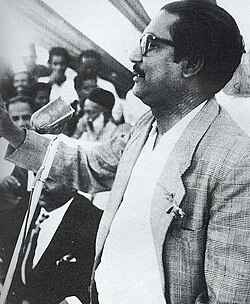
The federal government responded harshly. Sheikh Mujibur Rahman was indicted for treason in the Agartala Conspiracy Case. However, a mass uprising in 1969 led to his release and the eventual resignation of Ayub Khan in March 1969.
Economic Disparity and Social Unrest
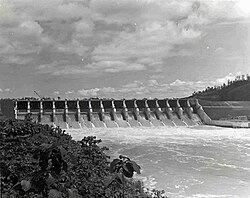
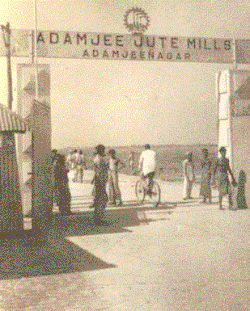
A primary driver of Bengali nationalism was the stark economic inequality between the two wings of the country. While East Pakistan contributed significantly to the national economy—particularly through the jute industry—the federal spending was heavily skewed toward West Pakistan.
| Period | Spending on West Pakistan (Millions PKR) | Spending on East Pakistan (Millions PKR) | East as % of West |
|---|---|---|---|
| 1950–55 | 11,290 | 5,240 | 46.4% |
| 1955–60 | 16,550 | 5,240 | 31.7% |
| 1960–65 | 33,550 | 14,040 | 41.8% |
| 1965–70 | 51,950 | 21,410 | 41.2% |
| Total | 113,340 | 45,930 | 40.5% |
This financial neglect, combined with the devastating impact of the 1970 Bhola cyclone—which claimed roughly 500,000 lives—fueled deep resentment against the central government.
The Path to Independence (1970–1971)
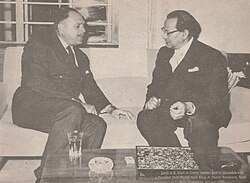
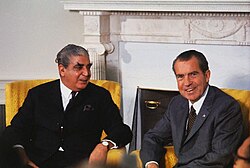
General Yahya Khan succeeded Ayub Khan and organized the 1970 general elections. Despite the electoral success of Bengali candidates, the federal government refused to transfer power. This deadlock led to open calls for self-determination.
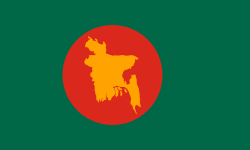
On March 23, 1971, the first Bangladeshi flag was hoisted across East Pakistan as a protest on Republic Day. The situation deteriorated rapidly, leading to the Bangladesh Liberation War. The Pakistani military launched Operation Searchlight, resulting in a genocide and the killing of many Bengali intellectuals.
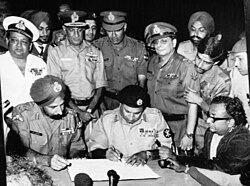
The conflict culminated in December 1971. With the support of Indian forces, the liberation struggle ended with the formal surrender of the Pakistani military on December 16, 1971, marking the birth of the independent state of Bangladesh.
Demographics and Culture

East Pakistan was characterized by a diverse but predominantly Muslim population. According to the 1951 census, 76.9% of the population followed Islam, while 22% were Hindu. By 1961, the Muslim population had risen to 80.4%, with Hindus making up 18.4%. Other minority groups included Buddhists, Christians, and Animists.
The region's identity was deeply tied to the Bengali language and culture, which became a rallying point for the independence movement against the Urdu-centric policies of the West.
Frequently Asked Questions
What was the One Unit scheme?
The One Unit scheme was a political arrangement implemented in 1955 by Prime Minister Mohammad Ali Bogra that merged the four provinces of West Pakistan into a single administrative unit to balance power with East Pakistan.
Who was Sheikh Mujibur Rahman?
Sheikh Mujibur Rahman was the leader of the Awami League and the primary architect of the Six Point movement, which demanded greater autonomy for East Pakistan. He is regarded as the founding father of Bangladesh.
Why did East Pakistan seek independence?
Independence was sought due to severe economic discrimination, political marginalization, the suppression of the Bengali language, and the federal government's failure to respond to humanitarian crises like the 1970 Bhola cyclone.
What happened on December 16, 1971?
December 16, 1971, marked the official surrender of the Pakistani military forces in Dacca, ending the Bangladesh Liberation War and establishing the sovereign state of Bangladesh.
What was the Six Point movement?
The Six Point movement was a political manifesto launched in 1966 by Sheikh Mujibur Rahman that called for greater provincial autonomy, including control over currency, taxation, and foreign trade for East Pakistan.