Weak Interaction: The Fundamental Force Behind Radioactive Decay
In the vast landscape of physics, the weak interaction (also known as the weak nuclear force) stands as one of the four fundamental interactions that govern the universe, alongside electromagnetism, the strong interaction, and gravitation. While it may be "weak" in intensity compared to others, it is the essential mechanism responsible for the radioactive beta decay of atoms and plays a critical role in the nuclear fission and fusion processes that power stars.
The behavior of this force is described by the electroweak theory (EWT), which unifies it with electromagnetism. Although the term quantum flavordynamics (QFD) is occasionally used, EWT remains the primary framework for understanding how subatomic particles interact via this force.
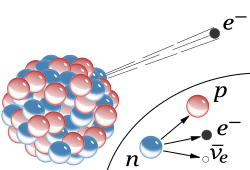
Key Facts
- Effective Range: Extremely short, limited to subatomic distances (less than the diameter of a proton).
- Carrier Particles: Mediated by the massive W and Z bosons.
- Unique Property: The only fundamental interaction that violates parity (P) and charge-parity (CP) symmetry.
- Primary Role: Enables the transformation of quarks and leptons, making beta decay and radiocarbon dating possible.
- Intensity: Significantly weaker than the strong and electromagnetic forces, with a coupling constant between 10-6 and 10-7.
The History of the Weak Force
The scientific journey to understand the weak interaction began in 1933 when Enrico Fermi proposed the first theory. Fermi suggested that beta decay resulted from a four-fermion interaction acting as a contact force with no range.
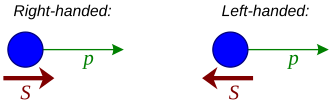
By the mid-1950s, physicists Chen-Ning Yang and Tsung-Dao Lee hypothesized that the "handedness" (spin) of particles might violate conservation laws. This was confirmed in 1957 by the Wu experiment, led by Chien Shiung Wu, which proved that the weak interaction violates parity symmetry.
The 1960s brought a major breakthrough when Sheldon Glashow, Abdus Salam, and Steven Weinberg unified the weak interaction and electromagnetism into a single framework called the electroweak force. This theoretical leap predicted the existence of the W and Z bosons, which were finally detected in 1983.
Physical Properties and Mechanics
The weak interaction is characterized by its extremely short range, typically between 0.01 and 0.1 femtometers (fm). At distances of 0.001 fm, its intensity is comparable to electromagnetism, but it decreases exponentially as distance increases.
The force is mediated by the W and Z bosons. Because these particles are very massive (approximately 90 GeV/c2), they are short-lived, existing for less than 10-25 seconds. This high mass is why weak-force interactions occur much more slowly than those driven by strong or electromagnetic forces.
For example, a neutral pion decays electromagnetically in about 10-16 seconds. In contrast, a charged pion, which must decay via the weak interaction, lives for about 10-8 seconds—roughly a hundred million times longer. A free neutron's decay is even slower, taking about 15 minutes.

Weak Isospin and Hypercharge
Particles interact with the W boson based on a property called weak isospin (T3). This acts as an additive quantum number similar to how electric charge works in electromagnetism. Left-handed fermions have a weak isospin of either +1/2 or -1/2, while right-handed fermions have an isospin of 0.
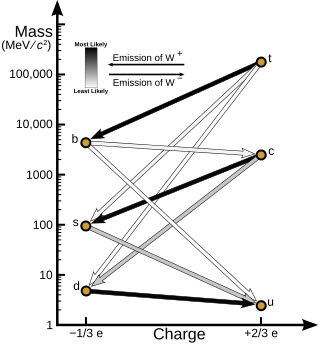
A critical rule of this interaction is that a quark never decays into another quark with the same weak isospin; they must switch between +1/2 and -1/2. Additionally, the electroweak theory introduces weak hypercharge (YW), a property held by all known spin-1/2 particles.
Types of Weak Interactions
Charged-Current Interactions
In these interactions, a charged lepton (like an electron) can absorb a W boson to become a neutrino of the same flavor. Similarly, quarks can change flavor: a down-type quark (down, strange, or bottom) can convert into an up-type quark (up, charm, or top) by emitting or absorbing a W boson.
Neutral-Current Interactions
These interactions are mediated by the Z boson. Unlike the W boson, the Z boson does not change the electric charge of the particles involved, though it still decays rapidly into other particles.

Symmetry Violation and the Higgs Boson
The weak interaction is famous for breaking parity symmetry (P), meaning the laws of physics change if a system is reflected in a mirror. It also violates charge-parity symmetry (CP), which combines parity with the swapping of particles for antiparticles. This CP violation is essential for explaining why the universe contains more matter than antimatter.
The Higgs mechanism explains why the W and Z bosons have mass while the photon (the carrier of electromagnetism) remains massless. The existence of the Higgs boson was formally confirmed by the ATLAS and CMS teams at the Large Hadron Collider in 2012, with tentative confirmation by March 2013.
| Property | Detail |
|---|---|
| Carrier Particles | W+, W-, and Z bosons |
| Effective Range | 0.01 to 0.1 fm |
| Symmetry Violations | Parity (P) and Charge-Parity (CP) |
| Key Process | Beta decay (Neutron → Proton + Electron + Antineutrino) |
| Unified Theory | Electroweak Theory (EWT) |
Frequently Asked Questions
Why is the weak interaction called "weak"?
It is called weak because its coupling constant (the measure of interaction frequency) is significantly lower than those of the strong interaction and electromagnetism, making these interactions occur much less frequently and more slowly.
What is the role of the weak interaction in carbon dating?
Radiocarbon dating is possible because carbon-14 is unstable and decays into nitrogen-14 through the weak interaction. By measuring the remaining carbon-14, scientists can determine the age of organic materials.
What is the difference between a W boson and a Z boson?
W bosons carry an electric charge (+1 or -1) and are involved in "charged-current" interactions that change the flavor of particles. Z bosons are electrically neutral and mediate "neutral-current" interactions.
What does it mean to violate parity symmetry?
Parity violation means that the laws of physics are not identical for a particle and its mirror image. The weak interaction is the only fundamental force that distinguishes between left-handed and right-handed particles.
How does the Higgs boson relate to the weak force?
The Higgs mechanism explains how the W and Z bosons acquire their large masses. Without this mechanism, these bosons would be massless like the photon, and the weak interaction would have a much longer range and different strength.