Waltham Cross Landmarks: A Journey Through Medieval History
The town of Waltham Cross is home to significant historical markers that bridge the gap between the medieval era and the present day. From royal memorials to local civic symbols, these landmarks offer a glimpse into the processional routes of royalty and the commercial heritage of the High Street.
The Eleanor Cross: A Royal Memorial
At the heart of the town stands one of only three surviving medieval Eleanor crosses. These monuments were completed by 1294 to commemorate the overnight resting places of the coffin of Eleanor of Castile, the wife of King Edward I. Following her death on November 28, 1290, her body was transported on a processional journey from Lincoln to Westminster Abbey.
According to historical records, the coffin rested at St Albans on December 12 and arrived at Waltham Abbey the following day. It finally reached London on December 14. The Waltham Cross is unique among the memorials as it was the only one designed by a foreigner, Nicholas Dymenge de Reyns (also known as de Legeri).
While three original crosses survived, a fourth—the southernmost monument—was destroyed during the English Civil War. A recreation of this lost cross now stands at Charing Cross station in London, located less than one mile (1.6 km) from the abbey.
Architecture and Preservation of the Cross
The monument features a hexagonal plan organized into three distinct stages. The main stage contains three statues of Queen Eleanor, each positioned within a niche under a canopy. The remaining three faces of the hexagon feature niches bisected by buttresses. While the original sculptures were created by Alexander of Abingdon, they have been replaced during various restorations; however, one original piece is preserved at the Victoria and Albert Museum.
The preservation of the cross has been a long-term effort. In 1721, the Society of Antiquaries of London surveyed the monument and published their findings in Vetusta Monumenta to advocate for its conservation. Actual restoration began in 1832 under William Barnard Clarke, followed by subsequent major works between 1885–92 and 1950–53.
The Four Swannes Sign
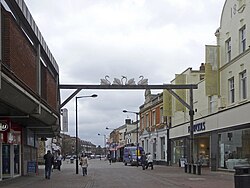
Beyond the royal monuments, the High Street is marked by a distinctive gantry sign featuring four sculpted swans. This landmark originally served as the sign for the Four Swans (or "Swannes") public house, which has since been demolished.
The sign currently visible to the public is a replica installed in 2007. The original historical signs have been preserved and are now housed at the Lowewood Museum in Hoddesdon.
Key Facts
- Purpose: The Eleanor Cross commemorates the funeral procession of Eleanor of Castile in 1290.
- Design: The Waltham Cross was designed by Nicholas Dymenge de Reyns, the only foreign designer of the series.
- Structure: The cross is hexagonal with three stages and originally featured sculptures by Alexander of Abingdon.
- Restorations: Major rebuilding occurred in 1832, 1885–92, and 1950–53.
- Local Heritage: The Four Swannes sign is a 2007 replica of a former public house sign.
| Landmark | Origin/Date | Key Figure/Designer | Current Status |
|---|---|---|---|
| Eleanor Cross | Completed by 1294 | Nicholas Dymenge de Reyns | Restored Original |
| Four Swannes Sign | Replica 2007 | N/A | Replica (Originals at Lowewood Museum) |
Frequently Asked Questions
Who was Eleanor of Castile?
Eleanor of Castile was the wife of King Edward I. The Eleanor crosses were built to mark the locations where her coffin rested during its journey to Westminster Abbey in 1290.
How many Eleanor crosses originally existed?
There were several crosses, including the three surviving medieval ones and a fourth (the southernmost) that was destroyed during the English Civil War and later recreated at Charing Cross station.
Where can I see the original sculptures from the Eleanor Cross?
While the sculptures on the cross have been replaced during restorations, one of the original works by Alexander of Abingdon is on display at the Victoria and Albert Museum.
What happened to the original Four Swannes sign?
The original signs from the now-demolished Four Swans public house are kept at the Lowewood Museum in Hoddesdon.
When was the Eleanor Cross first surveyed for conservation?
The monument was surveyed by the Society of Antiquaries of London in the early 18th century, with results published in 1721.