Walkway Over the Hudson: From Rail Bridge to Pedestrian Landmark
The Walkway Over the Hudson stands today as a premier pedestrian destination, but its origins lie in the ambitious industrial expansion of the 19th century. Originally designed as a vital rail link across the Hudson River south of Albany, this massive structure transitioned from a hub of freight transport to a derelict relic, and finally into a public park.
Early Planning and Challenges
The desire for a fixed crossing of the Hudson River emerged in the 1800s. As early as 1868, local newspapers discussed a railroad bridge at Poughkeepsie, while the Hudson Highland Suspension Bridge Company proposed a separate crossing near the site of the future Bear Mountain Bridge. However, that particular project never materialized.
The State of New York chartered the Poughkeepsie Bridge Company in 1872, but the path to completion was fraught with difficulty. The Panic of 1873—a severe economic depression—stalled early financing. A subsequent attempt to begin pier construction in 1876 was plagued by foundation failures, eventually leading the contractor into bankruptcy by 1878.
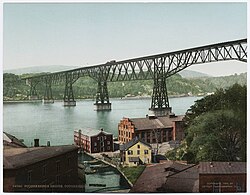
Construction and Engineering
Construction finally gained momentum in 1886 with the organization of the Manhattan Bridge Building Company. The project involved a collaboration of specialized firms: the Union Bridge Company handled major fabrication, while Dawson, Symmes, and Usher managed the foundation engineering. The structural design was led by John F. O'Rourke, P. P. Dickinson, and Arthur B. Paine.
The resulting structure is a multispan cantilever truss—a design where spans extend horizontally, supported by piers, to bridge long distances. The bridge spans a total of 6,768 feet (2,063 m), including its approaches, with the deck sitting approximately 212 feet (65 m) above the river.
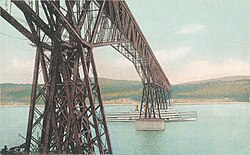
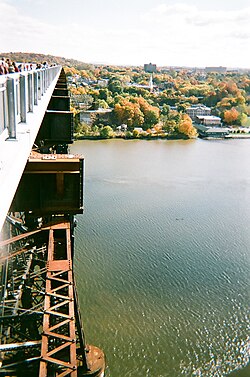
Following test operations in late December 1888, the bridge officially opened for rail service on January 1, 1889.
The Era of Rail Operation
For decades, the bridge served as a critical artery for freight traffic, connecting southern New England, New York, Pennsylvania, and the Midwest. Over the 20th century, ownership and operating interests shifted between several entities, including the New York, New Haven & Hartford Railroad and Penn Central.
To keep pace with evolving technology, the bridge underwent significant upgrades. In 1907, engineer Ralph Modjeski designed strengthening work to accommodate heavier trains. Between 1917 and 1918, the bridge implemented gauntlet track operation—a system where two tracks overlap but do not connect, requiring strict speed restrictions. This arrangement was eventually replaced by a single centered track in 1959.
Fire, Decline, and Disuse
The bridge's utility came to an abrupt end on May 8, 1974, when a fire destroyed approximately 700 feet (210 m) of decking and the underlying structure on the eastern end. Rail service ceased immediately.
Throughout the late 1970s and early 1980s, the bridge sat dormant. The lack of maintenance led to safety concerns, as debris falling from the approach structures onto adjacent roadways necessitated emergency repair and removal work.
The Path to Pedestrian Conversion
In 1984, Conrail sold the bridge to a private investor group for a nominal price. This period was marked by legal and regulatory disputes regarding insurance, lighting, utility attachments, and general maintenance.
A turning point arrived in 1998 when a nonprofit organization, Walkway Over the Hudson, acquired the structure. Their vision was to transform the industrial relic into a public walkway. This conversion required extensive structural repairs and the installation of a modern concrete deck.
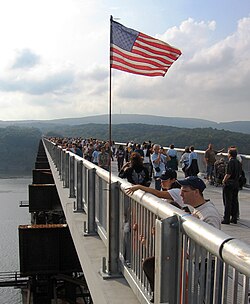
The Walkway officially opened to the public on October 3, 2009. Shortly thereafter, in December 2010, the nonprofit transferred ownership of the structure to the New York State Bridge Authority.
Key Facts
- Total Length: 6,768 feet (2,063 m), including approaches.
- Height: Approximately 212 feet (65 m) above the river.
- Structure Type: Multispan cantilever truss.
- Rail Opening: January 1, 1889.
- Pedestrian Opening: October 3, 2009.
- Current Owner: New York State Bridge Authority.
| Period | Status/Ownership | Key Event |
|---|---|---|
| 1872–1889 | Poughkeepsie Bridge Company | Planning and construction |
| 1889–1974 | Various Railroads (e.g., Penn Central) | Active freight rail service |
| 1974–1984 | Conrail | Closure following 1974 fire |
| 1984–1998 | Private Investor Group | Period of litigation and disuse |
| 1998–2010 | Walkway Over the Hudson (Nonprofit) | Conversion to pedestrian use |
| 2010–Present | New York State Bridge Authority | Public management and operation |
Frequently Asked Questions
Why did the bridge stop being used for trains?
Rail service ended after a fire on May 8, 1974, which damaged about 700 feet of the decking and structure on the east end of the bridge.
What is a cantilever truss structure?
It is a bridge design consisting of spans that project horizontally into space, supported on only one end, which allows for the crossing of wide distances like the Hudson River.
Who owns the Walkway Over the Hudson now?
The structure is currently owned and managed by the New York State Bridge Authority, which took ownership from the nonprofit organization in December 2010.
When did the bridge open to the public as a walkway?
The pedestrian conversion was completed and opened to the public on October 3, 2009.
What was gauntlet track operation?
Implemented between 1917 and 1918, gauntlet track is a system where two tracks are placed very close together—sometimes overlapping—but are not connected, requiring trains to move at restricted speeds.