Pittsburgh, Cincinnati, Chicago and St. Louis Railway: A History of the Panhandle Route
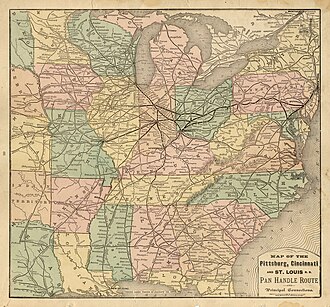
The development of the Panhandle Route represents a complex era of American industrial expansion, characterized by a fragmented landscape of small charters that eventually coalesced into a massive regional network. Spanning the heart of the Midwest, this rail system connected the industrial hub of Pittsburgh with the growing commercial centers of Columbus, Indianapolis, and Chicago.
Key Facts
- Core Route: Connected Pittsburgh, Pennsylvania, to Columbus, Ohio, and extended further to Indianapolis and Chicago.
- Major Merger: The Pittsburgh, Cincinnati, Chicago and St. Louis Railway (PCC&StL) was formed in 1890.
- PRR Influence: The Pennsylvania Railroad (PRR) exerted significant control through leases and subsidiaries.
- Technical Shift: Early lines utilized the Ohio gauge (4 ft 10 in) before standardizing.
- Modern Legacy: Many former rights-of-way are now public assets, including the Panhandle Trail and Major Taylor Trail.
Pittsburgh to Columbus (1848–1869)
The eastern leg of the network began with the Steubenville and Indiana Railroad, chartered in 1848 to build from the Ohio River at Steubenville toward the Indiana state line. Construction began in October 1851, with the first section opening in December 1853. By 1857, the line connected to Columbus via an agreement with the Central Ohio Railroad.
Simultaneously, the Pittsburgh and Steubenville Railroad was chartered in 1849 to bridge the gap from Pittsburgh to the Ohio border. To avoid opposition from the city of Wheeling, the railroad utilized private right-of-way deeds rather than eminent domain. The full line from Pittsburgh to the Steubenville Railroad Bridge opened on October 9, 1865, finally linking the Pennsylvania Railroad with the Steubenville and Indiana Railroad.
By April 30, 1868, several entities—including the Panhandle Railway and the Steubenville and Indiana Railroad—merged to form the Pittsburgh, Cincinnati and St. Louis Railway.
Columbus to Indianapolis (1847–1867)
The connection between Ohio and Indiana was forged through several competing and collaborating lines. The Terre Haute & Richmond Railroad (chartered 1847) and the Indiana Central Railway worked to link Indianapolis to the Ohio state line. In 1859, these lines adopted the Ohio gauge (4 ft 10 in), a wider track width designed to ensure compatibility with the Little Miami and Columbus and Xenia railroads.
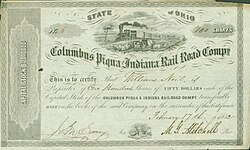
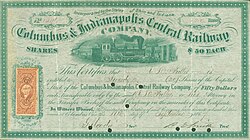
The Columbus Piqua & Indiana Railroad provided the necessary link from Columbus westward. After a period of financial instability and foreclosure in 1863, it was reorganized as the Columbus and Indianapolis Railroad. By October 19, 1864, the Indiana Central Railway and the Columbus and Indianapolis Railroad merged to create the Columbus and Indianapolis Central Railway.
Richmond to Chicago (1848–1865)
Expanding further west, the New Castle and Richmond Railroad (chartered 1848) began the push toward Chicago. Through a series of mergers and name changes—including the Cincinnati, Logansport and Chicago Railway and the Cincinnati and Chicago Railroad—the line eventually reached Logansport by 1857.
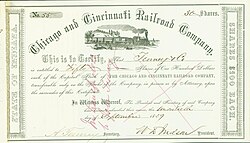
The final link to Chicago was established via the Chicago and Cincinnati Railroad, which opened in 1861, connecting Logansport to Valparaiso and subsequently to Chicago. Joint operations between Richmond and Chicago were established in July 1862, though these arrangements shifted frequently due to corporate reorganizations.
Realignments and the Formation of the CC&IC
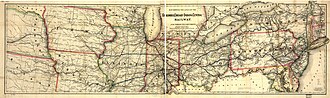
Between 1857 and 1869, the network underwent significant streamlining. The Chicago and Great Eastern Railway absorbed several smaller lines to create a more direct route from Chicago to La Crosse, Indiana, abandoning older, less efficient paths.
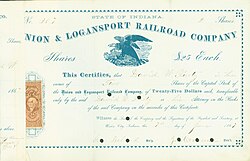
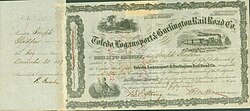
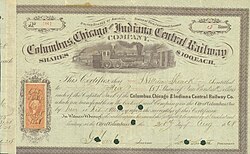
In September 1867, the Columbus and Indianapolis Central Railway merged with the Union and Logansport and the Toledo, Logansport and Burlington railways to form the Columbus and Indiana Central Railway. This was followed by a final merger on February 12, 1868, creating the Columbus, Chicago and Indiana Central Railway (CC&IC).
Expansion and Final Consolidation (1869–1956)
The late 19th century saw the Pennsylvania Railroad (PRR) consolidate its grip on the region. In 1869, the Pittsburgh, Cincinnati and St. Louis Railway leased the Little Miami Railroad, granting the PRR critical access to Cincinnati. Following a bankruptcy in 1883, the CC&IC was reorganized as the Chicago, St. Louis and Pittsburgh Railroad.
On September 30, 1890, a massive merger combined the Chicago, St. Louis and Pittsburgh with the PC&StL and other smaller lines to form the Pittsburgh, Cincinnati, Chicago and St. Louis Railway (PCC&StL). This entity was eventually leased by the PRR in 1921 and fully merged into the PRR's Philadelphia, Baltimore and Washington Railroad on April 2, 1956.
| Period | Key Entity | Primary Connection | Outcome |
|---|---|---|---|
| 1848–1868 | Steubenville & Indiana RR | Pittsburgh to Columbus | Merged into PC&StL |
| 1864–1868 | Columbus & Indianapolis Central | Columbus to Indianapolis | Merged into CC&IC |
| 1868–1883 | Columbus, Chicago & Indiana Central | Columbus to Chicago | Foreclosed/Reorganized |
| 1890–1956 | PCC&StL | Regional Network | Merged into PRR |
Current Use
Today, the legacy of the Panhandle Route is visible in both transit and recreation. In Pittsburgh, the route serves the Pittsburgh Light Rail system and Norfolk Southern's Mon Line. Other sections have been repurposed as the West Busway and the Panhandle Trail, a popular bicycling and walking path.
In the Midwest, portions of the right-of-way have become the Major Taylor Trail in Chicago and the Pennsy Greenway in Indiana and Illinois, while some segments in Ohio remain active as part of the Columbus and Ohio River Railroad.
Frequently Asked Questions
What was the 'Ohio gauge'?
The Ohio gauge was a track width of 4 feet 10 inches (1,473 mm), which was broader than the standard gauge. It was used by several early railroads in the region to ensure direct connections between specific lines, such as the Little Miami and Columbus and Xenia railroads.
How did the railroad bypass the city of Wheeling?
The Pittsburgh and Steubenville Railroad avoided the need for a government charter—which would have been opposed by Wheeling—by purchasing private right-of-way deeds from 36 different landowners across the Virginia Panhandle.
When did the Pennsylvania Railroad take full control?
While the PRR exerted influence through subsidiaries and leases starting in the mid-19th century, the PCC&StL was formally leased by the PRR on January 1, 1921, and finally merged into the PRR system in 1956.
What remains of the route today?
The route is now a mix of active rail (Columbus and Ohio River Railroad), public transit (Pittsburgh Light Rail), and recreational trails (Panhandle Trail, Major Taylor Trail, and Pennsy Greenway).