Voyager Golden Record: Humanity's Interstellar Time Capsule
Launched in 1977, the Voyager 1 and Voyager 2 spacecraft are more than just scientific probes; they are messengers. Each carries a Voyager Golden Record, a gold-plated copper disk designed as a time capsule to communicate the story of Earth and its inhabitants to any extraterrestrial intelligence that might encounter them in the distant future.
While these probes were not aimed at any specific star, they have both successfully reached interstellar space—the region between stars characterized by galactic plasma. Voyager 1 currently holds the title of the farthest human-made object from Earth.

Key Facts
- Composition: 12-inch copper disks plated with nickel and gold.
- Contents: 116 images, spoken greetings in 55 languages, and a diverse collection of music and sounds.
- Dating Mechanism: An electroplated sample of uranium-238 allows future finders to calculate the record's age via its half-life.
- Playback: Designed to be played at 16 + 2/3 revolutions per minute using an included stylus.
- Current Status: Both probes are in interstellar space; Voyager 1 is the most distant human object.
The Contents of the Record
The Golden Record serves as a curated snapshot of life on Earth. It includes spoken greetings in 55 ancient and modern languages, including a final English greeting from Nick Sagan, who was six years old at the time of recording.
Visuals and Audio
The record contains 116 images encoded in analogue form, each composed of 512 vertical lines. These images range from depictions of human consumption (eating, drinking, and licking) to scientific diagrams, such as the evolution of vertebrates and photos of the Arecibo Observatory and Jupiter.
The audio portion is a vast tapestry of Earth's sounds, including whale songs, natural environments, and music from various cultures. Notably, the team led by Carl Sagan attempted to include the Beatles' "Here Comes the Sun," but the request was denied by the record company EMI due to copyright complexities.
Decoding the Message: Playback and Navigation
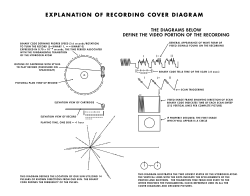
Because NASA could not assume an alien civilization would know how to use a record player, the cover provides detailed instructions in binary notation. The cover explains that the record should be played from the outside in, with one rotation taking 3.6 seconds—a unit based on the radiation of a hydrogen atom (the most abundant element in the universe).
The Pulsar Map and Hydrogen Scale
To help extraterrestrials locate Earth, the cover features a pulsar map. This diagram shows the Solar System's position relative to 14 pulsars with known precise periods. Additionally, a drawing of the hydrogen atom in its two lowest states provides the fundamental time scale used for the record's playback and image decoding.
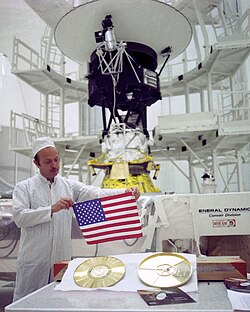
Image Reconstruction
Images are reconstructed from signals similar to analog television, but using vertical lines instead of horizontal ones. To ensure the correct aspect ratio, a circle was included in the first image. Color images were created by sequencing three separate images for red, green, and blue components, with a spectrum of the Sun used for calibration.
Manufacturing and Technical Specifications
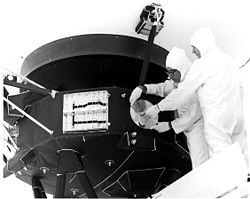
The records were manufactured at the James G. Lee Record Processing center in Gardena, California. The disks are made of copper, plated with nickel and gold for durability. The aluminum cover is electroplated with uranium-238, an isotope with a half-life of 4.468 billion years, allowing any civilization with mass spectrometry capabilities to determine when the record was created.
| Feature | Specification |
|---|---|
| Material | Gold-plated copper disk |
| Diameter | 12 inches (30 cm) |
| Playback Speed | 16 + 2/3 RPM |
| Image Resolution | 512 vertical lines per image |
| Dating Isotope | Uranium-238 |
The Interstellar Journey
Voyager 1 passed the orbit of Pluto in 1990 and crossed the termination shock—where the solar wind slows abruptly due to interstellar gas pressure—in November 2004. By September 12, 2013, NASA confirmed that Voyager 1 had officially entered interstellar space.
The probes continue to drift through the cosmos. In approximately 40,000 years, Voyager 1 is expected to pass within 1.6 to 1.8 light-years of the star Gliese 445 in the constellation Camelopardalis. Voyager 2 will similarly approach the star Ross 248 in the constellation Andromeda.
Frequently Asked Questions
What is the purpose of the Voyager Golden Record?
It is intended as a time capsule to communicate the story of humanity, our world, and our culture to any extraterrestrial intelligence that might find the spacecraft.
How would an alien civilization know how to play the record?
The record's cover contains binary instructions and diagrams showing the stylus position, the rotation speed based on the hydrogen atom's transition, and how to decode the image signals.
How can the age of the record be determined?
The cover is plated with uranium-238. Because this isotope has a known half-life of 4.468 billion years, a civilization could use mass spectrometry to calculate how much time has passed since the record was manufactured.
Is the music on the record available to the public?
Yes. NASA uploaded the audio contents to SoundCloud in 2015, and Ozma Records released a Grammy-winning 40th-anniversary vinyl box set in 2018.
Where are the Voyager probes now?
Both probes have entered interstellar space. Voyager 1 is the farthest human-made object from Earth, currently traveling through the region beyond the Sun's heliosheath.