Vicuña: The Rare Andean Camelid and Its Precious Wool
High in the alpine reaches of the Andes Mountains lives the vicuña (Lama vicugna), a graceful wild camelid renowned for producing some of the finest and most expensive wool in the world. A relative of the llama and the wild ancestor of the domesticated alpaca, the vicuña is more than just a biological marvel; it is a cultural icon, serving as the national animal of Peru and appearing on the Peruvian coat of arms.
Historically, the vicuña was so highly prized that the Inca Empire decreed only royalty could wear garments made from its fleece. Today, the species stands as a testament to successful international conservation efforts, having rebounded from the brink of extinction to thrive once again in its high-altitude habitat.
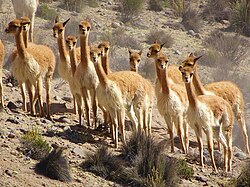
Key Facts
- Conservation Status: Least Concern (IUCN), though some populations remain threatened.
- Habitat: High alpine areas of the central Andes (3,200 to 4,800 meters).
- Wool Quality: Extremely fine fibers (12 μm diameter), prized for warmth and softness.
- Population Recovery: Grew from approximately 6,000 in 1974 to about 350,000 today.
- Diet: Primarily nutrient-poor, tough bunch grasses and Festuca.
Physical Characteristics and Biology
The vicuña is smaller and more delicate than its relative, the guanaco. It typically weighs between 35 and 65 kg and stands 75 to 85 cm at the shoulder, with a total head-and-body length of 1.45 to 1.60 meters. Its most striking feature is its long, woolly coat, which is tawny brown on the back and long white hair on the throat and chest.
This thick coat is a vital adaptation for survival. In the thin atmosphere of the Andes, daytime temperatures can be warm, but nights often drop to freezing. The wool traps layers of warm air close to the body, providing essential insulation. Morphologically, vicuñas are distinguished from guanacos by their shorter heads, longer ears, and less developed incisor roots.
Distribution and Habitat
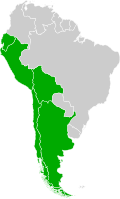
Modern vicuñas are primarily found in Peru, Bolivia, northwestern Argentina, and northern Chile, with a smaller introduced population in central Ecuador. While they are currently restricted to the central Andes, fossil evidence suggests they once ranged as far south as Uruguay and the Straits of Magellan during the Late Pleistocene and Early Holocene.
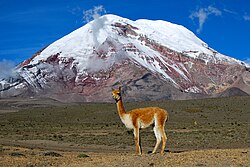
These animals are specialized for life at altitudes between 3,200 and 4,800 meters (10,500–15,700 ft). They spend their days grazing on grassy plains and retreat to the mountain slopes at night. Their primary natural predators include pumas, culpeos (Andean foxes), and domestic dogs.
Behavior and Social Structure
Vicuñas are timid animals with an extraordinary sense of hearing, making them highly alert to intruders. They are known for their cleanliness, consistently depositing excrement in the same designated areas. To supplement their diet of low grasses, they frequently lick salt water or calcareous rocks to obtain necessary minerals.
Their social structure is based on family groups consisting of one dominant male, 5 to 15 females, and their offspring. These groups maintain territories of approximately 18 km², which may shift based on food availability. Mating typically occurs between March and April, followed by an 11-month gestation period that results in a single fawn.
Conservation and Recovery
The history of the vicuña is a dramatic arc of decline and recovery. Unrestricted hunting led to a population crash, leaving only about 6,000 animals by the 1960s. This prompted the species to be declared endangered in 1974, which effectively banned the trade of its wool.
Recovery was driven by international cooperation. The 1969 Convention for the Conservation of the Vicuña (signed by Bolivia and Peru) and the subsequent 1979 Convention (including Chile, Ecuador, and later Argentina) established reserves and breeding centers. These efforts, combined with CITES (Convention on International Trade in Endangered Species) regulations, allowed populations to surge.
In Peru, the community of Lucanas continues the tradition of the chaccu—a ritualized process of herding, capturing, and shearing the animals—to harvest wool sustainably. While the IUCN downgraded the species to "Least Concern" in 2018, conservationists warn that poaching and habitat loss remain persistent threats.
The Value of Vicuña Wool
Vicuña wool is among the most expensive fibers in the world, often selling for over $300 per kg. Its extreme warmth and softness are due to hollow, air-filled fibers with tiny scales that interlock to trap heat. With a diameter of 12 μm, it is finer than cashmere (14–19 μm) and comparable to the rare shahtoosh of the Tibetan antelope.
| Fiber Source | Average Diameter (μm) |
|---|---|
| Vicuña | 12 |
| Cashmere Goat | 14 – 19 |
| Angora Rabbit | 8 – 12 |
| Shahtoosh (Tibetan Antelope) | 9 – 12 |
Frequently Asked Questions
What is the difference between a vicuña and an alpaca?
The vicuña is a wild species and is believed to be the ancestor of the domesticated alpaca. Vicuñas are generally smaller, more gracile, and produce a finer, more expensive wool than alpacas.
Why is vicuña wool so expensive?
The cost is driven by the rarity of the animal and the difficulty of harvest. Vicuñas must be caught in the wild and can only be shorn once every three years, resulting in a very small amount of extremely high-quality fiber.
Is the vicuña still endangered?
While the IUCN reclassified the species as "Least Concern" in 2018 due to population recovery, some specific populations (such as those in Ecuador) are still listed as endangered by other agencies, and poaching remains a threat.
How do vicuñas survive freezing Andean nights?
They possess a unique adaptation in the form of a thick, soft coat with hollow fibers that trap layers of warm air close to the skin, insulating them against sub-zero temperatures.
What is a chaccu?
A chaccu is a traditional Andean method of herding, capturing, and shearing vicuñas. It is performed in a sustainable manner to harvest wool without harming the wild population.