Norfolk Parakeet
The Norfolk parakeet (Cyanoramphus cookii), also known as the Tasman parakeet or Norfolk Island green parrot, is a rare species of parrot belonging to the family Psittaculidae. This striking bird is endemic to Norfolk Island, a remote location in the Tasman Sea situated between Australia, New Zealand, and New Caledonia.
Once a common sight across its home island, this species has faced a tumultuous history of decline and recovery, making it a focal point for avian conservation efforts in the region.
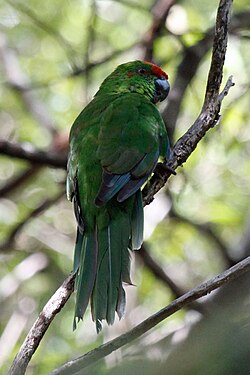
Key Facts
- Scientific Name: Cyanoramphus cookii
- Status: Listed under CITES Appendix I
- Habitat: Endemic to Norfolk Island, primarily native rain forests
- Diet: Primarily seed-based, focusing on five key plant species
- Conservation History: Population dropped to under 50 birds by the late 1970s
Taxonomy and Classification
The Norfolk parakeet was first described in 1859 by George Robert Gray as Platycercus Cookii. The species name honors James Cook, who encountered the birds upon landing on Norfolk Island in 1774 and noted their similarity to parakeets found in New Zealand.
Evolutionary History
For many years, scientists considered the Norfolk parakeet a subspecies of the red-fronted parakeet from New Zealand. However, ornithologists Alfred North and Graeme Phipps observed that the Norfolk variety was significantly larger. In 2001, DNA analysis revealed that C. cookii is an early offshoot of the Cyanoramphus genus, with only the Chatham and New Caledonian parakeets being more divergent.
Naming Controversies
While the International Ornithologists' Union (IOC) recognizes "Norfolk parakeet" as the official name, some researchers, such as Les Christidis and Walter Boles, prefer the name "Tasman parakeet." They argue that this species and the Lord Howe red-crowned parakeet may actually be a single species based on biogeographical evidence, though this "lumping" remains tentative as the latter was not included in the primary DNA phylogenetic reconstruction.
Distribution and Habitat
The Norfolk parakeet is found exclusively on Norfolk Island. While it originally inhabited the entire island, its range contracted severely over time. By 1908, the population was restricted to the forests surrounding Mount Pitt in the northwestern corner of the island.
Its primary habitat is the native rain forest, though the birds frequently venture into nearby orchards and plantations to forage.
Diet and Foraging
Seeds constitute more than half of the Norfolk parakeet's diet, a dependency that becomes even more pronounced during the winter months. Approximately 85% of its diet is derived from just five plant species:
- Norfolk pine (Araucaria heterophylla)
- Niau palm (Rhopalostylis baueri)
- Ake ake (Dodonaea viscosa)
- African olive (Olea europaea subsp. cuspidata) — introduced
- Cherry guava (Psidium cattleyanum) — introduced
Threats and Conservation Efforts
The population of the Norfolk parakeet plummeted to fewer than 50 individuals by the late 1970s. This decline was driven by several intersecting factors:
- Habitat Loss: The disappearance of large, old trees provided fewer hollows for breeding.
- Predation: Invasive rats and cats preyed upon eggs and young birds.
- Human Impact: Early settlers shot the birds.
- Competition: Introduced common starlings and crimson rosellas competed for limited nesting sites.
Conservation efforts began with a captive breeding program in 1983. While the breeding program itself was not successful, it raised significant public awareness. Between 1987 and 2000, more effective strategies were implemented, including the trapping of cats and rats and the installation of rat-proof nesting boxes. These efforts led to approximately 250 young birds fledging.
Despite these gains, the population remains fragile. A 2009 census estimated the population at 240 birds, and concerns regarding a renewed decline were raised between 2009 and 2012. Currently, the species is primarily found within the Norfolk Island National Park and its immediate surroundings.
Summary Table
| Category | Details |
|---|---|
| Scientific Classification | Genus: Cyanoramphus; Family: Psittaculidae |
| Endemic Range | Norfolk Island (Tasman Sea) |
| Primary Habitat | Native rain forest |
| Key Diet Components | Norfolk pine, Niau palm, Ake ake, African olive, Cherry guava |
| Major Threats | Invasive predators (rats/cats), habitat loss, competition |
| Conservation Status | CITES Appendix I |
Frequently Asked Questions
Where is the Norfolk parakeet found?
The Norfolk parakeet is endemic to Norfolk Island, located in the Tasman Sea between Australia, New Zealand, and New Caledonia. It is currently found mainly in and around the Norfolk Island National Park.
What do Norfolk parakeets eat?
Their diet consists mostly of seeds, especially in winter. Five species make up 85% of their food intake, including the Norfolk pine, niau palm, ake ake, and introduced species like the African olive and cherry guava.
Why did the population of these parrots decline?
The decline was caused by a combination of habitat loss (specifically the loss of nesting hollows in old trees), predation by invasive rats and cats, shooting by early settlers, and competition for nests from introduced starlings and crimson rosellas.
Is the Norfolk parakeet the same as the red-fronted parakeet?
While long considered a subspecies of the New Zealand red-fronted parakeet, DNA analysis in 2001 and observations of its larger size have led scientists to classify it as a distinct species, Cyanoramphus cookii.
How have conservationists helped the species recover?
Recovery efforts have included intensive trapping of invasive rats and cats, as well as the construction of specialized nesting boxes designed to protect the birds and their young from predators.