Venetian Windows: History, Design, and Architectural Influence
The Venetian window is a timeless architectural element characterized by its elegant symmetry and classical proportions. Often associated with the grandeur of Italian Renaissance villas and later adopted by neoclassical movements worldwide, this specific window configuration blends structural stability with aesthetic grace.
The Anatomy of a Venetian Window
At its core, a Venetian window features a central arched light that is symmetrically flanked by two shorter, rectangular sidelights. The structural framing is precise: each sidelight is bordered by two columns or pilasters (shallow, rectangular decorative columns attached to a wall). These are topped by a small entablature—a horizontal superstructure of moldings and cornices—which serves as the impost supporting the semicircular arch of the central opening.
While the standard design is rigid, some architects introduced variations. For instance, in the library at Venice, the architect Sansovino modified the design by replacing the two inner pilasters with full columns.
Origins and Evolution
Although frequently called a Palladian or Venetian window, neither term fully captures its origin. The motif was first utilized by Donato Bramante and was later documented by Serlio in his influential seven-volume work, Tutte l'opere d'architettura et prospetiva. Serlio's writings expounded upon the ideals of Vitruvius and Roman architecture, noting that the arrangement of an arched window flanked by two lower rectangular openings was originally inspired by the triumphal arches of ancient Rome.
Because of Serlio's role in documenting the style, the feature is also known as a Serlian window.
The Influence of Andrea Palladio
The window is most strongly associated with Andrea Palladio, who used the motif extensively throughout the Veneto region. His most notable application can be seen in the arcades of the Basilica Palladiana in Vicenza, as well as the entrance to Villa Forni Cerato. This widespread use in the Veneto region is likely why the term "Venetian window" became a common descriptor.
The enduring nature of this design ensured its survival long after the Renaissance, becoming a staple of later architectural styles derived from Palladianism.
Arrival in Britain
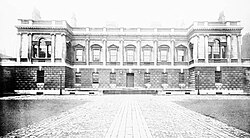
The Venetian window eventually made its way to British shores. According to architectural historian James Lees-Milne, the first appearance of the element in Britain occurred in the remodeled wings of Burlington House in London. Interestingly, the design for Burlington House was not drawn directly from Palladio, but was instead influenced by Inigo Jones's designs for Whitehall Palace.
Other early examples include the south front of Wilton House in Wiltshire, where Isaac de Caus designed a Venetian window with blind sides circa 1647.
![A Venetian window, with blind sides, designed by Isaac de Caus (d.1648)[3] circa 1647, south front of Wilton House, Wiltshire, England](/images/3f/9d/3f9de1576ff4c7f3cc26c824fbff9efe93d26ad4951f209032b841710e44e9bc.jpg)
Key Facts
- Structure: A central arched light flanked by two shorter rectangular sidelights.
- Origins: Derived from ancient Roman triumphal arches; first used by Donato Bramante.
- Alternative Name: Also referred to as a Serlian window.
- Key Proponent: Andrea Palladio popularized the style in the Basilica Palladiana.
- British Debut: First appeared at Burlington House, influenced by Inigo Jones.
| Term/Name | Association | Significance |
|---|---|---|
| Serlian Window | Serlio | Named after the author who documented the motif in his seven-volume work. |
| Palladian Window | Andrea Palladio | Named for his extensive use of the motif in the Veneto region. |
| Venetian Window | Venice/Veneto | A regional descriptor based on the prevalence of the style in Northern Italy. |
| Triumphal Arch | Ancient Rome | The original architectural source of the arched-and-rectangular motif. |
Frequently Asked Questions
What is the difference between a Venetian and a Serlian window?
There is no functional difference; they are two names for the same architectural motif. "Serlian" refers to the writer Serlio who documented the style, while "Venetian" refers to the region where Andrea Palladio popularized it.
Who first used the Venetian window design?
The motif was first used by Donato Bramante, though its conceptual roots trace back to the triumphal arches of ancient Rome.
What are the structural components of a Venetian window?
It consists of a central semicircular arched light and two smaller rectangular sidelights. The sidelights are framed by columns or pilasters and topped by entablatures that support the central arch.
How did the Venetian window arrive in British architecture?
It first appeared in the remodeled wings of Burlington House in London. This specific implementation was based on designs by Inigo Jones for Whitehall Palace rather than directly from Palladio's work.
Where can the most famous examples of this window be found?
Prominent examples include the Basilica Palladiana in Vicenza, Villa Forni Cerato, Burlington House in London, and Wilton House in Wiltshire.