Vehicle-Borne Improvised Explosive Devices (VBIED)
A Vehicle-Borne Improvised Explosive Device (VBIED)—commonly referred to as a car, bus, van, or truck bomb—is an improvised explosive designed to be detonated within a vehicle. These devices serve as their own delivery mechanisms, allowing perpetrators to transport large quantities of explosives without attracting suspicion.
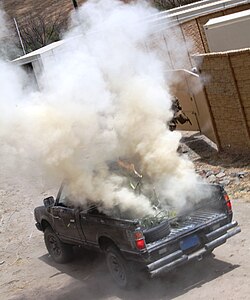
VBIEDs are primarily utilized in terrorism and guerrilla warfare to inflict mass casualties or destroy critical infrastructure. The effectiveness of these weapons is often enhanced by the vehicle's fuel tank, as the gasoline can ignite and disperse, increasing the overall power of the blast.
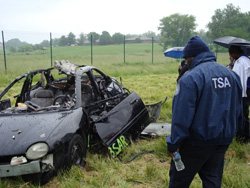
Key Facts
- VBIED stands for Vehicle-Borne Improvised Explosive Device.
- Devices can be used for targeted assassinations (killing occupants) or mass destruction (targeting external buildings and people).
- Detonation methods include remote triggers, timers, fuses, or triggers linked to vehicle operations like opening doors or pressing pedals.
- Payloads can vary wildly, from small car bombs to massive truck bombs exceeding 60,000 lbs of explosives.
- The tactic evolved from earlier "animal bombs" using horses and donkeys.
Categories and Operation
Car bombs are generally divided into two functional categories based on their intended target:
- Internal Targets: Designed to kill the occupants of the vehicle, frequently used in targeted assassinations.
- External Targets: Designed to kill, injure, or damage people and structures outside the vehicle. These may be parked bombs, where the vehicle hides the device and allows the bomber to escape, or suicide bombs, where the driver delivers the payload directly to the target.
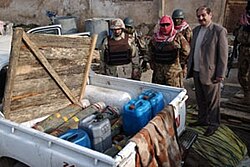
Detonation Mechanisms
The activation of a VBIED can be achieved through various means, depending on the goal of the attack. Common methods include:
- Remote detonation via radio or cellular signals.
- Timing devices or lit fuses.
- Booby traps triggered by opening doors, starting the engine, or depressing the brake and accelerator pedals.
Historical Evolution
Before the advent of the automobile, explosives were delivered via animal-drawn transport. In 1800, an unsuccessful attempt to kill Napoleon involved a "machine infernale" planted in a horse cart. In 1920, Mario Buda used an improvised wagon in the Wall Street bombing, which is viewed as a prototype for the modern car bomb.
In the 1930s, the Zionist militant group Irgun utilized both cars and donkeys in attacks on the Haifa vegetable market. While the Irgun and the Lehi splinter group are seen as key developers of the tactic, the first car bombing fully conceptualized as a weapon of urban warfare occurred on January 12, 1947, when Lehi bombed the Haifa police station.
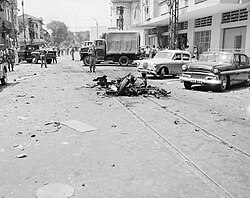
Global Usage and Notable Incidents
The Americas
In the United States, the 1995 Oklahoma City bombing remains one of the most devastating VBIED attacks. Timothy McVeigh used a Ryder box truck filled with ANFO (ammonium nitrate fertilizer and fuel oil), killing 168 people.
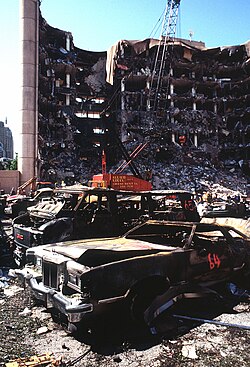
Other notable American incidents include the 1993 World Trade Center bombing, where Ramzi Yousef detonated a Ryder van in a parking garage, and the activities of the Lucchese crime family and Cleveland mobster Danny Greene, who used car bombs in gang warfare during the 1970s and 80s. In Colombia, drug lord Pablo Escobar used vehicle bombs extensively, most notably in the 1989 DAS Building bombing.
West Asia and the Middle East
The Lebanese Civil War saw an estimated 3,641 car bombs, including the 1983 Beirut barracks bombing that killed 241 U.S. and 58 French peacekeepers. In Iraq, the insurgency between 2003 and 2006 saw approximately 578 car bombs detonated.
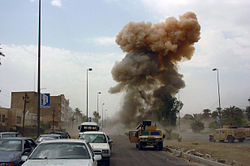
Modern conflicts have seen the evolution of the VBIED into armored versions. In the Russia-Ukraine conflict, both sides have reported the use of converted heavy machinery; Ukraine's 128th Mountain Assault Brigade converted a T-62 tank into a VBIED with 1.5 tons of explosives, while the Russian Army attempted to use an MT-LB vehicle filled with aerial bombs.
Europe and Other Regions
The IRA and Loyalist organizations used car bombs frequently during "The Troubles" in Northern Ireland and England. In Spain, the Basque separatist group ETA carried out at least 80 massive car bomb attacks before 2011. In 2011, Anders Behring Breivik used a car bomb in Oslo, Norway, killing eight people.
Summary of Notable VBIED Incidents
| Year | Location | Perpetrator/Group | Key Detail |
|---|---|---|---|
| 1920 | New York, USA | Mario Buda | Wall Street bombing (prototype VBIED) |
| 1983 | Beirut, Lebanon | Unconfirmed | Beirut barracks bombing; 299 peacekeepers killed |
| 1989 | Colombia | Pablo Escobar | DAS Building bombing; 63 killed |
| 1993 | New York, USA | Ramzi Yousef | World Trade Center parking garage blast |
| 1995 | Oklahoma City, USA | Timothy McVeigh | ANFO truck bomb; 168 killed |
| 2002 | Bali, Indonesia | Jemaah Islamiyah | Bali bombings; 202 killed |
| 2011 | Oslo, Norway | Anders Behring Breivik | Government quarter bombing; 8 killed |
| 2013 | Afghanistan | Haqqanis | Largest truck bomb ever built (61,500 lbs); defused |
Frequently Asked Questions
What is the difference between a car bomb and a VBIED?
There is no functional difference; "car bomb" is the common term, while "Vehicle-Borne Improvised Explosive Device" (VBIED) is the technical term used by security and military professionals.
How are VBIEDs typically detonated?
They can be detonated via remote control, timers, or manual fuses. Some are booby-trapped to explode when a door is opened, the engine starts, or the brakes/accelerator are pressed.
What makes a truck bomb more dangerous than a car bomb?
Larger vehicles can carry significantly more explosives. For example, while a car bomb might carry a few hundred pounds, truck bombs can carry thousands; one intercepted Haqqani bomb in Afghanistan contained 61,500 lbs of explosives.
Can the vehicle's own fuel increase the blast?
Yes, the gasoline or diesel in the fuel tank can ignite during the primary explosion, dispersing flammable liquid and increasing the intensity and reach of the fire and blast.
Who first developed the concept of the car bomb?
While animal-drawn bombs existed earlier, Mario Buda's 1920 Wall Street bombing is considered a prototype. Later, Zionist groups like the Irgun and Lehi are credited with developing the tactic into a conceptual weapon of urban warfare in the 1930s and 40s.