Che GuevaraCuban RevolutionErnesto GuevaraFidel Castroguerrilla warfare

Che Guevara: The Life and Legacy of a Revolutionary Icon

Che Guevara: The Life and Legacy of a Revolutionary Icon Ernesto "Che" Guevara remains one of the most recognizable figures of the 20th century. A physician by training and a guerrilla le...

Che Guevara: The Life and Legacy of a Revolutionary Icon

Ernesto "Che" Guevara remains one of the most recognizable figures of the 20th century. A physician by training and a guerrilla leader by conviction, Guevara transitioned from a wandering youth in Latin America to a central architect of the Cuban Revolution and a global symbol of rebellion. His life was defined by a relentless pursuit of socialist ideals and the belief in Guevarism—his specific adaptation of guerrilla warfare and revolutionary theory.
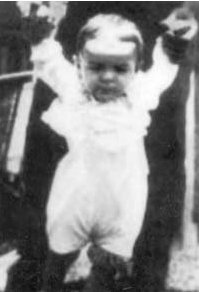
Baby Ernesto
Baby Ernesto

Early Life and Intellectual Awakening

Born on May 14, 1928, in Rosario, Argentina, Ernesto Guevara de la Serna grew up in a household that fostered intellectual curiosity. He pursued medical studies at the University of Buenos Aires, but his interests extended far beyond clinical practice. He developed a deep passion for literature and political philosophy, which began to shape his worldview during his formative years.
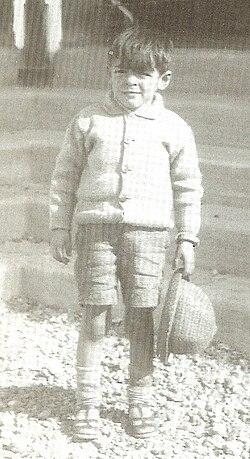
Ernesto aged 5 in 1933

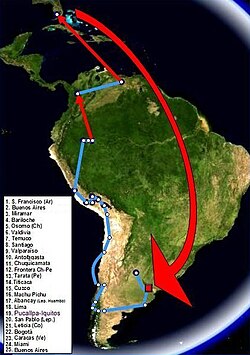
A pivotal moment in his development occurred in 1952 during a motorcycle journey across South America with Alberto Granado. This trip exposed him to the extreme poverty and social injustice prevalent in the region, transforming his perspective on the systemic failures of capitalism and the necessity of social change.
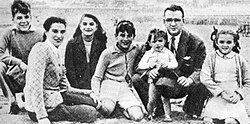
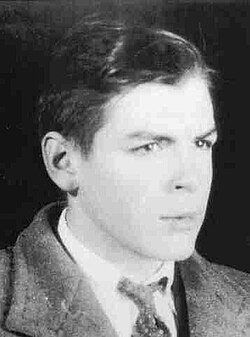
Teenage Ernesto (left) with his parents and siblings, c. 1944. Left to right: Celia (mother), Celia (sister), Roberto, Juan Martín, Ernesto (father) and Ana María

Guevara around 1945
Guevara around 1945

A map of Guevara's 1952 trip with Alberto Granado. Red arrows correspond to air travel.

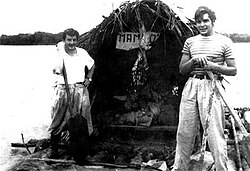
black and white photograph of two men on a raft, fitted with a large hut. The far bank of the river is visible in the far distance
Guevara (right) with Alberto Granado (left) in June 1952 on the Amazon River aboard their "Mambo-Tango" wooden raft, which was a gift from the lepers whom they had treated[46]

The Path to Revolution

Guevara's political activism intensified in Guatemala, where he witnessed the overthrow of a democratically elected government. This experience convinced him that armed struggle was the only viable path to liberation in Latin America. After a period of exile in Mexico, he met Fidel Castro and joined the 26th of July Movement (M-26-7), a revolutionary group dedicated to overthrowing the Cuban government.
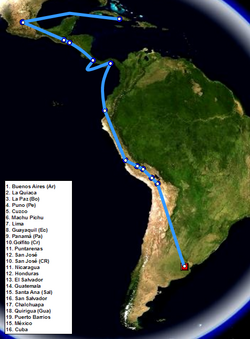
A map of Che Guevara's travels between 1953 and 1956, including his journey aboard the Granma

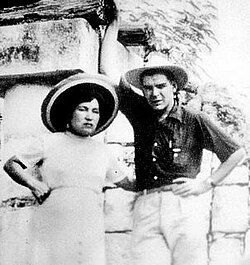
Guevara with his first wife Hilda Gadea at Chichen Itza during their honeymoon trip

In 1956, Guevara sailed from Mexico to Cuba aboard the yacht Granma. Despite a perilous journey and initial setbacks, he rose quickly through the ranks to become a Comandante. He played a critical role in the guerrilla campaign in the Sierra Maestra mountains and led the decisive Battle of Santa Clara in December 1958, which paved the way for the victory of the revolution on January 1, 1959.
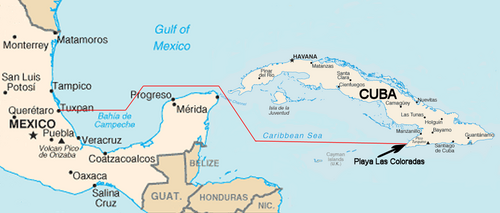
Journey of the yacht "Granma", from Mexico to Cuba

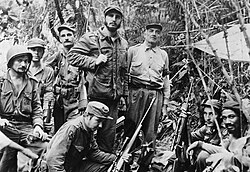
Granma survivors in the Sierra Maestra. Fidel Castro stands at center. Che Guevara stands second from left.

Guevara at his guerrilla base in the Escambray Mountains

After the Battle of Santa Clara, 1 January 1959

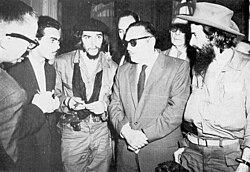
(Right to left) rebel leader Camilo Cienfuegos, Cuban President Manuel Urrutia Lleó, and Guevara (January 1959)

Political Career in Cuba

Following the revolution, Guevara held several high-ranking positions in the new government. He served as the President of the National Bank of Cuba from 1959 to 1961 and later as the Minister of Industries from 1961 to 1965. During this time, he focused on economic reforms and the concept of the "New Man," arguing that socialist society required a shift in human consciousness away from material incentives toward moral motivation.
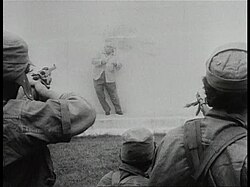
Televised execution of Colonel Rojas, ordered by Che Guevara. (7 January 1959).

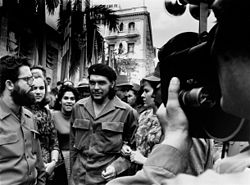
Guevara in 1960, walking through the streets of Havana with his second wife Aleida March (right)

His tenure was marked by both administrative rigor and controversy, including his oversight of revolutionary tribunals. He also represented Cuba on the international stage, traveling to the United Nations and visiting various nations to build diplomatic ties with other socialist and non-aligned states.
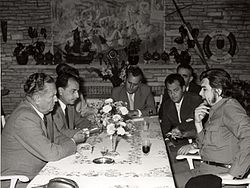
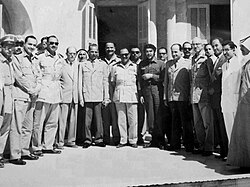
Che Guevara meeting Josip Broz Tito, during Guevara's 1959 diplomatic travels.

Che Guevara visiting Gaza during his diplomatic tour. (1959)

Guevara meeting with French existentialist philosophers Jean-Paul Sartre and Simone de Beauvoir at his office in Havana, March 1960. Sartre later wrote that Che was "the most complete human being of our time". In addition to Spanish, Guevara was fluent in French.[167]

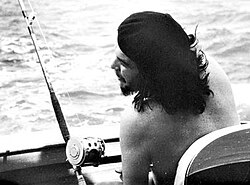
Guevara fishing off the coast of Havana, on 15 May 1960. Along with Castro, Guevara competed with expatriate author Ernest Hemingway at what was known as the "Hemingway Fishing Contest".

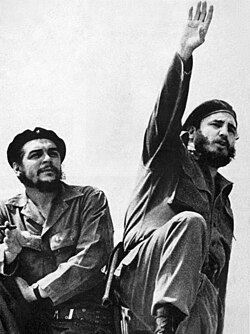
Guevara (left) and Fidel Castro, photographed by Alberto Korda in 1961

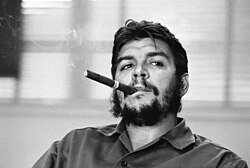
Che Guevara in his office as Minister of Industry (in the Hotel Riviera), while being interviewed by Laura Berquist for Look magazine. (1963)

Internationalism and Final Campaigns

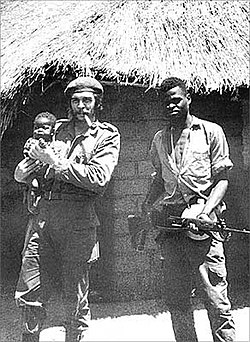
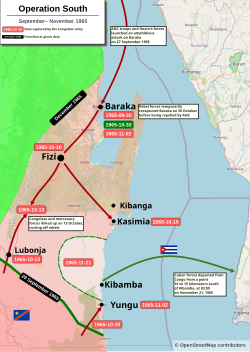
Driven by a belief in global revolution, Guevara eventually left his government posts to export the Cuban model of insurgency. He first traveled to the Congo in 1965 to support the Simba rebellion during the Congo Crisis. However, the mission faced significant challenges and ultimately failed, forcing his return to Cuba.
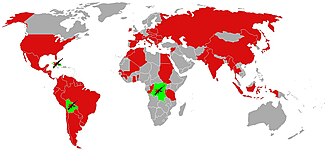
Countries Che Guevara: visited participated in armed revolution

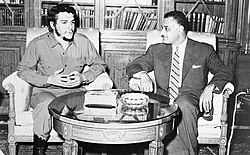
Meeting Egyptian President Gamal Abdel Nasser in Cairo, 1964

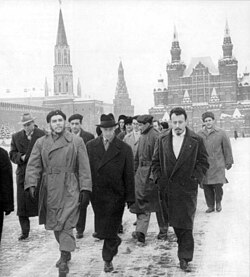
Walking through Red Square in Moscow, November 1964

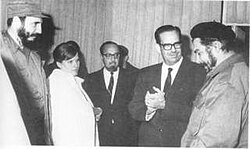
Guevara returning to Cuba at Rancho Boyeros airport on 14 March 1965. He is received by (left to right) Fidel Castro, Aleida March, Carlos Rafael Rodriguez, and Osvaldo Dorticos.

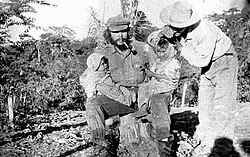
37-year-old Guevara, holding a Congolese baby and standing with a fellow Afro-Cuban soldier in the Congo Crisis, 1965

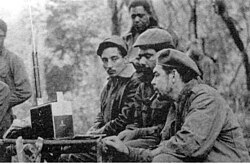
Listening to a Zenith Trans-Oceanic shortwave radio receiver are (seated from the left) Rogelio Oliva, José María Martínez Tamayo (known as "Mbili" in the Congo and "Ricardo" in Bolivia), and Guevara. Standing behind them is Roberto Sánchez ("Lawton" in Cuba and "Changa" in the Congo), 1965.

Map of the Operation South which forced Che Guevara to flee Congo

In 1966, Guevara embarked on his final mission in Bolivia, attempting to ignite a peasant-led revolution. Operating under a false identity, he led the Ñancahuazú Guerrilla. However, lacking sufficient local support and facing pressure from the Bolivian army and the CIA, his forces were depleted.
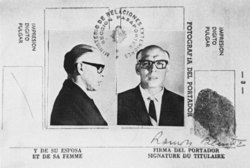
Guevara's 1966 passport featuring him in disguise with a false name

Guevara in rural Bolivia, shortly before his death (1967)

Guevara was captured in October 1967 and executed by firing squad on October 9, 1967, in La Higuera, Bolivia. He was 39 years old.
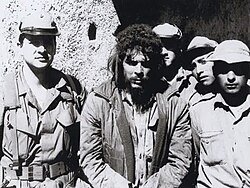
Guevara shortly before his execution, with CIA officer Félix Rodríguez (left)

The day after his execution on 10 October 1967, Guevara's corpse was displayed to the news media in the laundry house of the Vallegrande hospital (photo by Freddy Alborta [es]). Face Side angle Shoes

Key Facts

  • Full Name: Ernesto Guevara de la Serna.
  • Professional Background: Trained as a physician at the University of Buenos Aires.
  • Military Rank: Comandante in the Cuban Revolutionary Armed Forces.
  • Key Government Roles: President of the National Bank of Cuba and Minister of Industries.
  • Major Battles: Battle of Santa Clara and the Bay of Pigs Invasion.
  • Death: Executed by shooting in Bolivia on October 9, 1967.
  • Final Resting Place: Che Guevara Mausoleum in Santa Clara, Cuba.

Summary of Life and Career

Overview of Che Guevara's Life Phases
Period Primary Role Key Location Major Achievement/Event
1928–1953 Student/Physician Argentina/South America Motorcycle Diaries journey
1954–1958 Guerrilla Leader Mexico/Cuba Victory in the Cuban Revolution
1959–1965 Government Official Cuba Minister of Industries
1965–1967 International Revolutionary Congo/Bolivia Ñancahuazú Guerrilla campaign

Legacy and Commemoration

After his death, Guevara's image became a global icon of rebellion and anti-imperialism. The photograph Guerrillero Heroico, taken by Alberto Korda in 1961, has been reproduced millions of times, evolving from a political statement into a commercial logo.
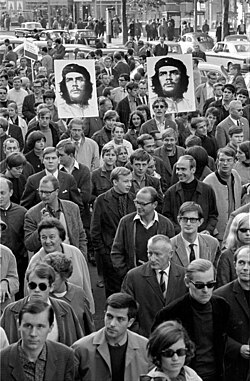
Portraits of Che Guevara at a march during the West German student movement

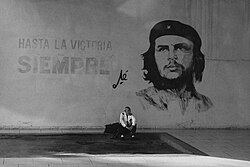
Portrait of Che Guevara, with quote, in Santa Clara, Cuba. Quote translates as: "Until victory, always".

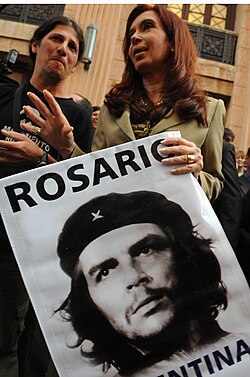
Former Argentine president Cristina Fernández de Kirchner with a poster of Che Guevara, 2009.

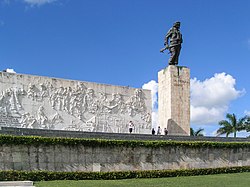
Che Guevara's Monument and Mausoleum in Santa Clara, Cuba

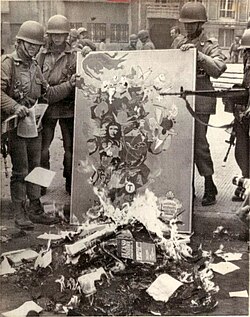
Burning of a painting containing Che's face, following the 1973 coup that installed the Pinochet regime in Chile

Author Michael Casey notes how Che's image—largely based on Alberto Korda's 1960 photograph Guerrillero Heroico—has become a logo as recognizable as the Nike Swoosh or McDonald's Golden Arches.[230]

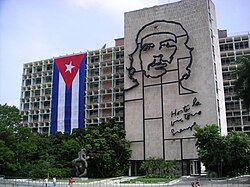
Plaza de la Revolución, in Havana, Cuba. Aside the Ministry of the Interior building where Guevara once worked is a 5-story steel outline of his face. Under the image is Guevara's motto, the Spanish phrase: "Hasta la Victoria Siempre" (English: Until Victory, always).

Frequently Asked Questions

Why was he called "Che"?

The nickname "Che" is an Argentine slang term similar to "hey" or "friend," which he used frequently, leading his Cuban comrades to call him by that name.

What was Guevara's role in the Cuban government?

He served as the President of the National Bank of Cuba and the Minister of Industries, where he attempted to implement socialist economic policies and industrialize the nation.

Where did Che Guevara die?

He was captured and executed in La Higuera, Santa Cruz, Bolivia, on October 9, 1967.

What is the "New Man" theory?

It was Guevara's belief that for socialism to succeed, individuals had to move beyond material greed and be motivated by a sense of duty and moral commitment to the collective good.

How is he remembered today?

He is viewed diversely: as a heroic symbol of liberation and sacrifice by some, and as a ruthless executioner and failed strategist by others.