Articles/Cuba: A Comprehensive Overview of History, Geography, and Culture
Republic of CubaCuban historyHavanaCuban RevolutionCaribbean geography
Cuba: A Comprehensive Overview of History, Geography, and Culture
Cuba: A Comprehensive Overview of History, Geography, and Culture The Republic of Cuba is a nation defined by its complex history, vibrant culture, and strategic location in the Caribbean...
Cuba: A Comprehensive Overview of History, Geography, and Culture
The Republic of Cuba is a nation defined by its complex history, vibrant culture, and strategic location in the Caribbean. From its colonial past under Spanish rule to the transformative Cuban Revolution, the island has undergone profound political and social shifts that continue to shape its identity in the modern era.
As a communist state, Cuba operates under a centralized government led by the First Secretary and President, Miguel Díaz-Canel. The nation's journey from a Spanish colony to an independent republic, and eventually to its current political structure, is a narrative of resilience and significant geopolitical influence.
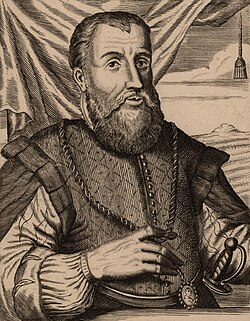
Diego Velázquez de Cuéllar, conquistador of Cuba: Diego Velázquez de Cuéllar, conquistador of Cuba
Key Facts
Since 1959, Cuba has regarded the U.S. presence in Guantánamo Bay as illegal.[24]
Capital: Havana
Official Language: Spanish
Government Type: Communist state
Motto: "Patria o Muerte, Venceremos" (Homeland or Death, We Shall Overcome!)
Currency: Cuban peso (CUP)
Total Area: 110,860 km²
Historical Evolution
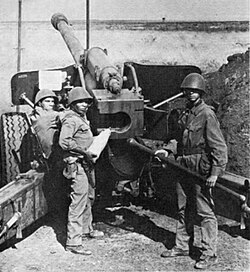
Cuban artillery crew in Ethiopia during the Ogaden War.
Cuba's history is marked by several pivotal eras, beginning with Spanish colonization in 1492. The struggle for sovereignty became a defining feature of the 19th century, leading to the Declaration of Independence on October 10, 1868.
Independence and the Early Republic
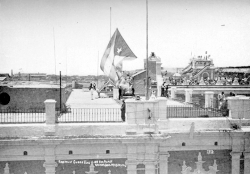
The War of Independence, which began in 1895, eventually led to Spain relinquishing sovereignty in 1898. Following a period of United States occupation, the Republic of Cuba was officially declared on May 20, 1902.
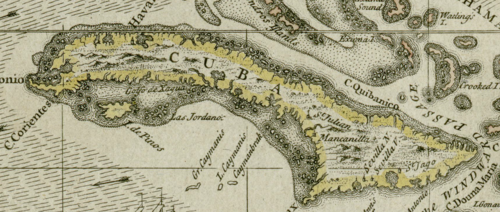
A map of Cuba c. 1680: A map of Cuba c. 1680
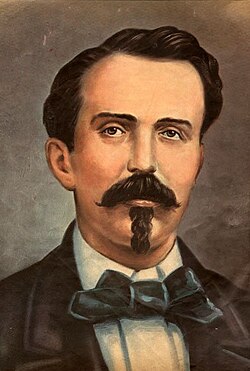
Carlos Manuel de Céspedes is known as Father of the Homeland in Cuba, having declared its independence from Spain in 1868.: Carlos Manuel de Céspedes is known as Father of the Homeland in Cuba, having declared its independence from Spain in 1868.
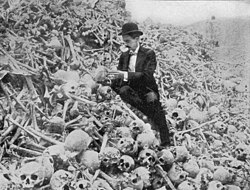
Human remains from the Cuban War of Independence after the Spanish reconcentration policy, 1898: Human remains from the Cuban War of Independence after the Spanish reconcentration policy, 1898
Raising the Cuban flag on the Governor General's palace at noon on 20 May 1902.: Raising the Cuban flag on the Governor General's palace at noon on 20 May 1902.
The Revolution and Modern Era
The mid-20th century brought radical change through the Cuban Revolution, which took place between July 26, 1953, and January 1, 1959. This period fundamentally restructured the nation's economy and political landscape, leading to the current constitution adopted on April 10, 2019.
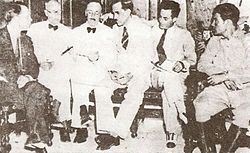
The Pentarchy of 1933. Fulgencio Batista, who controlled the armed forces, appears at far right: The Pentarchy of 1933. Fulgencio Batista, who controlled the armed forces, appears at far right
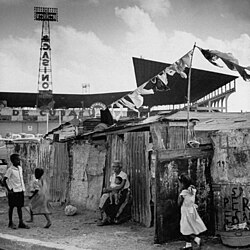
Slum (bohío) dwellings in Havana, Cuba in 1954, just outside Havana baseball stadium. In the background is advertising for a nearby casino.: Slum (bohío) dwellings in Havana, Cuba in 1954, just outside Havana baseball stadium. In the background is advertising for a nearby casino.
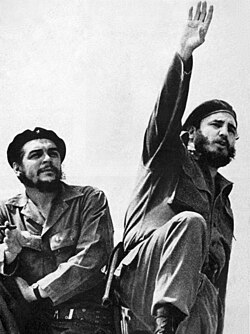
Che Guevara and Fidel Castro, photographed by Alberto Korda in 1961: Che Guevara and Fidel Castro, photographed by Alberto Korda in 1961
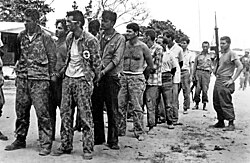
Brigade 2506 prisoners, 1961: Brigade 2506 prisoners, 1961
Geography and Climate
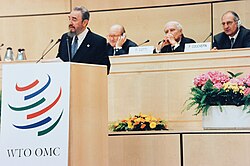
Cuban leader Fidel Castro in Geneva, Switzerland, May 1998
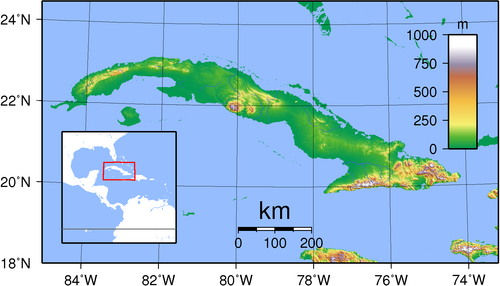
Cuba is an archipelago located in the Caribbean, characterized by diverse landscapes. The island's topography and climate play significant roles in its biodiversity and agricultural output.
Topographic map of Cuba: Topographic map of Cuba
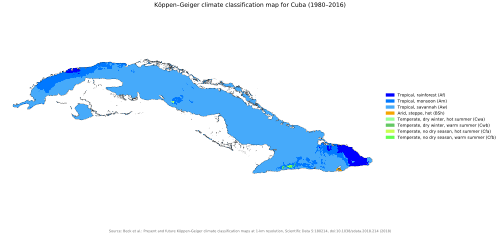
Köppen climate classification of Cuba: Köppen climate classification of Cuba
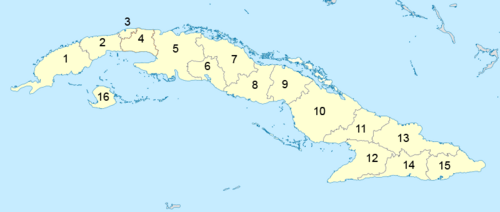
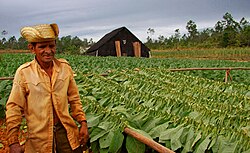
The nation is divided into several administrative provinces, including Pinar del Río, Havana, Santiago de Cuba, and Guantánamo. The climate varies across the island, influencing the types of crops grown, such as the famous tobacco in the Viñales region.
Provinces of Cuba: Provinces of Cuba
Tobacco fields in Viñales: Tobacco fields in Viñales
Demographics and Culture
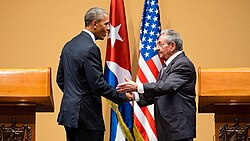
Raúl Castro and U.S. President Barack Obama at their joint press conference in Havana, Cuba, 21 March 2016
The Cuban population is ethnically diverse, with 2012 data indicating a composition of approximately 64.12% White, 26.62% Mixed/Mulatto, and 9.26% Black. This diversity is reflected in the nation's rich traditions, music, and cuisine.
Cultural Identity
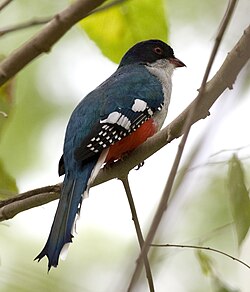
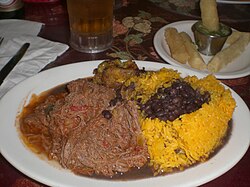
Cuban culture is celebrated globally through its music, dance, and culinary arts. Traditional dishes like ropa vieja (shredded flank steak in tomato sauce) are staples of the local diet. The national bird, the Cuban trogon, serves as a biological symbol of the island's unique natural heritage.
The Cuban trogon is the island's national bird. Its white, red and blue feathers match those of the Cuban flag.: The Cuban trogon is the island's national bird. Its white, red and blue feathers match those of the Cuban flag.
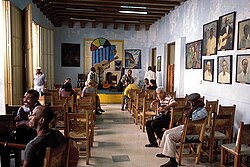
A local musical house, Casa de la Trova in Santiago de Cuba: A local musical house, Casa de la Trova in Santiago de Cuba
A traditional meal of ropa vieja (shredded flank steak in a tomato sauce base), black beans, yellow rice, plantains and fried yuca with beer: A traditional meal of ropa vieja (shredded flank steak in a tomato sauce base), black beans, yellow rice, plantains and fried yuca with beer
Urban Life and Tourism
Havana, the capital and largest city, serves as the country's economic and cultural heart. From the historic colonial architecture of Camagüey to the resort areas of Varadero, tourism is a vital component of the Cuban experience.
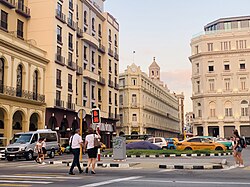
Hotel Parque Central in Havana: Hotel Parque Central in Havana
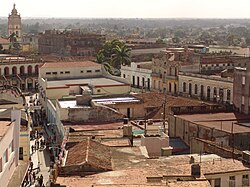
Historic Centre of Camagüey, a colonial city UNESCO World Heritage Site: Historic Centre of Camagüey, a colonial city UNESCO World Heritage Site
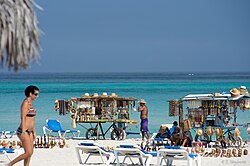
Varadero resort area: Varadero resort area
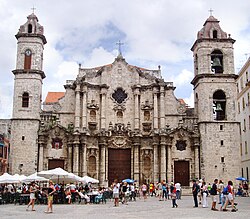
Havana Cathedral, built between 1748 and 1777: Havana Cathedral, built between 1748 and 1777
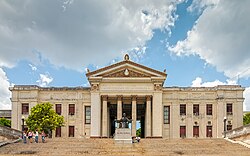
University of Havana, founded in 1728: University of Havana, founded in 1728
Economic Overview
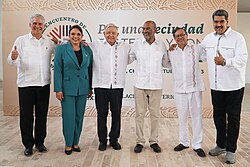
Cuban President Miguel Díaz-Canel with Venezuelan President Nicolás Maduro, Mexican President López Obrador and other leaders in Palenque, Mexico, 22 October 2023
Cuba's economy has undergone various adjustments, including recent moves toward allowing small businesses in certain sectors. While the nation faces challenges such as the long-standing U.S. embargo, it continues to manage its resources and tourism sectors to sustain its development.
Summary of Key National Indicators
Indicator
Value/Detail
Total Population (2024 Est.)
9,748,007
GDP (Nominal 2024 Est.)
$252.063 billion
GDP Per Capita (Nominal 2024 Est.)
$22,957
HDI (2023)
0.762 (High)
Official Language
Spanish
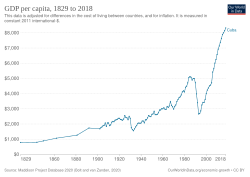
Historical GDP per capita development: Historical GDP per capita development
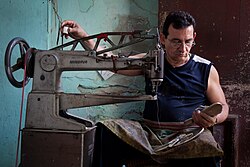
Cubans are now permitted to own small businesses in certain sectors.: Cubans are now permitted to own small businesses in certain sectors.
Frequently Asked Questions
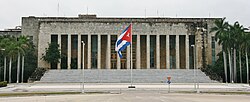
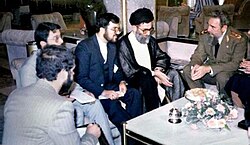
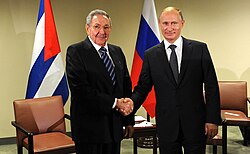
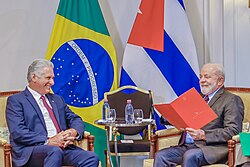
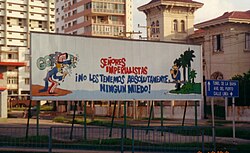
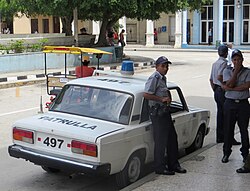
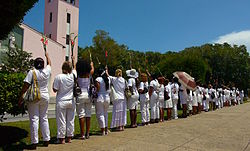
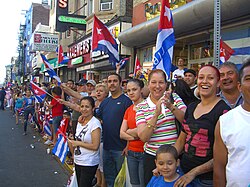
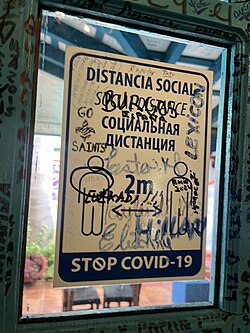
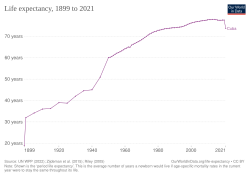
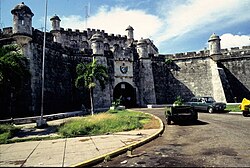
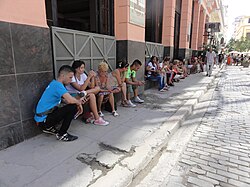
The headquarters of the Communist PartyFidel Castro and Ali Khamenei at a meeting of the Non-Aligned Movement in Zimbabwe, 3 September 1986Raúl Castro with Russian President Vladimir Putin in New York City, 28 September 2015Cuban leader Miguel Díaz-Canel with Brazilian President Luiz Inácio Lula da Silva in Paris, France, 22 June 2023Propaganda sign in front of the United States Interests Section in HavanaA Lada Riva police car in HolguínLadies in White demonstration in Havana (April 2012)North Hudson, New Jersey, is home to a large Cuban American population.A trilingual sign encouraging social distancing in Cuba during the Covid-19 pandemic, written in Spanish, English, and RussianLife expectancy development in CubaThe 18th-century entrance of the Castillo del Príncipe in Havana, photo taken in 1997Users of a public WiFi hotspot in Havana, Cuba
What is the current government of Cuba?
Cuba is a communist state. The current leadership includes President Miguel Díaz-Canel, Vice President Salvador Valdés Mesa, and Prime Minister Manuel Marrero Cruz.
What are the main ethnic groups in Cuba?
Based on 2012 data, the population is approximately 64.12% White, 26.62% Mixed/Mulatto, and 9.26% Black.
What is the official language spoken in Cuba?
The official language of Cuba is Spanish.
What is the capital of Cuba?
The capital and largest city of Cuba is Havana.
When did the Cuban Revolution occur?
The Cuban Revolution took place between July 26, 1953, and January 1, 1959.
![Since 1959, Cuba has regarded the U.S. presence in Guantánamo Bay as illegal.[24]](/images/0e/ff/0eff8661ffe26d5ef4e8b459eda341f41ae9ad3f4472a04a58819e34ac6be45d.jpg)