Vavilov Centers: Mapping the Global Origins of Agriculture
Where did the food we eat today first begin? To answer this, scientists look to Vavilov centers, or centers of origin. These are specific geographical areas where groups of organisms—whether wild or domesticated—first developed their unique, distinctive properties. The concept was pioneered by Nikolai Vavilov, who sought to understand the spatial patterns of plant evolution and diversity.
Vavilov originally posited that a species' center of origin is identical to its center of diversity—the region where it possesses its highest level of genetic variation. While later scholars have debated this direct equivalence, the concept remains a cornerstone of agricultural science. By identifying these regions, researchers can locate wild relatives and related species that carry vital new genes, such as those providing resistance to diseases.
The Importance of Protecting Plant Diversity
Locating the origins of crop plants is a fundamental task in modern plant breeding. Access to the genetic material found in these centers allows breeders to combat genetic erosion. Genetic erosion is the loss of germplasm (the genetic resources of an organism) caused by the disappearance of landraces (locally adapted traditional varieties), the loss of specific ecotypes, habitat destruction like deforestation, and increasing urbanization.
To prevent this loss, scientists utilize gene banks. These facilities preserve genetic material through seed collections and, increasingly, by storing frozen stem sections. Protecting the natural habitats within Vavilov centers is also a critical strategy for long-term agricultural security.
Key Facts
- Nikolai Vavilov first identified these centers in 1924.
- A center of origin is where a species first developed its unique traits.
- Centers of diversity are regions with the highest genetic variation for a species.
- Gene banks are essential for preserving germplasm through seeds and frozen tissue.
- Identifying these centers helps breeders find genes for disease resistance.
Major Centers of Origin and Diversity
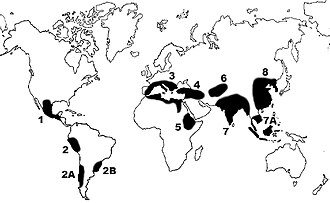
Vavilov's understanding of these regions evolved over time. Between 1924 and 1940, his list of identified centers fluctuated, eventually settling on seven primary regions. These centers are characterized by a high density of crop wild relatives—the natural, non-domesticated ancestors of our modern crops.
Regional Breakdown of Crop Centers
The following table summarizes the major centers identified by Schery (1972) and Janick (2002), highlighting the diverse plant groups found in each.
| Center | Subcenters/Regions | Key Plant Examples |
|---|---|---|
| South Mexican & Central American | Mexico, Guatemala, El Salvador, Honduras, Costa Rica | Maize, common bean, lima bean, squash, cacao, pepper |
| South American | Peruvian, Ecuadorean, Bolivian, Chiloé, Brazilian-Paraguayan | Andean potato, tomato, manioc, peanut, pineapple, cocoa |
| Mediterranean | Southern Europe, Northern Africa | Durum wheat, olive, flax, cabbage, grape, various legumes |
| Middle East | Asia Minor, Transcaucasia, Iran, Turkmenistan | Einkorn wheat, barley, lentil, fig, pomegranate, apple |
| Abyssinian | Ethiopia, Eritrea, Somalia | Coffee, teff, sorghum, pearl millet, okra, sesame |
| Central Asiatic | NW India, Afghanistan, Uzbekistan, Tajikistan | Common wheat, chickpea, pistachio, almond, grape |
| Indian | Assam, Bangladesh, Burma, Siam-Malaya-Java | Rice, mango, sugarcane, coconut, black pepper, turmeric |
| Chinese | Large independent center | Rice, soybean, millet, peach, apricot, walnut |
![Approximate centers of origin of agriculture in the Neolithic Revolution and its spread in prehistory as understood in 2003: the Fertile Crescent (11,000 BP), the Yangtze and Yellow River basins (9,000 BP) and the New Guinea Highlands (9,000–6,000 BP), Central Mexico (5,000–4,000 BP), Northern South America (5,000–4,000 BP), sub-Saharan Africa (5,000–4,000 BP, exact location unknown), eastern North America (4,000–3,000 BP).[3]](/images/fb/ce/fbcedea371c23b9724cced0b0232407ecee2b3adc9d74a886cd702223c5f2a11.webp)
Chronology of Agricultural Development
Modern archaeological and genetic research, such as the work by Purugganan and Fuller (2009), provides a timeline for when these plants were domesticated. This timeline shows that agriculture did not emerge simultaneously across the globe, but rather in distinct waves across different millennia.
Timeline of Domestication (Years Before Present)
- 13,000–10,000 BP: Near East (Wheat, barley, lentils, peas).
- 10,000 BP: Mesoamerica (Cucurbita pepo).
- 9,000–6,000 BP: Yangtze and Yellow River basins (Rice).
- 7,000 BP: New Guinea and Wallacea (Taro, banana).
- 5,000–4,000 BP: Central Mexico, Northern South America, and sub-Saharan Africa.
- 4,500–4,000 BP: Eastern North America.
Frequently Asked Questions
What is the difference between a center of origin and a center of diversity?
A center of origin is the geographic location where a species first developed its distinctive characteristics. A center of diversity is the area where that species exhibits its highest level of genetic variation. While Vavilov suggested they are the same, modern science considers this a point of debate.
Why is it important to find wild relatives of crops?
Wild relatives often contain unique genes that have been lost in domesticated crops. These genes can provide essential traits, such as resistance to new diseases, pests, or environmental stresses, which are vital for plant breeding.
What is genetic erosion?
Genetic erosion is the loss of genetic diversity within a species. This occurs when landraces and ecotypes disappear due to habitat loss, urbanization, or the replacement of diverse traditional crops with a few high-yield varieties.
How are plant genes preserved today?
Genetic resources are primarily preserved in gene banks. These institutions use seed collections and frozen stem sections to ensure that the genetic material of various plants is available for future research and breeding.
What was the Neolithic Revolution?
The Neolithic Revolution refers to the period in prehistory when humans began the transition from hunting and gathering to agriculture and the domestication of plants and animals.