The Global Journey of the Tomato: From Wild Berry to Culinary Staple
Few ingredients are as ubiquitous in modern kitchens as the tomato. From the rich sauces of Italy to the fresh salads of North America, this versatile fruit has traveled across oceans and centuries to become a cornerstone of global cuisine. However, the path from a wild, pea-sized berry in Mesoamerica to the supermarket shelves of today is a complex story of biological evolution, cultural misunderstanding, and scientific discovery.
Key Facts
- Scientific Name: Solanum lycopersicum.
- Botanical Classification: A berry (fruit), though legally classified as a vegetable in the U.S. for trade purposes.
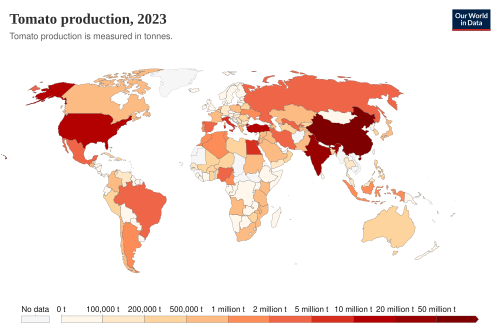
- Top Producer: China is the world's leading producer of tomatoes.
- Primary Nutrient: High in Vitamin C and the antioxidant lycopene.
- Origin: Domesticated approximately 7,000 years ago.
Origins and Domestication
The modern large-fruited tomato likely descended from the cherry tomato, known scientifically as S. lycopersicum var. cerasiforme. While it was once believed that the cherry tomato was the direct ancestor, recent genomic analysis—the study of an organism's complete set of DNA—suggests a more intricate process. Evidence indicates that var. cerasiforme may have appeared around 78,000 years ago, while the cultivated tomato we recognize today originated roughly 7,000 years ago (5,000 BCE).
The Great Migration: From the Americas to Europe
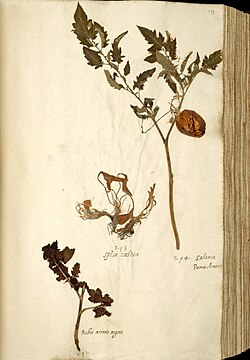
The tomato's journey to the Old World began with the Columbian exchange, the widespread transfer of plants, animals, and culture between the Americas and Afro-Eurasia following the arrival of Europeans. After the Spanish conquistador Hernán Cortés captured Tenochtitlan in 1521, tomatoes were introduced to Europe. By the 1540s, they were being grown in Mediterranean climates.
![Soon after Hernán Cortés arrived in Mexico (portrayed here) and his conquest of the Aztecs, the tomato was brought to Europe in the Columbian exchange.[15]](/images/1c/9e/1c9e29850d4af4902c723a306126b8c29f0b46600c3775a5564496c4083fb7e0.jpg)
Adoption in Italy
In Italy, tomatoes were initially viewed as ornamental plants. Early records from the 16th century describe them as pomi d'oro, or "golden apples," prized more for their beauty in gardens than for their taste. For a long time, they were avoided as food because some varieties were toxic and inedible. It wasn't until the late 17th or early 18th century that tomatoes were fully integrated into local Italian cuisine, with the first known cookbook featuring tomato recipes appearing in Naples in 1692.
Resistance in Britain
The tomato faced a harder road in England. Introduced in the 1590s, the fruit was long considered poisonous. This belief was championed by influential figures like the barber-surgeon John Gerard, whose 1597 herbal publication suggested the fruit was unfit for consumption. For years, tomatoes were referred to as "Love Apples" (pomme d'amour), a name likely resulting from a French misreading of the Italian pomo dei Mori ("the Moors' apple"). It was not until the 19th century that they became common in British vegetable markets.
The Tomato in North America
Tomatoes appeared in British North America as early as 1710 in present-day South Carolina. Thomas Jefferson furthered their cultivation by sending seeds back to America after tasting them in Paris. By the 19th century, the tomato transitioned from a garden curiosity to a commercial powerhouse.
Alexander W. Livingston played a pivotal role in this shift. Between 1870 and the late 19th century, he developed over 17 varieties, including the "Paragon" and "Acme," focusing on sweetness, uniform size, and smooth contours. These efforts laid the groundwork for the commercial cultivars used today.
Botany, Genetics, and Breeding
The classification of the tomato has seen several shifts. Carl Linnaeus first placed it in the genus Solanum in 1753. While it was later moved to the genus Lycopersicon by Philip Miller, modern botanical nomenclature—the formal system of naming plants—has largely returned it to Solanum lycopersicum.
Modern science has unlocked the secrets of the tomato's biology. An international consortium completed the sequencing of the Heinz 1706 cultivar genome in 2012. The latest reference genome identifies 12 chromosomes and encodes over 34,000 predicted proteins.
![Evolution of genetic diversity in cultivated tomatoes[70]](/images/2f/cb/2fcbdf637afd68ffe0a50d446d2e008fa8e3b0c62169e68238508447de2a6481.jpg)
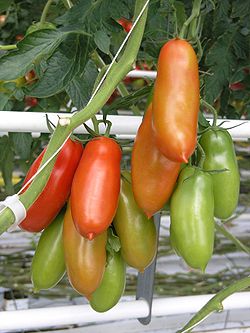
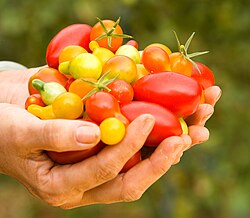
Breeding has led to a vast array of types, from the highly prized San Marzano plum tomato used for pizza to various cherry and grape varieties.
Global Production and Nutrition
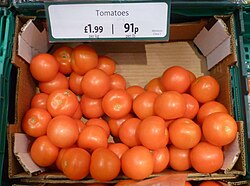
Today, tomato production is a massive global industry. China leads the world in output, followed by India, Turkey, and the United States.
Nutritionally, the tomato is composed mostly of water, but it provides essential vitamins and minerals. It is particularly noted for its lycopene content, a powerful antioxidant.
| Nutrient | Amount | % Daily Value (DV) |
|---|---|---|
| Energy | 18 kcal | - |
| Carbohydrates | 3.9 g | - |
| Protein | 0.9 g | - |
| Vitamin C | - | 16% |
| Potassium | - | 8% |
| Vitamin K | - | 7% |
| Lycopene | 2570 μg | - |
Cultural Impact and Curiosities
The tomato has inspired everything from massive botanical experiments to chaotic festivals. At the Walt Disney World Resort, an experimental greenhouse once housed a "tomato tree" that produced over 32,000 tomatoes weighing 522 kg.
![The "tomato tree" at the Walt Disney World Resort's experimental greenhouses[114]](/images/40/52/40528a7565b36afcb651e2931b8040a48f1316de9473fcbe150e085c4123f480.jpg)
In Spain, the town of Buñol hosts La Tomatina, an annual festival where thousands of people engage in a massive tomato fight. In 2007 alone, 40,000 participants threw 115,000 kg of tomatoes.
The Great Fruit vs. Vegetable Debate
One of the most enduring questions about the tomato is whether it is a fruit or a vegetable. Botanically, it is a berry—a fruit developed from the ovary of a flowering plant. However, in 1893, the U.S. Supreme Court ruled in Nix v. Hedden that for tariff purposes, the tomato should be classified as a vegetable because it is typically served with dinner rather than as a dessert.
Frequently Asked Questions
Is the tomato actually poisonous?
No, the cultivated tomato is not poisonous. However, some wild varieties are inedible, and the plant belongs to the nightshade family, which contains some toxic species. This likely contributed to early European fears that tomatoes were dangerous.
Why is the tomato called a "Love Apple"?
The term "Love Apple" (pomme d'amour) likely originated from a French misinterpretation of the Italian phrase pomo dei Mori, which means "the Moors' apple."
What is the most produced tomato variety in the world?
While the source does not name a single most-produced variety, it highlights that China is the world's leading producer by volume, and commercial breeding has created numerous standardized cultivars for global markets.
Can tomatoes cause food poisoning?
Yes, tomatoes have been linked to Salmonella outbreaks. Notable instances occurred in 2008 in the U.S. and Canada, and again between 2022 and 2023, affecting the U.S. and 12 European countries.
What is the difference between a botanical fruit and a culinary vegetable?
Botanically, a fruit is the seed-bearing structure of a flowering plant. Culinarily, "vegetable" is a broader term used to describe plant parts that are savory rather than sweet. The tomato fits both definitions depending on whether you are speaking to a scientist or a chef.