The Vibrant World of Begonias: A Comprehensive Guide to a Diverse Genus
With over 2,000 species, Begonia is one of the largest and most visually stunning genera of flowering plants. Belonging to the family Begoniaceae, these perennial plants are celebrated for their striking foliage and colorful blooms. While they are widely cultivated as ornamental houseplants and garden bedding, their natural history spans across the tropical and subtropical regions of Africa, Asia, and the Americas.
Key Facts
- Species Diversity: Contains more than 2,000 different species.
- Center of Origin: Africa is considered the primary point of origin.
- Flower Type: Monoecious, meaning separate male and female flowers grow on the same plant.
- Leaf Characteristic: Typically asymmetric, with the left and right sides differing in size.
- Size Range: Varies from small herbs to the Begonia giganticaulis, which can exceed 12 feet (3.6 meters) in height.
- Distribution: Primarily found in moist tropical and subtropical climates.
Botanical Characteristics
Begonias are primarily terrestrial herbs or undershrubs, though some are epiphytic, meaning they grow on other plants for support rather than in soil. In the wild, terrestrial species may be upright-stemmed, rhizomatous (growing from a horizontal underground stem), or tuberous.
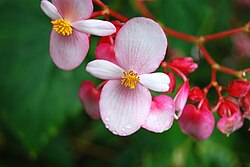
One of the most defining features of the genus is that they are monoecious. The male flowers contain numerous stamens, while the female flowers feature a large inferior ovary and two to four branched or twisted stigmas. These flowers appear in almost every color except blue, ranging from tiny blossoms to those the size of dinner plates. Most species produce a winged capsule containing minute seeds, though some produce baccate (berry-like) fruits.
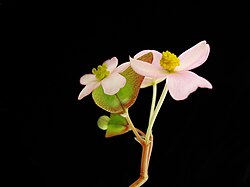
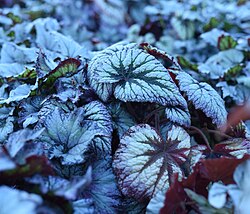
The foliage is equally distinctive. Begonia leaves are often large, variegated, or marked with intricate patterns. Their characteristic asymmetry is a hallmark of the genus.
Origin, Evolution, and Distribution
While fossil evidence is limited, phylogenetic research suggests begonias originated between 20 and 65 million years ago, during the Paleogene to the Miocene epochs. Africa is regarded as the center of origin, with most current species evolving during the Pleistocene.
During the warm Mid-Miocene period, begonias likely expanded into Asia. It is speculated that the formation of the Himalayas approximately 35 million years ago created montane habitats that acted as a bridge, allowing African ancestors to migrate eastward. This migration turned China and the Malay Archipelago into major diversity hotspots. A similar expansion occurred in the Americas, where the plants now range from southern Mexico to the tip of Argentina, likely arriving via at least two separate dispersal events from Africa.
Cultivation and Care
Because most begonias originate in tropical forest understories, they generally require warm temperatures and bright shade. Very few species can tolerate full sun, particularly in hot climates. To thrive, they need a well-drained growing medium that remains moist but never waterlogged.
Growth patterns vary by group. Many species flower year-round, but tuberous begonias have a dormant period during which their tubers should be stored in a cool, dry place. The semperflorens group, commonly known as wax begonias, are popular outdoor bedding plants that can live for 4 to 5 years and can be brought indoors for winter.
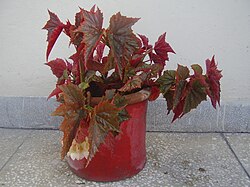
For those in cooler climates, Begonia grandis (the "hardy begonia") is a notable exception, as it is hardy to USDA hardiness zone 6. Propagation is typically straightforward, achieved through division, stem cuttings, or leaf cuttings—the latter being especially effective for Rex and rhizomatous varieties.

Horticultural Variety and Classification
The genus is unique because species from different continents can often be hybridized, leading to a vast array of cultivars. The American Begonia Society categorizes these into several major groups, including:
- Cane-like and Shrub-like
- Rex and Rhizomatous
- Tuberous and Semi-Tuberous
- Semperflorens (Wax begonias)
- Trailing/Scandent and Thick-stemmed
- × Hiemalis/Reiger/Elatior Cheimantha
Horticulturists also use specific abbreviations to describe flower shapes, such as (S) Single for flat tepals, (C) Camellia for large double flowers, and (N) Narcissiflora for "trumpet" shaped centers. Modern hybrids, such as the "Dragonwing" begonias, offer larger leaves and flowers than their ancestors.
Cultural Significance and Symbolism
Begonias appear in various cultural contexts worldwide. In North Korea, the cultivar 'Kimjongilia' serves as a floral emblem. In the world of pop culture, Begonia darthvaderiana was named after the Star Wars character.
In China, begonias are symbols of love. This is reflected in the Biji literary genre, specifically in the legend Cailan zazhi, which tells of a woman's tears turning into "heartbreaking flowers" (begonias). In the language of flowers (floriography), they can represent a warning or a call to "take heed."
Regarding consumption, some people eat begonias, which have a sour taste. However, they should only be eaten in small amounts, as they contain oxalic acid, which can be toxic in large quantities.
Begonia Summary Table
| Feature | Details |
|---|---|
| Scientific Name | Begonia L. |
| Family | Begoniaceae |
| Estimated Species | 2,000+ |
| Primary Habitats | Tropical and subtropical Africa, Asia, and Americas |
| Key Morphological Trait | Asymmetric leaves; monoecious flowers |
| Common Cultivars | Rex, Tuberous, Wax (Semperflorens), Dragonwing |
| Hardy Species | Begonia grandis (Zone 6) |
Frequently Asked Questions
Are begonias edible?
Most begonias have a sour taste and are eaten in some regions. While safe in small amounts, they can be potentially toxic in large quantities due to the presence of oxalic acid in their tissues.
What does it mean for a plant to be monoecious?
A monoecious plant is one that has separate male and female flowers growing on the same individual plant, rather than having both reproductive organs in a single flower or on entirely different plants.
How should I water my begonias?
Begonias generally require a well-drained growing medium. The soil should be kept moist, but it should not be constantly wet, nor should it be allowed to dry out completely.
Why are begonia leaves uneven?
Asymmetry is a natural botanical characteristic of the Begonia genus; the left and right sides of the leaf are typically different sizes.
Can begonias grow in direct sunlight?
Most begonias are forest understory plants and prefer bright shade. Very few species can tolerate full sun, especially in warmer climates where they may scorch.
How do I propagate begonias?
They are easily propagated through division or stem cuttings. Certain groups, such as the Rex and rhizomatous begonias, can also be propagated using leaf cuttings or sections of leaves.