Vanellus: The Diverse Genus of Lapwings
The genus Vanellus comprises a fascinating group of waders known as lapwings. These birds are members of the plover family (Charadriidae) and are recognized for their striking appearances and distinctive behaviors. The name "vanellus" is derived from the Latin word for "little fan," a reference to the unique sound their wings produce during flight.
While most lapwings are grouped within this single genus, the red-kneed dotterel (Erythrogonys cinctus) remains the only exception, sitting outside the Vanellus classification. From the wispy crests of the Eurasian plains to the bold wattles of tropical regions, these birds exhibit a wide array of morphological adaptations.
Key Facts
- Genus: Vanellus, established by Mathurin Jacques Brisson in 1760.
- Species Count: Approximately 24 recognized species.
- Defining Features: Long legs, strongly patterned plumage, and often red or yellow facial wattles.
- Size: Some species are the largest in the plover family, exceeding 30 cm (12 in) in length.
- Migration: Only a few species, including the northern and sociable lapwings, are truly migratory.
Physical Characteristics and Diversity
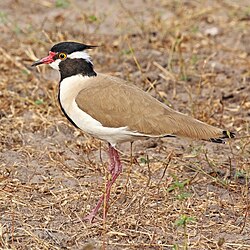
Lapwings are characterized by their long legs and bold plumage patterns. One of the most recognizable features is the wattle—a fleshy growth on the face. These vary significantly across the genus; some species, such as the black-headed and red-wattled lapwings, possess small wattles, while others, like the masked and African wattled lapwings, have much larger ones.
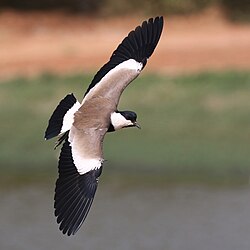
The northern lapwing (Vanellus vanellus) is famous for its wispy crest, a trait shared by only two other species in the genus. Another distinct group, including the spur-winged and pied lapwings, is identified by their red eyes and a spurred carpal (wrist) joint.
Migration and Habitat
Migration patterns vary widely among Vanellus species. True migratory behavior is limited to the northern, sociable, white-tailed, grey-headed, and brown-chested lapwings. In contrast, the Andean lapwing exhibits altitudinal migration, moving downhill during the winter months.
Systematics and Classification
The classification of Vanellus has historically been a subject of scientific debate. Because the birds display a confusing mix of apomorphic (derived) and plesiomorphic (ancestral) traits, taxonomists have struggled to reach a consensus. At one point, up to 19 different genera were proposed to categorize the 24 species.
Recent molecular data has provided some clarity, though it remains insufficient for a full revision. DNA sequence data suggests that a group of five wattle-less species—distributed across tropical regions excluding Australia—may form a distinct clade. If these were separated, the genus name Hoplopterus would likely be used, as it is the most widely recognized alternative.
| Category | Details |
|---|---|
| Scientific Order | Charadriiformes |
| Family | Charadriidae |
| Type Species | Tringa vanellus (Linnaeus, 1758) |
| Key Morphological Traits | Facial wattles, spurred wrist joints, patterned plumage |
| Distribution | Global, with specific tropical and temperate concentrations |
Prehistoric Lapwings
The fossil record reveals that the Vanellus lineage has a deep history. Several extinct species have been identified, including Vanellus madagascariensis from 14th-century Madagascar and Vanellus liffyae from the Late Pliocene of central Australia. Other species, such as V. lilloi, V. downsi, and V. edmundi, appear closely related to the modern southern lapwing.
Some older fossils, such as the Early Oligocene Dolicopterus from France, are suspected to be ancient lapwings, though they require further modern study to be definitively placed within the genus.
Frequently Asked Questions
What does the name Vanellus mean?
The name is Latin for "little fan," referring to the specific sound the birds' wings make while they are in flight.
Which lapwings are the largest?
The largest species in the plover family are those with large wattles, such as the white-crowned, African wattled, yellow-wattled, Javan, and masked lapwings, some of which exceed 30 cm in length.
Are all lapwings migratory?
No. Only the northern, sociable, white-tailed, grey-headed, and brown-chested lapwings are truly migratory. Others, like the Andean lapwing, move based on elevation.
Why is the classification of this genus so difficult?
Systematics are complex because the birds possess a mix of ancestral and derived physical traits that do not clearly align, and molecular data has not yet provided a definitive resolution for all species.
What is a carpal spur?
A carpal spur is a bony projection at the wrist joint, found in species such as the spur-winged, blacksmith, river, southern, Andean, and pied lapwings.