Masked Lapwing: The Bold and Conspicuous Bird of Australasia
The masked lapwing (Vanellus miles) is a large, highly visible bird native to Australia, New Zealand, and New Guinea. Known for its striking appearance and vocal nature, this bird is a common sight in open fields, wetlands, and even urban environments. While often mistaken for a plover, the masked lapwing belongs to its own distinct subfamily, Vanellinae.
These birds are most frequently encountered in moist, open environments, though they are remarkably adaptable and can survive in arid regions, beaches, and coastlines. In New Zealand, the subspecies V. m. novaehollandiae is recognized as a self-introduced native, having spread throughout the country since the 1930s.
Key Facts
- Scientific Name: Vanellus miles
- Conservation Status: Least Concern (IUCN 3.1)
- Distinctive Feature: A yellow spur located on the carpal joint of each wing.
- Diet: Primarily insects and worms.
- Lifespan: Approximately 16 years.
- Behavior: Highly territorial during nesting, known for "swooping" intruders.
Taxonomy and Classification
The masked lapwing was first described in 1781 by the French polymath Georges-Louis Leclerc, Comte de Buffon. However, the formal binomial name Tringa miles was coined in 1783 by Dutch naturalist Pieter Boddaert. The current genus, Vanellus, was established in 1760 by Mathurin Jacques Brisson; the name is derived from the Modern Latin for "lapwing," which itself comes from the Latin vanus, meaning "winnowing" or "fan." The specific epithet miles translates to "soldier" in Latin.
There are two recognized subspecies:
- V. m. miles: Found in northern Australia, the Aru Islands, and coastal New Guinea.
- V. m. novaehollandiae: Found in southern Australia and New Zealand. This subspecies is sometimes classified as a separate species, the black-shouldered lapwing.
Physical Description
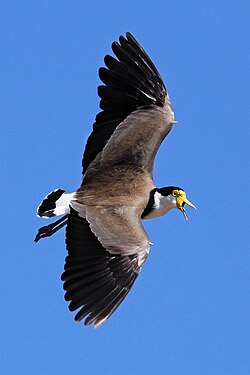
As the largest member of the family Charadriidae, the masked lapwing measures between 30 and 37 cm in length with a wingspan of 75–85 cm. A defining physical characteristic is the conspicuous yellow spur on the carpal joint (the wrist) of each wing.
The two subspecies differ primarily in their markings and size. The northern V. m. miles has an all-white neck and large yellow wattles (fleshy caruncles hanging from the face), with males possessing a more distinct mask. The southern V. m. novaehollandiae is generally larger and heavier, featuring a black neck-stripe and smaller wattles.
Comparison of Subspecies
| Feature | V. m. miles (Northern) | V. m. novaehollandiae (Southern) |
|---|---|---|
| Weight | 191–300 g | 296–412 g |
| Neck Appearance | All-white | Black neck-stripe |
| Wattles | Large | Smaller |
| Primary Range | N. Australia, New Guinea | S. Australia, New Zealand |
Behavior and Ecology
Masked lapwings are ground-dwelling birds that spend the majority of their time foraging for worms and insects. They are perpetually alert; because they live on the ground, they never sleep deeply, remaining vigilant against predators.
Nesting and Territoriality
While generally harmless in autumn and summer, these birds become aggressively territorial during the nesting season, which typically begins around the winter solstice (June 21). They are opportunistic nesters, placing their eggs on open ground such as suburban parks, school ovals, and even supermarket carparks. This behavior can lead to dangerous bird strikes at airports, as the birds are reluctant to leave their nesting sites even for aircraft.
To defend their territory, lapwings use a variety of tactics:
- Swooping: Flying fast and low to strike intruders with their feet.
- Wing Spurs: Using the yellow carpal spur to attack animals on the ground.
- Diversion: Performing distraction displays, such as hopping on one leg, to lead predators away from chicks or nests.
Despite a common myth, the wing spur does not inject venom. While attacks are most frequent against other birds (like ravens) or pets, strikes on humans are rarer. In urban areas, high levels of disturbance from cars and pedestrians can prevent some pairs from breeding successfully.
Frequently Asked Questions
Do masked lapwings have venomous spurs?
No. There is a widely believed myth that their spurs inject venom, but this is incorrect. The spurs are used as physical weapons for striking intruders during territorial disputes.
Why do masked lapwings swoop people?
Swooping is a defensive behavior used during the nesting season. The birds are protecting their eggs or young from perceived threats by attempting to drive intruders away from their territory.
What is the difference between a lapwing and a plover?
Although often called plovers, lapwings are classified in their own subfamily, Vanellinae, distinguishing them from the plover subfamily, Charadriinae.
Where can masked lapwings be found?
They are native to Australia, New Guinea, and New Zealand. They prefer moist, open environments like wetland edges, but are adaptable enough to live in arid areas and suburban landscapes.
How long do masked lapwings live?
The average lifespan of a masked lapwing is approximately 16 years.