Australian Brushturkey: The Master Mound-Builder of Eastern Australia
The Australian brushturkey (Alectura lathami), also known as the gweela, scrub turkey, or bush turkey, is a remarkable large bird belonging to the family Megapodiidae. Found throughout eastern Australia, from Far North Queensland to the south coast of New South Wales, and introduced to Kangaroo Island, it is the largest living member of its family. While it may superficially resemble the American turkey or the Australian bustard, it is not closely related to either; its nearest relatives are the malleefowl and the brushturkeys of New Guinea.
Key Facts
- Scientific Name: Alectura lathami
- Conservation Status: Least Concern (IUCN 3.1)
- Distinctive Feature: Builds massive composting mounds for egg incubation.
- Distribution: Eastern Australia (Cape York to Wollongong).
- Size: 60–75 cm in length with an 85 cm wingspan.
- Parental Care: Chicks are fully independent immediately upon hatching.
Habitat and Distribution
The Australian brushturkey is highly adaptable, inhabiting rainforests, wet sclerophyll forests, drier scrubs, and open areas across both mountainous and lowland regions. In northern regions, they typically prefer higher altitudes but migrate to lowlands during winter. In the south, they are common across various elevations.
In recent years, these birds have successfully colonized urban environments. They are now frequent sights in the backyards of major cities like Brisbane and Sydney, where they have adapted to human presence.
Physical Characteristics
The brushturkey is characterized by its black plumage and a striking red head. It possesses a fan-like tail that is flattened sideways. Depending on the subspecies, the wattle (a fleshy lobe of skin hanging from the neck) varies: the nominate subspecies A. l. lathami has a yellow wattle, while the smaller A. l. purpureicollis (the purple-wattled brushturkey) from the Cape York Peninsula features a purple wattle.
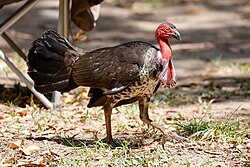
During the breeding season, males experience a surge in brightness in their heads and wattles, which grow larger and often swing as the bird runs. While they are clumsy flyers and cannot travel long distances, they use flight to escape predators or to roost in trees during the day and night.
The Engineering of the Nest
The most fascinating aspect of the Australian brushturkey's biology is its reproduction. A dominant male constructs a massive mound of earth, leaves, and compostable material, reaching heights of 1 to 1.5 meters and widths up to 4 meters.
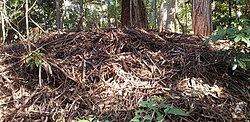
The male maintains the mound's temperature between 33–35 °C (91–95 °F) by adding or removing material, checking the heat by inserting his beak into the mound. Females visit the mound to mate and lay a clutch of 16 to 24 large white eggs. In some cases, multiple females may use a single mound, resulting in up to 50 eggs.
Temperature and Sex Determination
Interestingly, the incubation temperature influences the sex ratio of the offspring through temperature-dependent embryo mortality. While a temperature of 34 °C results in an equal sex ratio, cooler temperatures produce more males and warmer temperatures produce more females. Warmer incubation is also associated with heavier, fitter chicks.
Life Cycle and Survival
Once the eggs hatch, the young must dig themselves out of the mound. Unlike most birds, brushturkey chicks are fully fledged upon hatching; they are independent and can fly within hours of their feathers drying.
Because they receive no parental care, chicks face a high mortality rate. Common predators include snakes, dingoes, dogs, and goannas. The latter often bear wounds on their tails from being pecked by protective males defending their nests.
Human Interaction and Conservation
In urban areas, brushturkeys are opportunistic scavengers, often raiding compost bins and stealing food from picnic tables. While they are viewed as pests by some gardeners due to their habit of raking up mulch and damaging crops, they are legally protected in several regions.
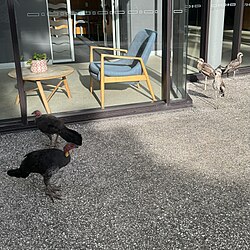
In Queensland, harming a brushturkey is a serious offense under the Nature Conservation Act 1992, with penalties ranging from fines to imprisonment. Similarly, in New South Wales, shooting these birds can result in significant fines under the Biodiversity Conservation Act.
| Feature | Details |
|---|---|
| Scientific Name | Alectura lathami |
| Average Length | 60–75 cm |
| Incubation Method | Composting mound (33–35 °C) |
| Clutch Size | 16–24 eggs (up to 50 per mound) |
| Dietary Behavior | Omnivorous/Opportunistic scavenger |
| Conservation Status | Least Concern |
Frequently Asked Questions
Is the Australian brushturkey related to the American turkey?
No. Despite the similar name and appearance, the Australian brushturkey is not closely related to the American turkey. Its closest relatives are other megapodes, such as the malleefowl.
How do brushturkeys hatch their eggs without sitting on them?
They use the heat generated by the decomposition of organic matter in a large mound of leaves and soil. The male regulates this temperature by adding or removing material to keep it within the required 33–35 °C range.
Do the parents take care of the chicks?
No. Once the chicks hatch and dig themselves out of the mound, they are completely independent and must fend for themselves immediately.
Why do brushturkeys dig up garden mulch?
They are searching for food and collecting materials to build or maintain their large nesting mounds.
Is it legal to kill a brushturkey in Australia?
No, they are protected in several states. In Queensland and New South Wales, harming or shooting a brushturkey can lead to heavy fines or imprisonment under environmental protection laws.