Australian Magpie
The Australian magpie (Gymnorhina tibicen) is one of Australia's most iconic and intelligent birds. Known for its striking black-and-white plumage and complex song, this member of the Artamidae family is as famous for its social complexity as it is for its territorial nature. While native to Australia, its presence has expanded through human introduction to other regions, where its impact varies from welcomed resident to invasive pest.
Beyond its physical presence, the magpie holds a significant place in cultural identity, serving as the mascot for numerous sporting teams such as the Collingwood Magpies and the Port Adelaide Magpies. In the wild, these birds exhibit a sophisticated level of social cooperation and a highly developed vocal range.
Key Facts
- Scientific Name: Gymnorhina tibicen
- Conservation Status: Least Concern (IUCN 3.1)
- Family: Artamidae (Subfamily Cracticinae)
- Range: Native to Australia; introduced to New Zealand, Fiji, and the Solomon Islands.
- Swooping Behavior: Primarily carried out by males (approx. 99%) during nesting periods.
- Taxonomy: Sister taxon to the black butcherbird (Melloria quoyi).
Taxonomy and Evolution
The Australian magpie belongs to the genus Gymnorhina. Molecular genetic research published in 2013 clarified its evolutionary lineage, revealing that the magpie is a sister taxon to the black butcherbird. Together, these two species form a sister group to a larger clade of butcherbirds within the genus Cracticus.
Evidence suggests that the ancestor of the Australian magpie and the black butcherbird split from other butcherbirds between 8.3 and 4.2 million years ago during the late Miocene to early Pliocene. The two species then diverged from each other during the Pliocene, roughly 5.8 to 3.0 million years ago.
Physical Characteristics and Subspecies
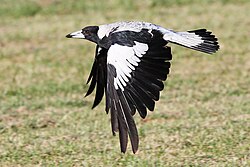
The species is characterized by its bold contrast of black and white feathers, though appearance varies across its nine recognized subspecies. For example, G. t. tyrannica (found on the southern Victorian coast) is known for prominent white backs in males, while G. t. dorsalis exhibits a starker white plumage at the nape in males.
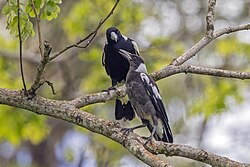
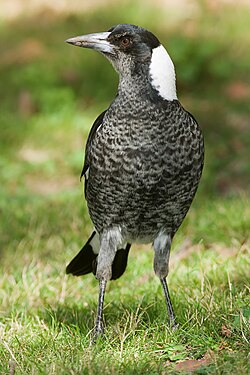
Juvenile magpies differ significantly from adults, often possessing dark irises and less distinct plumage patterns.
Regional Variations
Subspecies are distributed across various Australian regions, including G. t. terraereginae in Queensland, G. t. tibicen in Sydney, and G. t. telonocua in Adelaide.
Distribution and Global Impact
While the Australian magpie is native to the Australian continent, it was introduced to New Zealand between 1864 and 1874. Over 1,000 birds were released, but they are now classified as a pest species in New Zealand because they displace native bird populations. In contrast, introductions to Fiji and the Solomon Islands are not considered invasive.
Behavior and Social Intelligence
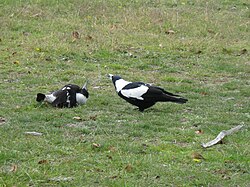
Australian magpies are highly social birds with complex behavioral patterns. Recent studies have highlighted their capacity for altruism and cooperation; for instance, magpies have been observed helping one another remove tracking devices attached by scientists.
Vocalizations
The magpie is renowned for its melodic and complex song. Their vocal abilities extend beyond simple calls, with some individuals capable of mimicking sounds in their environment, including emergency sirens.
The Science of Swooping
The most notorious behavior associated with the Australian magpie is "swooping," a territorial defense mechanism used to protect nests. Despite public perception, the percentage of magpies that swoop is relatively low, estimated at less than 9% of the population.
Target Specificity
Swooping is almost exclusively performed by males (approximately 99%). These birds often exhibit target specificity, meaning an individual bird will specialize in attacking either pedestrians or cyclists. Typically, pedestrians are targeted within 50 meters (160 ft) of the nest, while cyclists are targeted from up to 100 meters (330 ft) away.
Prevention and Management
To deter attacks, some people use helmets equipped with "spikes" to discourage diving birds. In some regions, warning signs are posted to alert the public to active swooping areas.
Summary Table: Australian Magpie Overview
| Feature | Detail |
|---|---|
| Scientific Classification | Order: Passeriformes; Family: Artamidae |
| Conservation Status | Least Concern |
| Number of Subspecies | 9 |
| Primary Swooping Gender | Male (>99%) |
| Key Evolutionary Relative | Black butcherbird (Melloria quoyi) |
| Status in New Zealand | Pest species (Invasive) |
Frequently Asked Questions
Why do Australian magpies swoop?
Swooping is a territorial behavior used primarily by males to defend their nests and offspring from perceived threats during the breeding season.
Do all Australian magpies swoop?
No. It is estimated that less than 9% of the population engages in swooping behavior.
Are magpies invasive in other countries?
They are considered a pest species in New Zealand due to the displacement of native birds, but they are not viewed as invasive in Fiji or the Solomon Islands.
How do magpies differ from butcherbirds?
While they are closely related (sister taxa), they diverged millions of years ago. The Australian magpie belongs to the genus Gymnorhina, while most butcherbirds belong to the genus Cracticus.
Can magpies mimic other sounds?
Yes, Australian magpies are highly intelligent and have been documented mimicking various sounds, including emergency sirens.