Valmiera History: From Ancient Settlement to Modern Transport Hub
Valmiera stands as one of the longest-inhabited regions in Latvia, with a legacy that stretches back millennia. Archaeological evidence suggests that the area was inhabited as far back as 9,000 years ago, establishing it as a site of enduring human significance long before it became a formalized urban center.
The Medieval Era and the Livonian Order
The strategic importance of Valmiera grew in 1224 following the partition of Tālava. At this time, the trade routes along the Gauja river became the property of the Livonian Brothers of the Sword, who constructed a castle that is known today as Valmiera Castle. Following the Battle of Saule in 1236, the castle and its surrounding lands transitioned to the newly established Livonian Order.
While first mentioned as a town in a 1323 chronicle, Valmiera was likely founded at least 40 years prior. This development was spearheaded by Wilken von Endorp, the master of the Livonian Order, who built a Catholic church and a castle (Wolmar) on the banks of the Gauja.
Hanseatic Influence and Regional Power
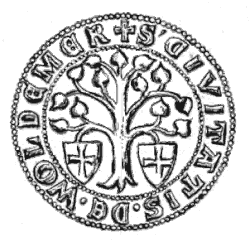
Between the 14th and 16th centuries, Valmiera was a member of the Hanseatic League, a powerful commercial and defensive confederation of merchant guilds and market towns. This membership brought significant trade and vitality to the town. During this period, Valmiera also served as a political center, hosting several landtags (regional assemblies).
Conflict, Decline, and Recovery
The late 16th and 17th centuries were marked by volatility. Following the Livonian War in 1583, the town suffered heavy devastation and was incorporated into the Duchy of Livonia as part of the Wenden Voivodeship. By 1622, after the Polish-Swedish war, management of the town passed to Axel Oxenstierna, the Lord High Chancellor of Sweden.
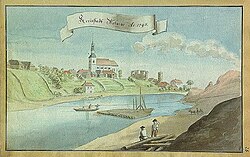
The Great Northern War brought further tragedy; in 1702, Valmiera was burned and destroyed, and the population was further decimated by plague. This led to a period of decline during the first half of the 18th century.
The Path to Modernization
Recovery began in 1738 when M.E. von Hallart opened the first seminary of the Moravian Church, a movement that became influential throughout the Vidzeme region. By 1785, Valmiera was designated as a district center, setting the stage for rapid 19th-century growth.
Two major infrastructure projects catalyzed this expansion: the construction of the first bridge over the Gauja river in 1865 and the arrival of the Riga-St. Petersburg railway line in 1899. These developments spurred the growth of new factories and settlements on both banks of the river. By 1911–12, the addition of a narrow-gauge railway connecting Ainaži, Valmiera, and Smiltene solidified the town's status as a major transport hub.
Political Awakening and the 20th Century
The early 1900s marked a shift in local governance. In the 1906 municipal elections, Valmiera became one of the few Latvian towns where Latvians won a majority of seats (18 out of 24), leading to the election of local doctor Georgs Apinis as mayor. The town also evolved into a cultural and educational center, establishing a merchant school, a women's gymnasium, and the Vidzeme teachers seminary.
World War II and the Cold War
The mid-20th century brought severe hardship. On July 4, 1941, the German Army Group North captured Valmiera, placing it under the administration of the Reichskommissariat Ostland. In October 1941, 209 Jews from the town and surrounding areas were murdered in local forests. The city was recaptured on September 24, 1944, by the Red Army's 3rd Baltic Front during the Riga Offensive, though the center of the city was almost entirely destroyed during the conflict.
During the Cold War, the region's strategic importance continued with the presence of the Liepas Air Base nearby.
Key Facts
- Ancient Roots: Inhabited for approximately 9,000 years.
- Medieval Trade: Member of the Hanseatic League from the 14th to 16th centuries.
- Transport Hub: Connected by the Riga-St. Petersburg railway (1899) and a narrow-gauge line (1911–12).
- Political Milestone: Latvians won the majority of municipal seats in 1906.
- Modern Legacy: Version 2.2 of the open-source mapping software QGIS was named in honor of the city.
| Period/Year | Key Event | Significance |
|---|---|---|
| 9,000 years ago | Early habitation | One of Latvia's oldest inhabited regions |
| 1224 | Castle construction | Established by Livonian Brothers of the Sword |
| 14th–16th C. | Hanseatic League membership | Increased trade and economic movement |
| 1702 | Great Northern War | Town burned and devastated by plague |
| 1865 / 1899 | Bridge and Railway construction | Rapid industrial and urban development |
| 1941–1944 | World War II | German occupation and subsequent Red Army recapture |
Frequently Asked Questions
Who founded the town of Valmiera?
The town was likely founded at least 40 years prior to 1323 by Wilken von Endorp, the master of the Livonian Order, who constructed a castle and a Catholic church on the banks of the Gauja river.
What role did the Hanseatic League play in Valmiera's history?
Between the 14th and 16th centuries, membership in the Hanseatic League brought significant trade and economic activity to the town, enhancing its regional importance.
How did Valmiera become a transport hub?
Valmiera's status as a hub was established through the construction of the first bridge over the Gauja in 1865, the Riga-St. Petersburg railway in 1899, and a narrow-gauge railway line connecting Ainaži, Valmiera, and Smiltene between 1911 and 1912.
What happened to Valmiera during World War II?
The city was occupied by German forces in July 1941, during which time 209 Jews were murdered in local forests. It was recaptured by the Red Army in September 1944, though the city center was almost completely destroyed.
Is Valmiera mentioned in modern technology?
Yes, version 2.2 of the open-source mapping application QGIS was named in honor of Valmiera.