The Black-White-Red Flag: History and Symbolism of the German Imperial Tricolor
The black-white-red flag (Schwarz-Weiß-Rot), widely known as the Reichsflagge (Empire Flag) or Kaiserflagge (Imperial Flag), served as a primary symbol of German national identity for several decades. A horizontal tricolor, it represents a synthesis of various historical German entities, blending the colors of the Prussian state with those of the Holy Roman Empire and the Hanseatic League.
Originally established as the national flag of the North German Confederation, it became the official emblem of the German Reich, which existed from 1871 to 1945. While its official adoption as the national flag of the German Empire occurred in 1892 under Wilhelm II, its influence extended far beyond official state use, appearing in political movements and military organizations throughout the early 20th century.
Key Facts
- Design: A horizontal tricolor consisting of black, white, and red stripes.
- Origins: Combines Prussian colors (black and white) with Hanseatic colors (red and white).
- Official Status: Adopted by the North German Confederation in 1867 and officially as the German Empire's national flag in 1892.
- Proportions: Primarily 2:3, though a 3:5 ratio was used between 1933 and 1935.
- Political Legacy: Used by various right-wing and nationalist groups after 1918, and later by the National Committee for a Free Germany during WWII.
The Symbolism of Colors
White and Red: The Hanseatic and Imperial Legacy
The combination of white and red is deeply rooted in German heraldry. These colors were prevalent in the flags and coats of arms of the Hanseatic cities—powerful trading hubs including Hamburg, Bremen, Lübeck, Rostock, and Wismar. Additionally, the red and white scheme appears in the Saxon Steed (the white horse on a red shield) and the state colors of Berlin, Thuringia, and Hesse.
Historically, these colors also linked back to the Holy Roman Empire. The original imperial flag from the 12th century featured a silver cross on a red field, and while this evolved into the imperial eagle banner around 1350, the red and white influence persisted in imperial war flags.
White and Black: The Prussian Influence
The black and white colors are inextricably linked to the history of Prussia. This palette was used by the knights of the Teutonic Order, who bore a black cross on a white shield. The Prussian eagle coat of arms also evolved from these colors, specifically from the black imperial eagle granted to Hermann von Salza by Emperor Frederick II.
The Hohenzollern family, the ruling dynasty of Brandenburg and Prussia, utilized a quartered white and black shield as their family coat of arms. This color scheme was further mirrored in the flags of the provinces of East Prussia, West Prussia, and Posen, as well as the traditional black bear of Berlin on a white field.
Historical Evolution
Unification and the North German Confederation
Following the dissolution of the German Confederation, Prussia established the North German Confederation in 1866. The need for a recognizable national flag was driven largely by the shipping industry, which required a distinct international identity. Adolf Soetbeer, secretary of the Hamburg Chamber of Commerce, proposed combining the Prussian colors (black and white) with the Hanseatic colors (red and white).
Under the leadership of Otto von Bismarck, the 1867 constitution declared the black-white-red tricolor as the civil and war ensign. King Wilhelm I approved the scheme, noting that red and white also represented the Margraviate of Brandenburg. Crucially, the exclusion of gold signaled that the new state did not include the Austrian Empire.
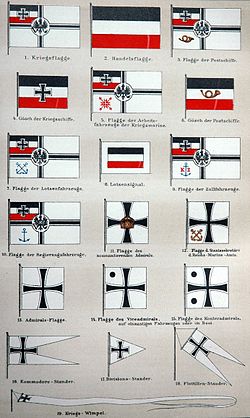
After the Franco-Prussian War and the subsequent unification of Germany in 1871, the German Empire retained these colors. The flag was officially adopted as the national flag in 1892 during the reign of Wilhelm II and remained so until the German Revolution of 1918–1919.
The Weimar Republic and the Third Reich
The Weimar Republic replaced the imperial tricolor with the black-red-gold flag. However, the black-white-red flag remained a potent symbol for the Reichswehr (the national defense force) and various paramilitary groups like the Freikorps. Right-wing conservative and liberal parties, such as the German National People's Party and the German People's Party, used the flag to protest the Weimar Republic, most notably during the 1920 Kapp Putsch.

In March 1933, following the Nazi Party's electoral victory, President Paul von Hindenburg reinstated the black-white-red flag by decree. It was flown alongside the Nazi swastika flag until September 1935, when the swastika flag became the sole national flag. At that point, the imperial flag was banned as being "reactionary."
World War II and the National Committee for a Free Germany
During World War II, the flag was adopted by the National Committee for a Free Germany (NKFD), an anti-fascist organization composed of German exiles and prisoners of war in the Soviet Union. The NKFD used the black-white-red flag to signal their rejection of the "weakness" of the Weimar Republic while distancing themselves from the Nazi regime.
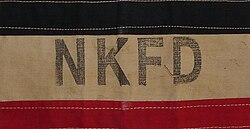
The NKFD hoped the flag would represent a strong, democratic German state. While some proposed the imperial flag for East Germany after the war as a symbol of resistance to Nazism, the East German government ultimately chose the black-red-gold flag, adding a coat of arms to distinguish it from West Germany.
Post-Reunification and Modern Usage
Since the reunification of Germany, the black-white-red flag has primarily been used by right-wing monarchist organizations and far-right groups. Because the swastika flag is banned in modern Germany, some neo-Nazis have adopted the Imperial Flag as a substitute. While the flag did not originally possess racist or anti-Semitic meanings, in a modern context, it often represents a rejection of the Federal Republic of Germany.

| Period | Entity/Organization | Status/Role |
|---|---|---|
| 1867–1871 | North German Confederation | Civil and War Ensign |
| 1871–1918 | German Empire | National Colors (Official flag from 1892) |
| 1919–1933 | Right-wing parties / Reichswehr | Political and Paramilitary Symbol |
| 1933–1935 | Nazi Germany | National Flag (flown with swastika) |
| WWII Era | National Committee for a Free Germany | Anti-fascist symbol |
| Post-1990 | Far-right / Monarchists | Political symbol of rejection of the Federal Republic |
Frequently Asked Questions
What do the colors of the Imperial Flag represent?
The black and white represent Prussia and the Teutonic Order, while the red and white represent the Hanseatic League and the Holy Roman Empire.
Why was gold excluded from the flag?
The absence of gold was a deliberate political statement to indicate that the new German state did not include the Austrian Empire, which used black and gold.
Was the black-white-red flag always associated with the Nazi party?
No. The flag originated in 1867 and was the symbol of the German Empire long before the Nazi party existed. While it was used briefly by the Third Reich, it did not originally have racist or anti-Semitic meanings.
Why did the National Committee for a Free Germany use this flag?
The NKFD used the flag because they rejected the Weimar Republic's black-red-gold colors, viewing the Weimar era as too weak, and wanted a symbol that appealed to a broad range of anti-Nazi views.
Is the Imperial Flag legal in modern Germany?
Unlike the swastika flag, the black-white-red imperial flag is not banned, although its use is often associated with far-right political movements today.