US Census Race and Ethnicity: A History of Classification
The collection of demographic data in the United States is more than a simple head count; it is a reflection of how the nation perceives identity. The U.S. Census Bureau and the Office of Management and Budget (OMB) establish the categories used to define race and ethnicity, allowing residents to self-identify with the groups they most closely align with. These classifications are not intended to be scientific or anthropological; instead, they are social-political constructs that reflect the cultural characteristics and ancestry recognized within the country.
A critical distinction in the census is the separation of race and ethnicity. While race refers to broader social categories, ethnicity is handled as a distinct identity. Specifically, respondents are asked a separate question regarding whether they are of Hispanic or Latino origin, regardless of their identified race.
Key Facts
- Self-Identification: Since 1970, Americans have provided their own racial identity, replacing the previous system where census enumerators decided a person's race.
- Race vs. Ethnicity: The census treats race and ethnicity as separate categories; Hispanic or Latino origin is classified as an ethnicity.
- Legal Drivers: The shift toward self-identification was driven by the Civil Rights Act of 1964 and the Voting Rights Act of 1965.
- Multiracial Reporting: Starting with the 2000 Census, respondents could select more than one race category.
- Social Construct: The OMB explicitly states that census race categories are based on social and cultural characteristics rather than biological or genetic data.
The Evolution of Racial Classification
The Early Years (1790–1840)
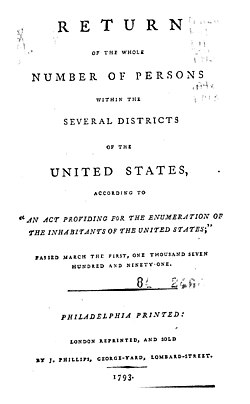
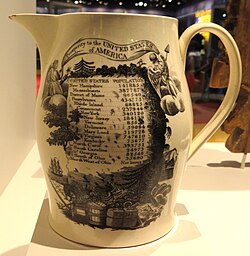
The first United States Census in 1790 was mandated by the US Constitution to record the population, which totaled 3,929,214. During this era, data collection was handled by US Marshals. The 1790 census categorized inhabitants into groups such as free white males (split by age), free white females, "all other free persons" (reported by sex and color), and slaves.
By 1840, the role of US Marshals in conducting the census ended. This transition occurred after Northern Whig Party members opposed claims in the 1840 data suggesting that free Black Americans in the North exhibited higher rates of "insane" or "idiotic" behavior compared to enslaved Black Americans. From 1850 onward, a specialized census bureau within the Department of the Interior took over tabulation.
The Shift to Self-Identification (1960–1980)
For nearly two centuries, census enumerators chose the race of the respondents. This changed with the 1970 Census, when the government began allowing self-identification. This reform was a direct result of the Civil Rights Act of 1964 and the Voting Rights Act of 1965, which necessitated more accurate and fair demographic data for legal and political representation.
In 1980, the census further refined its approach by formally separating race and ethnicity. All respondents were categorized as either "Hispanic or Latino" or "Not Hispanic or Latino," a practice that continues today despite criticism from the American Anthropological Association and the US Commission on Civil Rights.
Modern Era and Multiracial Identity (1990–2020)
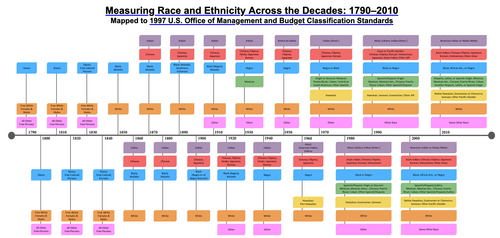
The 1990 Census noted a significant rise in interracial families, with the number of children in such families growing from under 500,000 in 1970 to approximately two million by 1990. This trend led to a major change in the 2000 Census: for the first time, respondents could select one or more race categories. This resulted in nearly seven million Americans identifying as multiracial.
The 2010 and 2020 censuses maintained these designs, adhering to 1997 OMB standards. The 2020 census focused on improving the phrasing of questions to enhance clarity for respondents while maintaining the distinction between race and Hispanic origin.
Census Data Summary
| Era/Census | Method of Classification | Key Feature/Change | Notable Data Point |
|---|---|---|---|
| 1790 | Enumerator-assigned | First US Census | Total Pop: 3,929,214 |
| 1970 | Self-identified | Post-Civil Rights reforms | Shift to respondent choice |
| 1980 | Self-identified | Separation of Race and Ethnicity | Hispanic/Latino category added |
| 2000 | Self-identified | Multiple race selection | ~7 million identified as 2+ races |
| 2010 | Self-identified | Refined OMB standards | 12.5% identified as Hispanic/Latino |
Frequently Asked Questions
Why is Hispanic origin considered an ethnicity and not a race?
The OMB defines Hispanic or Latino origin as an ethnicity because it is based on shared cultural and linguistic characteristics rather than a single biological or genetic racial group. This allows individuals of any race to also identify as Hispanic or Latino.
When did the US Census start allowing people to choose their own race?
Americans began providing their own racial self-identification starting with the 1970 Census, following the legislative reforms of the mid-1960s.
Can a person identify as more than one race on the census?
Yes. Since the 2000 Census, respondents have had the option to select one or more race categories to more accurately reflect their racial identities.
What was the primary purpose of the 1790 Census?
The 1790 Census was mandated by the US Constitution to record the population, specifically tracking free white males of various ages, free white females, other free persons, and slaves to assess the nation's military and industrial potential.
Has the American Anthropological Association agreed with these categories?
No. The AAA has criticized the separation of race and ethnicity, recommending that the OMB combine them into a single "race/ethnicity" question to better align with how people conceptualize their identities.