1990 United States Census: Population Shifts and Historic Milestones
The 1990 United States census, conducted by the Census Bureau, served as a critical snapshot of the nation's demographic landscape at the turn of the decade. By determining the resident population of the country, the census provided essential data used for everything from political representation to social planning.
The results revealed a total population of 248,709,873, marking a 9.8 percent increase over the 226,545,805 people counted during the 1980 census. This growth reflected broader national trends in migration and birth rates during the 1980s.
Key Facts
- Total Population: 248,709,873 (a 9.8% increase since 1980).
- Most Populous State: California (29,760,021).
- Least Populous State: Wyoming (453,588).
- Leadership: Barbara Everitt Bryant became the first woman to direct the census.
- City Shift: Los Angeles overtook Chicago as the second-largest city in the U.S. for the first time since 1880.
- Racial Classification: "Native Hawaiian and Other Pacific Islander" was designated as a separate racial group from Asians for the first time.
Census Methodology and Outreach
To gather comprehensive data, the Census Bureau utilized different forms. While most residents received a short form, approximately 16 percent of households were given a long form, which contained more than 100 detailed questions to provide deeper sociological insights.
Recognizing the importance of inclusive counting, the bureau launched a high-profile campaign to increase participation among Black communities. This effort included recruiting well-known spokespeople such as Bill Cosby, Magic Johnson, Alfre Woodard, and Miss America Debbye Turner.
State Population Trends and Rankings
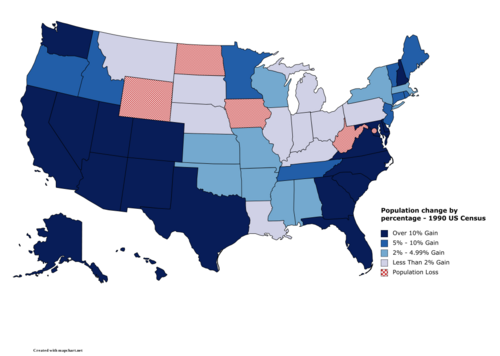
The 1990 data highlighted significant regional growth, particularly in the West and South. California remained the most populous state, while Wyoming was recorded as the least populous state for the first time.
Some states experienced explosive growth; for example, Nevada saw a population increase of 50.1%, and Alaska grew by 36.8%. Conversely, some states saw declines, such as West Virginia, which decreased by 8.0%.
| Rank | State | 1990 Population | 1980 Population | Percent Change |
|---|---|---|---|---|
| 1 | California | 29,760,021 | 23,667,902 | 25.7% |
| 2 | New York | 17,990,455 | 17,558,072 | 2.5% |
| 3 | Texas | 16,986,510 | 14,229,191 | 19.4% |
| 4 | Florida | 12,937,926 | 9,746,324 | 32.7% |
| 5 | Pennsylvania | 11,881,643 | 11,863,895 | 0.2% |
| 6 | Illinois | 11,430,602 | 11,426,518 | 0.0% |
| 7 | Ohio | 10,847,115 | 10,797,630 | 0.4% |
| 8 | Michigan | 9,295,297 | 9,262,078 | 0.4% |
| 9 | New Jersey | 7,730,188 | 7,364,823 | 5.0% |
| 10 | North Carolina | 6,628,637 | 5,881,766 | 12.7% |
Political Impact: Reapportionment
The census results directly influenced reapportionment, the process of redistributing the 435 seats in the U.S. House of Representatives based on population changes. These results determined the number of seats each state received for the 1992 elections and subsequently affected the Electoral College votes for the 1992 presidential election.
In total, 21 states saw changes in their seat counts, with 19 seats being switched. California gained the most with seven additional seats, while Florida and Texas each gained four. On the other hand, states like New York lost three seats.
Urban Centers and City Rankings
The 1990 census confirmed New York City as the largest city in the United States with a population of 7,322,564. However, a major shift occurred in the second-place spot: Los Angeles (3,485,398) officially surpassed Chicago (2,783,726). This marked the first time since 1880 that Chicago was not the second-largest city.
Frequently Asked Questions
Who directed the 1990 United States census?
The 1990 census was directed by Barbara Everitt Bryant, who was the first woman to hold this position.
How did the 1990 census change racial classifications?
It was the first census to designate "Native Hawaiian and Other Pacific Islander" as a racial group separate from Asians.
What was the impact of the 1990 census on the House of Representatives?
The results led to the reapportionment of seats for the 1992 elections, with 21 states experiencing a change in their number of seats, including California gaining seven seats.
When will personally identifiable information from the 1990 census be released?
Personally identifiable information from the 1990 census is scheduled to be available in 2062.
Which city became the second-largest in the U.S. in 1990?
Los Angeles became the second-largest city, overtaking Chicago for the first time since 1880.