1970 United States Census: Population Shifts and Demographic Milestones
The 1970 United States census, conducted by the Census Bureau, served as a critical snapshot of a nation in transition. On April 1, 1970, the survey determined that the resident population of the United States had reached 203,392,031. This represented a 13.4% increase over the 179,323,175 people enumerated during the previous 1960 census.
Beyond the raw numbers, the 1970 census captured significant shifts in regional dominance and urban growth, marking the first time in over a century that the nation's demographic center of gravity shifted away from the Northeast.
Key Facts
- Total Population: 203,392,031 (a 13.4% increase since 1960).
- Most Populous State: California, with 19,953,134 residents.
- Least Populous State: Alaska, with 300,382 residents.
- Historic Shift: California overtook New York as the most populous state in November 1962.
- Urban Milestone: Houston became the first city in the geographic South to exceed a population of 1 million.
- Methodology Change: Race was identified via self-identification for the first time, rather than by enumerators.
Demographic Shifts and State Rankings
The 1970 data revealed a notable trend toward the West and South. For the first time since 1820, New York was no longer the most populous state, having been surpassed by California. Additionally, this census marked the first instance where every single state recorded a population exceeding 300,000.
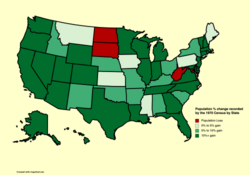
While the national trend was one of growth, it was not universal. Four states experienced population declines, with West Virginia seeing the most significant drop, decreasing by approximately 7% compared to 1960 levels.
Top 10 Most Populous States (1970)
| Rank | State | 1970 Population | 1960 Population | Percent Change |
|---|---|---|---|---|
| 1 | California | 19,953,134 | 15,717,204 | 27.0% |
| 2 | New York | 18,236,967 | 16,782,304 | 8.7% |
| 3 | Pennsylvania | 11,793,909 | 11,319,366 | 4.2% |
| 4 | Texas | 11,196,730 | 9,579,677 | 16.9% |
| 5 | Illinois | 11,113,976 | 10,081,158 | 10.2% |
| 6 | Ohio | 10,652,017 | 9,706,397 | 9.7% |
| 7 | Michigan | 8,875,083 | 7,823,194 | 13.4% |
| 8 | New Jersey | 7,168,164 | 6,066,782 | 18.2% |
| 9 | Florida | 6,789,443 | 4,951,560 | 37.1% |
| 10 | Massachusetts | 5,689,170 | 5,148,578 | 10.5% |
Civil Rights and Methodology Changes
The 1970 census introduced a pivotal change in how the government collected racial data. Driven by the requirements of the Civil Rights Act of 1964 and the Voting Rights Act of 1965, the Census Bureau shifted to a system of self-identification. Previously, government census enumerators (officials who collect the data) determined a person's race; under the new system, individuals identified their own race.
Data Availability and Accuracy
For researchers and historians, microdata from the 1970 census is available through the Integrated Public Use Microdata Series, while aggregate data and boundary files are provided by the National Historical Geographic Information System (originally created by DUALabs). Due to privacy laws, personally identifiable information from this census will not be released until 2042.
It is important to note that the initial results were later refined. On April 25, 1973, the Census Bureau announced a reanalysis suggesting a net undercount of approximately 5.33 million people (a 2.5% undercount rate). This adjustment would have brought the actual population to approximately 208.7 million, with the undercount including an estimated 3.45 million white individuals and 1.88 million black individuals.
Frequently Asked Questions
Which state became the most populous in 1970?
California became the most populous state, overtaking New York. This shift actually occurred in November 1962, but was formally recorded in the 1970 census.
How did the 1970 census change the way race was recorded?
In response to the Civil Rights Act of 1964 and the Voting Rights Act of 1965, the census moved from having enumerators assign race to allowing individuals to self-identify their race.
Which city reached a major population milestone in 1970?
Houston became the first city in the geographic South to record a population of over 1 million people.
Were there any states that lost population between 1960 and 1970?
Yes, four states recorded population losses, with West Virginia experiencing the largest decline at roughly 7%.
Was the 1970 census population count perfectly accurate?
No. A 1973 reanalysis by the Census Bureau estimated a net undercount of about 5.33 million people, which would have increased the total population to approximately 208.7 million.