1930 United States Census: Population Trends and Social Shifts
The 1930 United States census, conducted by the Census Bureau over the course of one month starting April 1, 1930, provides a detailed snapshot of a nation in transition. This fifteenth national census recorded a total resident population of 122,775,046, marking a 13.7% increase from the 106,021,537 people enumerated in 1920.
Beyond the raw numbers, the 1930 data captured pivotal shifts in American living patterns. It was the first census to document the early effects of suburban sprawl—the unplanned expansion of urban areas into surrounding rural land. This was most evident in the "Roaring Twenties," as a significant portion of New York City's working population migrated to New Jersey, facilitated by the opening of the George Washington Bridge, which allowed for rapid transport into Manhattan.
The census also highlighted the growth of the American West. For the first time, a city in the Western United States, Los Angeles, surpassed the one million population milestone.
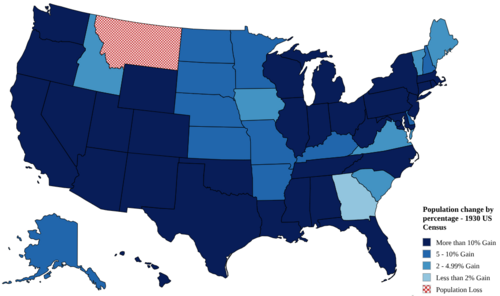
Key Facts
- Total Population: 122,775,046 (a 13.7% increase since 1920).
- Most Populous State: New York (12,588,066 residents).
- Least Populous State: Nevada (91,058 residents).
- Urban Milestone: Los Angeles became the first Western city to reach at least one million people.
- Infrastructure Impact: The George Washington Bridge drove population growth in New Jersey via suburban sprawl.
Census Questions and Data Collection
The 1930 census was comprehensive, gathering a wide array of demographic, economic, and social data. Enumerators collected basic identity information such as name, address, age, sex, race, and marital status (including the age at first marriage).
Housing and Lifestyle
To understand the economic status of households, the census asked whether a home was owned or rented. Owners provided the value of their home, while renters reported their monthly rent. Notably, the 1930 census asked whether the household owned a radio set, reflecting the growing influence of mass media.
Employment and Education
The Bureau tracked literacy, school attendance, and detailed employment data, including occupation, industry, and the class of worker. They also recorded whether the individual had been at work on the previous day (or their last regular work day) and their veteran status.
Immigration and Heritage
For foreign-born residents, the census recorded the year of immigration, naturalization status, ability to speak English, and the language spoken at home prior to arriving in the U.S. Birthplaces of both the individual and their parents were also documented. For individuals identified as Indian, the census recorded tribal affiliation and whether they were of full or mixed blood.
Population Rankings by State and City
The distribution of the population showed significant growth in several states, with California experiencing a massive 65.7% increase between 1920 and 1930. Conversely, Montana saw a slight population decline of 2.1%.
| Rank | State | 1930 Population | 1920 Population | Percent Change |
|---|---|---|---|---|
| 1 | New York | 12,588,066 | 10,385,227 | 21.2% |
| 2 | Pennsylvania | 9,631,350 | 8,720,017 | 10.5% |
| 3 | Illinois | 7,630,654 | 6,485,280 | 17.7% |
| 4 | Ohio | 6,646,697 | 5,759,394 | 15.4% |
| 5 | Texas | 5,824,715 | 4,663,228 | 24.9% |
| 6 | California | 5,677,251 | 3,426,861 | 65.7% |
| 7 | Michigan | 4,842,325 | 3,668,412 | 32.0% |
| 8 | Massachusetts | 4,249,614 | 3,852,356 | 10.3% |
| 9 | New Jersey | 4,041,334 | 3,155,900 | 28.1% |
| 10 | Missouri | 3,629,367 | 3,404,055 | 6.6% |
At the city level, New York remained the dominant urban center with nearly 7 million residents, followed by Chicago and Philadelphia. Los Angeles ranked fifth, cementing its status as a major Western hub.
Data Availability and Access
The original 1930 census enumeration sheets were microfilmed by the Census Bureau in 1949 and subsequently destroyed. Today, the records exist on 2,667 rolls of microfilm held by the National Archives and Records Administration. Digital indices and images are also hosted by various organizations online.
Researchers can access microdata through the Integrated Public Use Microdata Series (IPUMS), while aggregate data for small areas and electronic boundary files are available via the National Historical Geographic Information System (NHGIS).
Frequently Asked Questions
What was the total population of the U.S. in 1930?
The total resident population was 122,775,046, which represented a 13.7% increase over the 1920 census.
Which state had the largest population in 1930?
New York was the most populous state with 12,588,066 residents.
What unique lifestyle question was asked in the 1930 census?
The census asked residents whether they owned a radio set, reflecting the technological trends of the era.
How did the 1930 census record suburban sprawl?
It recorded a significant shift of New York City's working population to New Jersey, aided by the transport capabilities of the George Washington Bridge.
Where can the original 1930 census records be found today?
Because the original sheets were destroyed after 1949, the records are available as microfilm through the National Archives and Records Administration, as well as through digital platforms like IPUMS and NHGIS.