UNPROFOR: The United Nations Peacekeeping Mission in the Yugoslav Wars
The United Nations Protection Force (UNPROFOR), also known by its French acronym FORPRONU, was the primary international peacekeeping presence in Croatia and Bosnia and Herzegovina during the tumultuous Yugoslav Wars. Established in February 1992, the force was tasked with maintaining stability and providing humanitarian relief in a region torn apart by ethnic conflict and war.
Operating under a complex and evolving mandate, UNPROFOR navigated the volatile landscape between the Croatian War of Independence and the Bosnian War. The mission eventually transitioned in March 1995 into three separate operations, with its Bosnian operations continuing until they were replaced by NATO and EU missions in December 1995.
Key Facts
- Active Period: 1992–1995.
- Personnel: Approximately 25,000 to 38,000 troops from over 40 nations.
- Casualties: 167 fatalities, including military observers, personnel, and civilian staff.
- Primary Goal: Peacekeeping and the protection of humanitarian aid.
- Successor: NATO-led Implementation Force (IFOR).
The Mandate in Croatia
UNPROFOR was created via UN Security Council Resolution 743 on February 21, 1992. Its initial objective was to create stable conditions for peace negotiations and ensure security within three demilitarized "safe-haven" enclaves known as United Nations Protected Areas (UNPAs). These areas were controlled by the Republic of Serbian Krajina.
As the conflict evolved, the mandate expanded to include the "pink zones" (areas controlling access to UNPAs), border monitoring, and the demilitarization of the Prevlaka peninsula near Dubrovnik.
Operations in Bosnia and Herzegovina
The mission in Bosnia was implemented in three distinct phases to address the escalating humanitarian crisis.
Phase 1: Aid to Sarajevo
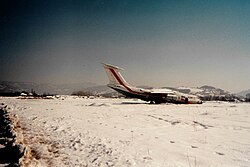
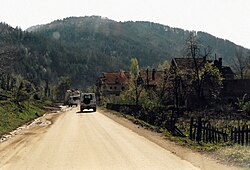
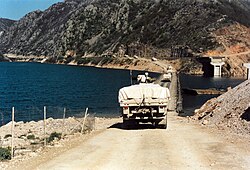
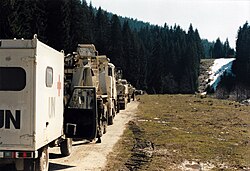
Starting June 5, 1992, UNPROFOR took responsibility for the protection of the Sarajevo airport. This was critical for establishing a security corridor to move humanitarian aid from the airport into the besieged city.
Phase 2: Escort of Humanitarian Aid
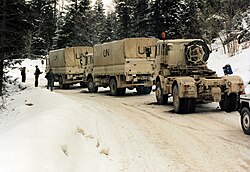
By September 1992, Resolution 776 authorized UNPROFOR to protect humanitarian organizations, including the International Committee of the Red Cross and the UN High Commissioner for Refugees (UNHCR). The force was permitted to use self-defense if armed groups attempted to block aid convoys.
Phase 3: Protection of Safe Areas
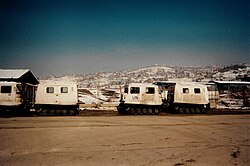
In April 1993, the UN declared Srebrenica a "safe area" to protect civilians from armed attack. This list was soon expanded to include Bihać, Sarajevo, Goražde, Žepa, and Tuzla. To support these areas, 7,600 reinforcements were deployed alongside NATO air support.
Major Engagements and Challenges
Operation Deny Flight
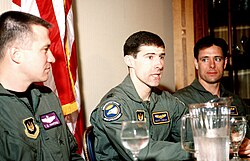
Following violations of "no-flight zones" near Srebrenica, the UN authorized Operation Deny Flight in March 1993. This operation, involving French, Dutch, and American aircraft, aimed to prevent military flights by belligerents. Between March 1993 and December 1994, 3,317 violations were recorded, and four military aircraft were shot down by NATO jets.
The Siege of Sarajevo and Urban Conflict
Sarajevo remained a flashpoint of violence, characterized by sniper fire and mortar attacks on civilians. A devastating mortar explosion at the Markale market on February 5, 1994, killed 68 people. This led to a UN ultimatum requiring the removal of all heavy weapons within 20 km of the city.
Hostages and Escalation
Tensions peaked in April 1995 when Bosnian Serb forces took 150 UN personnel hostage following NATO airstrikes near Goražde. Additionally, the Vrbanja bridge observation post became a site of intense combat in May 1995, resulting in casualties for both French UN forces and Bosnian Serb troops.
Transition to Peace
The political landscape shifted in August 1995 following Operation Storm and the subsequent Dayton Agreement (General Framework Agreement for Peace). On December 20, 1995, UNPROFOR was reflagged under the NATO-led Implementation Force (IFOR), marking the end of the UN's primary peacekeeping role in the region.
Mission Summary
| Category | Details |
|---|---|
| Active Years | 1992–1995 |
| Total Personnel | ~25,000 to 38,000 |
| Contributing Nations | 40+ (including France, UK, USA, Netherlands, Canada) |
| Key Locations | Croatia, Bosnia and Herzegovina (Sarajevo, Srebrenica, Goražde) |
| Total Fatalities | 167 |
Frequently Asked Questions
What was the primary purpose of UNPROFOR?
UNPROFOR was established to ensure stable conditions for peace talks in Croatia and to provide humanitarian aid and protection for civilians in Bosnia and Herzegovina during the Yugoslav Wars.
What were the "Safe Areas"?
Safe Areas were specific towns—including Srebrenica, Sarajevo, and Tuzla—declared by the UN Security Council to be free from armed attacks and hostile acts to protect fleeing refugees and civilians.
How did Operation Deny Flight work?
Operation Deny Flight was a NATO-enforced no-fly zone designed to prevent belligerent military aircraft from operating in designated areas of Bosnia and Herzegovina.
What happened to UNPROFOR after 1995?
Following the Dayton Agreement, UNPROFOR was restructured and eventually replaced on December 20, 1995, by the NATO-led Implementation Force (IFOR).
How many countries contributed to the force?
Over 40 countries contributed personnel, including nations such as Argentina, Bangladesh, Canada, France, India, the Netherlands, the Russian Federation, the United Kingdom, and the United States.