University of Zurich: A Legacy of Innovation and Academic Excellence
The University of Zurich (UZH), known in Latin as Universitas Turicensis, stands as the largest university in Switzerland. As a premier public research institution located in the heart of Zurich, it serves as a global hub for scholarship, blending a rich historical foundation with cutting-edge modern research. With an enrollment of approximately 28,700 students, UZH is a cornerstone of the Swiss educational landscape.
Founded in 1833, the university emerged from the merger of existing colleges of theology, law, and medicine—some of which date back to 1525—alongside a newly established faculty of philosophy. This transition marked a significant milestone in European education, as UZH was the first university on the continent to be founded by the state rather than by a monarch or the church.
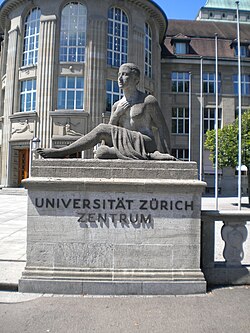
Key Facts
- Established: 1833 (with roots dating back to 1525).
- Student Population: Approximately 28,700 enrolled students.
- Budget: 1.578 billion Swiss francs.
- Staffing: 3,702 full-time equivalent faculty and 2,051 administrative staff.
- Global Standing: Ranked among the top 100 universities globally across various indices (ARWU, CWUR, QS, THE).
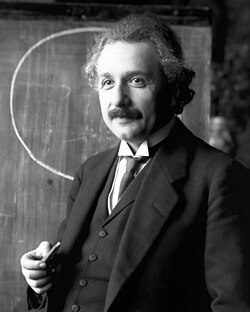
- Notable Alumnus: Albert Einstein received his PhD from the philosophical faculty in 1906.
Historical Milestones
Pioneering Education and Gender Equality
The University of Zurich has a long history of breaking social barriers. Women were permitted to attend philosophy lectures as early as 1847. The institution became a sanctuary for women seeking medical degrees when other European universities remained closed to them. This led to the emergence of the Zurich Seven, the first seven women to be awarded medical degrees at the university, including Nadezhda Suslova, who graduated in 1867.
Architectural Evolution
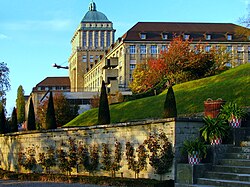
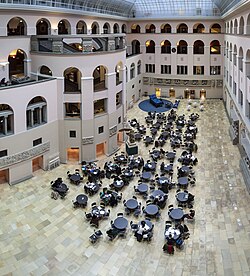
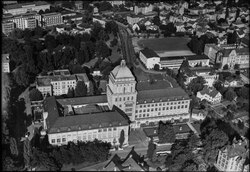
In 1914, the university transitioned to its iconic premises on Rämistrasse 71, designed by the renowned architect Karl Moser.
Scientific Contributions and Modern Achievements
The university's association with genius is most famously highlighted by Albert Einstein, who earned his PhD here and later served as an associate professor. In more recent years, UZH continues to lead in sustainability and technology; in 2025, the university and the Zurich University of Applied Sciences received the Geospatial World Excellence Award for their "Spatial Sustainable Finance" project.
Campus and Facilities
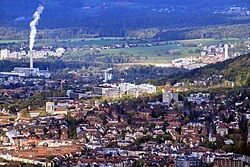
Unlike traditional enclosed campuses, the University of Zurich is an urban campus, with its facilities scattered throughout the city of Zurich. The primary hubs are located in the city center, Oerlikon, and the Irchelpark.
The Irchelpark campus, developed in stages between 1973 and 1983, serves as a center for the faculty of science. It also houses the Staatsarchiv Zürich (cantonal archives) and the Anthropologisches Museum (anthropological museum).
Students have access to extensive academic resources, including the Zurich Central Library and the ETH-library, which together provide access to over 5 million volumes.
Academic Standing and Rankings
UZH is recognized globally for its research output and teaching quality. It is particularly noted for its Department of Economics, which was ranked first in the German-speaking area by Handelsblatt in 2017. The faculty of Business Administration also maintains a high standing, ranking third in the same region in 2009.
| Ranking Body | Rank/Year |
|---|---|
| ARWU World | 59 (2023) |
| CWUR World | 62 (2025) |
| QS World | 100 (2026) |
| THE World | 80 (2024) |
| USNWR Global | 59 (2025-2026) |
Distinguished Alumni and Faculty
The university has been the academic home to a vast array of influential figures across various disciplines:
- Science: Beyond Albert Einstein, the university is linked to Nobel laureates such as Wilhelm Conrad Röntgen (Physics), Alfred Werner (Chemistry), and Rolf M. Zinkernagel (Medicine).
- Politics and Law: Numerous Presidents of the Swiss Confederation, including Moritz Leuenberger and Doris Leuthard, as well as the creator of the Swiss Civil Code, Eugen Huber.
- Philosophy and Activism: The Marxist theorist Rosa Luxemburg is among the notable figures associated with the institution.
Frequently Asked Questions
When was the University of Zurich founded?
The university was officially founded on April 29, 1833, though it incorporated existing colleges of theology, law, and medicine that dated back to 1525.
Who are the "Zurich Seven"?
The Zurich Seven were the first seven women to receive medical degrees from the University of Zurich, representing diverse nationalities including Russia, England, Scotland, the United States, and Switzerland.
What is the significance of the Irchelpark campus?
The Irchelpark campus is the primary site for the faculty of science and houses important cultural institutions like the Anthropological Museum and the cantonal archives.
Which Nobel laureates are associated with UZH?
The university has associations with many Nobel laureates, including Albert Einstein, Erwin Schrödinger, and Paul Karrer, spanning the fields of Physics, Chemistry, and Medicine.
Is the University of Zurich a private or public institution?
It is a public research university, and it was notably the first university in Europe to be established by the state rather than by a church or monarch.