United Arab Republic: The Rise and Fall of a Pan-Arab Union
The United Arab Republic (UAR) was a sovereign state in the Middle East that existed from 1958 to 1971. Born from the ambitious dream of Pan-Arabism—the movement to unify the Arabic-speaking peoples of the region—it began as a political union between the Republic of Egypt and the Second Syrian Republic. While the union with Syria was short-lived, the UAR remained the official name of Egypt for a decade after the split, marking a pivotal era of socialist reform and geopolitical tension during the Cold War.
Key Facts
- Duration: 1958–1971 (Union with Syria lasted from 1958 to 1961).
- Key Leaders: Gamal Abdel Nasser and Anwar Sadat.
- Capital: Cairo.
- Territories: Egypt, Syria (until 1961), and the Gaza Strip (until 1967).
- Government Type: Unitary Arab socialist republic.
- Dissolution: Formally renamed the Arab Republic of Egypt on September 11, 1971.
The Origins of the Union
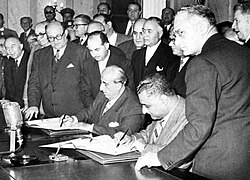
The UAR was established on February 1, 1958, as a strategic step toward a larger pan-Arab state. The impetus for the merger came from Syrian political and military leaders who feared a Communist takeover. In 1957, the Syrian Crisis intensified as Western powers grew concerned over the influence of the Communist Party and the sympathies of army chief of staff Afif al-Bizri.
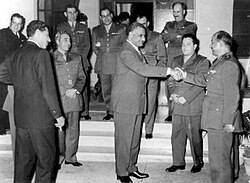
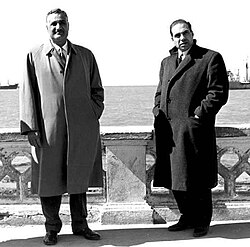
Syrian leaders, including President Shukri al-Quwatli, argued that only a total union with Egypt under the leadership of Gamal Abdel Nasser could neutralize the Communist threat. Although Nasser initially preferred a looser federal arrangement, he eventually agreed to a full merger to prevent a Communist shift in Damascus.
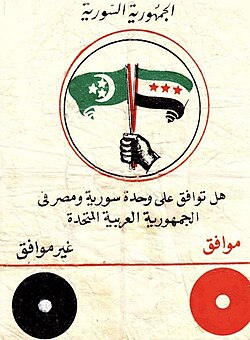
Following referendums on February 21, 1958, voters in both Egypt and Syria overwhelmingly supported the merger. Nasser was declared President of the new republic on February 22.
Governance and Internal Tension
The union was built on the hope that Nasser would collaborate with the Ba'ath Party (a secular Arab nationalist party) to govern Syria. However, Nasser sought centralized control. He established a provisional constitution and a 600-member National Assembly, with a heavy Egyptian majority (400 members from Egypt and 200 from Syria). Crucially, he disbanded all political parties, including the Ba'ath Party.
Over time, Syrian officials were systematically pushed out of influential roles. By 1960, Egyptian officials dominated key sectors, such as the Ministry of Industry and the General Petroleum Authority. While Egypt experienced economic growth with a GNP increase of 4.5%, Nasser tightened his grip on information by nationalizing the Egyptian press.
Foreign Relations and the Arab Cold War
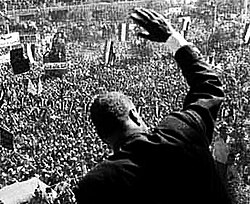
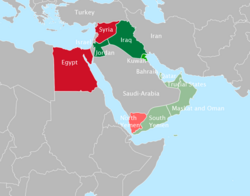
The formation of the UAR sent shockwaves through the region, particularly in Jordan, where King Hussein feared the union would embolden dissidents. In response, Jordan and Iraq formed the Arab Federation on February 14, 1958, to counter Nasser's influence.
The geopolitical landscape shifted again after the July 14 Revolution in Iraq ended the Hashemite dynasty. Iraq initially sought to join the UAR, and although formal talks were cancelled in 1959, the idea of a tripartite union (Egypt, Syria, and Iraq) persisted. This ambition was reflected in the Iraqi flag of the era, which featured three stars symbolizing the three intended member states.
Economic Reforms and Nationalization
In 1960, Nasser attempted to align the Syrian economy with Egypt's strong public sector. This led to an aggressive wave of nationalizations starting in July 1961. The government seized control of the cotton trade, import-export firms, banks, insurance companies, and all heavy industry.
Nasser also implemented sweeping social justice policies, including:
- Reducing the land ownership limit from 200 to 100 feddans.
- Implementing a 90% tax on income exceeding £E10,000.
- Granting workers a 25% share in firm profits and representation on management boards.
- Reducing the average workday to seven hours without cutting pay.
The Collapse of the Union
The push for extreme centralization eventually alienated the Syrian leadership. In August 1961, Nasser abolished regional governments in favor of a single central authority. This marginalization of Syrian power culminated in a coup d'état on September 28, 1961, leading to Syria's secession from the union.
Despite the loss of Syria, Egypt continued to call itself the United Arab Republic for another decade. During this period, the UAR administered the Gaza Strip until the 1967 Six-Day War, when Israel invaded the Sinai Peninsula, Gaza, the West Bank, and the Golan Heights.
Following the death of Nasser in 1970, his successor, Anwar Sadat, reversed many socialist reforms and formally renamed the country the Arab Republic of Egypt on September 11, 1971.
Summary of the United Arab Republic
| Feature | Details |
|---|---|
| Official Name | United Arab Republic (al-Jumhūriyya al-ʿArabiyya al-Muttaḥida) |
| Capital | Cairo |
| Presidents | Gamal Abdel Nasser (1958–1970), Anwar Sadat (1970–1971) |
| Total Area | 1,195,000 km² (at peak) |
| Official Language | Arabic |
| Currency | Egyptian pound (Egypt/Gaza), Syrian pound (Syria) |
Frequently Asked Questions
Why did Syria and Egypt unite in 1958?
The union was primarily driven by Syrian fears of a Communist takeover and a desire for Pan-Arab unity under the charismatic leadership of Gamal Abdel Nasser.
Why did the union between Egypt and Syria fail?
The union failed due to Nasser's insistence on extreme centralization, the disbanding of Syrian political parties like the Ba'ath Party, and the marginalization of Syrian officials in government.
What happened to the name "United Arab Republic" after 1961?
Even after Syria seceded in 1961, Egypt continued to use the name United Arab Republic officially until Anwar Sadat changed it to the Arab Republic of Egypt in 1971.
How did the UAR affect the flags of other Arab nations?
The UAR flag, based on the 1952 Arab Liberation Flag, influenced several others. Syria used a version of it until 2024, and the current flags of Egypt, Sudan, and Yemen are all based on the same red, white, and black horizontal bands.
What role did the Gaza Strip play in the UAR?
Following the dissolution of the All-Palestine Government in 1959, the UAR administered the Gaza Strip until it was invaded by Israel during the Six-Day War in 1967.