Union Army: The Force That Preserved the United States
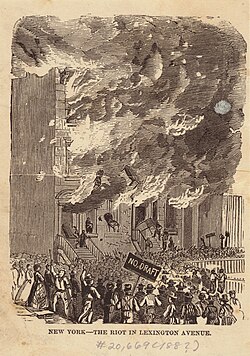
The Union Army served as the primary military force of the United States during the American Civil War, tasked with the monumental goal of preserving the nation. Operating under the U.S. Department of War, this massive organization grew from a small professional core into a multi-million man force composed of diverse volunteers and regulars.
From the early clashes at Fort Sumter to the final surrender at Appomattox Court House, the Union Army navigated unprecedented logistical challenges and internal social shifts, eventually securing a victory that redefined the American landscape.
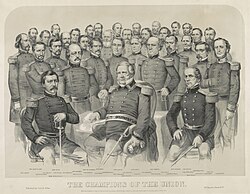
Key Facts
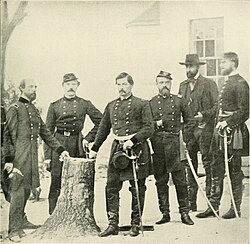
- Total Enlistment: 2,128,948 men served throughout the war.
- Peak Strength: The army reached a peak of 700,000 soldiers.
- Diversity: Approximately 8.4% (178,895) were colored troops, and 25% of white soldiers were immigrants.
- Casualties: 596,670 soldiers were killed, wounded, or went missing.
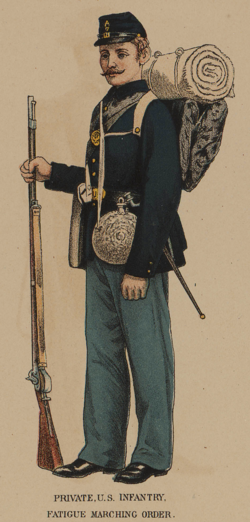
- Primary Color: The army was identified by its signature dark blue uniforms.
Army Organization and Hierarchy
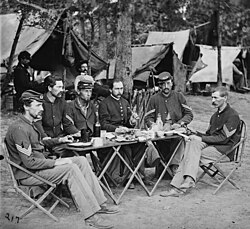
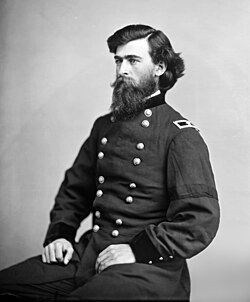
The Union Army utilized a structured hierarchy to manage its vast numbers. While the Commander-in-Chief role was held by President Abraham Lincoln (1861–1865) and later Andrew Johnson (1865), the operational leadership shifted through several Commanding Generals, most notably ending with Ulysses S. Grant.
Tactical Structure
The army was organized into specific tactical units to ensure efficient command and control on the battlefield. The structure progressed from the smallest unit, the company, up to the massive army corps.
| Unit Name | Commander | Sub-units | Approx. Soldiers |
|---|---|---|---|
| Corps | Major General | 2–6 Divisions | 36,000 |
| Division | Major General | 2–6 Brigades | 12,000 |
| Brigade | Brigadier General | 2–12 Regiments | 4,000 |
| Regiment | Colonel | 10 Companies | 1,000 |
| Company | Captain | 2 Platoons | 100 |
Personnel and Composition
![John Haag, a 21-year-old immigrant from Germany, affiliated with Company B of the 26th Wisconsin Infantry Regiment in August 1862[75]](/images/93/26/93266517f322369b32d3913b16e45d80d4a540b0c68b3986a60e5699da18f34c.jpg)
Regulars vs. Volunteers
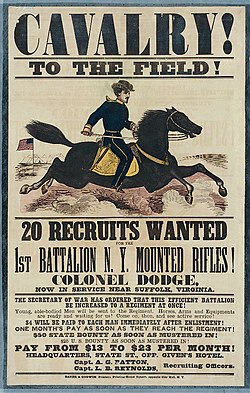
A distinct divide existed between the Regular Army (professional soldiers) and Volunteer units. Before the war, the regular army numbered only 16,400. By the end, while the total force exceeded a million, regulars only numbered about 21,699. Because of their professional training, regulars were often viewed as elite troops and held in reserve for critical emergencies.
Ethnic and Social Diversity
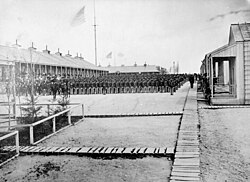
The Union Army was a melting pot of the 19th-century American population. Native-born white Americans formed the bulk of the force (1.4 million), but significant contributions came from immigrants and minority groups.
- German-Americans: Approximately 216,000 soldiers.
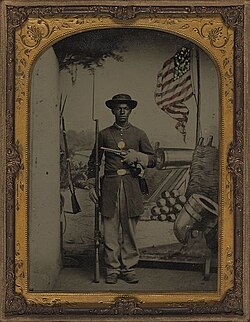
- African Americans: Approximately 210,000 soldiers, including the U.S. Colored Troops.
- Irish-born: Approximately 150,000 soldiers.
- Other groups: Including Canadians, English-born, French-Canadians, and various other European and Native American origins.
Administration and Logistics
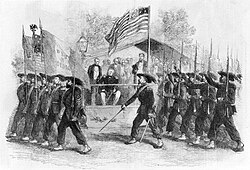
Managing a force of over two million men required a massive administrative apparatus. The army established various bureaus to handle everything from justice and engineering to medical care and food supply.
The Medical and Ordnance Departments
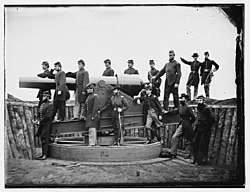
The Medical Department expanded rapidly to handle the carnage of war, increasing its number of hospital stewards from 201 in 1862 to 931 by 1865. Simultaneously, the Ordnance Department relied on a network of arsenals—such as the Springfield Armory in Massachusetts—to supply the troops with weaponry.
Financial and Subsistence Challenges
The Pay Department faced the daunting task of paying a force fifty times larger than the pre-war army. Over the course of the war, they disbursed $1,029,239,000. To feed the troops, the Subsistence Department evolved from a few officers in 1861 to a complex system of chief commissaries assigned to every field army and division by 1865.
Frequently Asked Questions
Who were the Commanding Generals of the Union Army?
The leadership evolved over the war, starting with Winfield Scott, followed by George B. McClellan, Henry W. Halleck, and finally Ulysses S. Grant, who served from 1864 to 1869.
What was the role of African Americans in the Union Army?
African Americans played a vital role, with approximately 210,000 serving in the force. This included the U.S. Colored Troops, who contributed significantly to the Union's military efforts.
How did the Union Army differ from the Regular Army?
The Regular Army consisted of professional, pre-war soldiers who were often used as elite reserves. The vast majority of the Union Army, however, consisted of volunteers who enlisted specifically for the duration of the conflict.
What were the primary logistical challenges faced by the Union?
The primary challenges included the rapid scaling of the Pay Department to handle millions of dollars in disbursements and the expansion of the Subsistence Department to feed a force that grew by over 50 times its original size.