Abraham Lincoln: The Life and Legacy of the 16th U.S. President
Abraham Lincoln remains one of the most iconic figures in American history. Serving as the 16th President of the United States from March 4, 1861, until his death on April 15, 1865, Lincoln led the nation through its greatest internal crisis: the American Civil War. Known as "Honest Abe," he is remembered for his leadership in preserving the Union and his pivotal role in the abolition of slavery.
Lincoln's journey from a humble background to the White House is a testament to his perseverance and intellectual growth. His career spanned various roles, from a prairie lawyer and state legislator to a member of the U.S. House of Representatives, eventually culminating in the presidency.
![A daguerreotype of Lincoln, taken around 1847, the earliest known photograph of him[65]](/images/86/b2/86b2595160e9b077b098254e9dde4d6677380b37112b5d6114d7c2f10f14cf78.jpg)
Key Facts
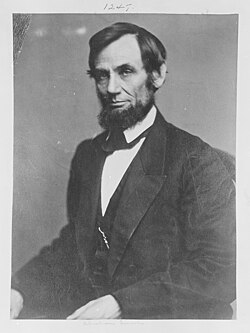
- Full Name: Abraham Lincoln
- Presidency: March 4, 1861 – April 15, 1865
- Political Parties: Whig (until 1856), Republican (after 1856), National Union (1864–1865)
- Key Achievements: Preserved the Union, issued the Emancipation Proclamation, and delivered the Gettysburg Address.
- Physical Stature: 6 ft 4 in (193 cm)
- Death: Assassinated by gunshot on April 15, 1865
Early Life and Political Ascent
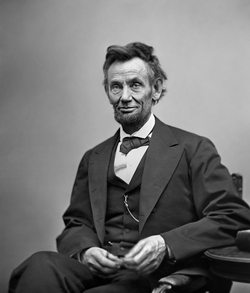
Born on February 12, 1809, Lincoln's early years were marked by a drive for self-improvement. After moving to Illinois, he entered the political arena, serving in the Illinois House of Representatives from 1834 to 1842. His reputation as a skilled prairie lawyer (a lawyer practicing in rural areas) helped him build a foundation of trust and visibility.
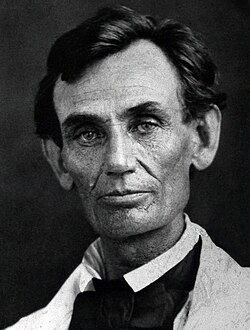
Lincoln's national profile rose significantly during the 1850s. He became a leader within the Republican Party, gaining attention for his opposition to the expansion of slavery. This period was highlighted by the Lincoln–Douglas debates of 1858 and his influential Cooper Union speech in New York City on February 27, 1860.
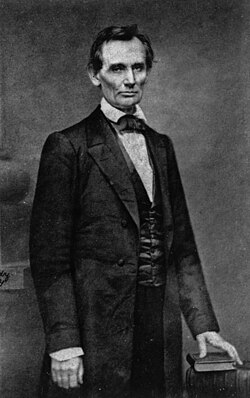
The Presidency and the Civil War
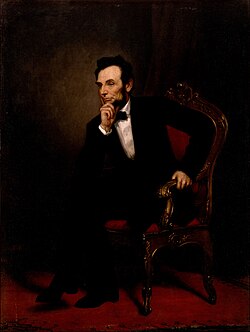
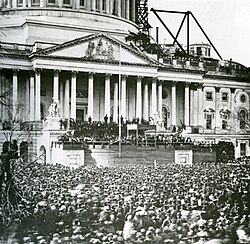
Lincoln assumed the presidency on March 4, 1861, a time of extreme volatility as several Southern states began the process of secession (the formal withdrawal of a state from the Union). His primary goal was the preservation of the United States as a single entity.
As Commander-in-Chief, Lincoln managed the Union military strategy, navigating the challenges of early leadership under generals like George B. McClellan. One of his most transformative acts was the issuance of the Emancipation Proclamation, which shifted the purpose of the war toward the liberation of enslaved people.
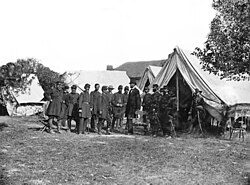
In 1863, Lincoln delivered the Gettysburg Address, one of the most famous speeches in human history, redefining the American struggle as a quest for a "new birth of freedom." He continued to refine military strategy, eventually promoting Ulysses S. Grant to lead the Union forces toward victory.
![One of only two confirmed photos of Lincoln at Gettysburg (seated in center facing camera),[215][216] taken about noon on November 19, 1863; some three hours later, Lincoln delivered the famed address. To Lincoln's right is Ward Hill Lamon, Lincoln's bodyguard.](/images/78/6f/786f3fc76c60de96b87cd6fa7a58872327d1d79b65aeacbb1d56896d1291cee4.jpg)
The Lincoln Cabinet
Lincoln assembled a diverse and often challenging team of advisors. His cabinet included figures such as William H. Seward (Secretary of State) and Edwin M. Stanton (Secretary of War), who played critical roles in managing the war effort and foreign diplomacy.
| Office | Name | Term |
|---|---|---|
| President | Abraham Lincoln | 1861–1865 |
| Vice President | Hannibal Hamlin / Andrew Johnson | 1861–1865 |
| Secretary of State | William H. Seward | 1861–1865 |
| Secretary of War | Edwin M. Stanton | 1862–1865 |
| Secretary of the Treasury | Salmon P. Chase / William P. Fessenden / Hugh McCulloch | 1861–1865 |
Personal Life and Final Days
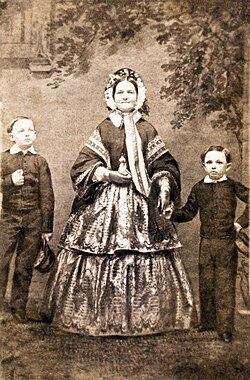
Lincoln was married to Mary Todd, and together they had four children. Despite the immense pressure of the presidency, he remained dedicated to his family, though the era was marked by personal loss.
Following his re-election and the nearing end of the Civil War, Lincoln began planning for Reconstruction—the process of reintegrating the Southern states back into the Union. However, his vision was cut short. On April 14, 1865, Lincoln was assassinated by John Wilkes Booth at Ford's Theatre in Washington, D.C.
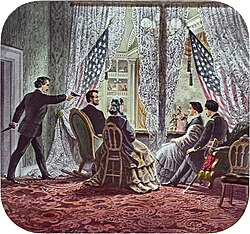
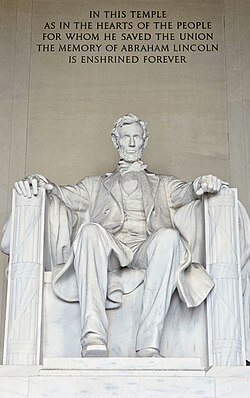
He passed away the following morning, April 15, 1865, at the age of 56. He was later interred in the Lincoln Tomb.
Frequently Asked Questions
What was Abraham Lincoln's role in ending slavery?
While initially focused on preserving the Union, Lincoln issued the Emancipation Proclamation in 1863, which declared that all persons held as slaves within the rebellious states "are, and henceforward shall be free." This fundamentally changed the legal status of millions of enslaved African Americans.
Who succeeded Abraham Lincoln as President?
Following his assassination, Andrew Johnson, who had served as Vice President since March 1865, succeeded him as the 17th President of the United States.
What were the Lincoln-Douglas debates?
These were a series of seven debates in 1858 between Abraham Lincoln and Stephen A. Douglas during the campaign for the U.S. Senate seat in Illinois. The debates focused heavily on the issue of slavery and its expansion into new territories.
How tall was Abraham Lincoln?
Abraham Lincoln was 6 feet 4 inches (193 cm) tall, making him one of the tallest presidents in U.S. history.
Where is Abraham Lincoln buried?
Abraham Lincoln is buried in the Lincoln Tomb, located in Springfield, Illinois.