Unified Team of Germany: The Complex History of Olympic Representation
The history of German participation in the Olympic Games during the Cold War era is a fascinating study of political compromise and evolving national identity. For several decades, athletes from East and West Germany navigated a delicate balance between their separate political regimes and their shared athletic ambitions, leading to the creation of a unique "unified team."
The Era of Compromise (1956–1968)
During the mid-20th century, the International Olympic Committee (IOC) sought ways to represent both German states without triggering political conflict. Because East Germany had introduced its own national anthem in 1949, a compromise was reached: the melody of Beethoven's Symphony No. 9 (Schiller's "Ode to Joy") was played for winning athletes from either side.
A similar challenge arose regarding national symbols. In 1959, East Germany adopted an altered version of the black-red-gold tricolour flag. To maintain a unified appearance, the sports teams agreed to use a plain tricolour flag superimposed with white Olympic rings. This specific flag served as the symbol of the unified team from 1960 to 1968.
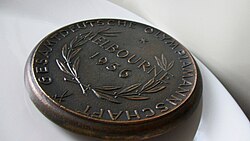
Naming and Coding Confusion
Between 1956 and 1964, the team was simply identified as "Germany," typically using the country code GER. However, inconsistencies existed; for instance, the 1964 Innsbruck Games used the German "D" for Deutschland. In modern records, the IOC retrospectively applies the code EUA (derived from the French Équipe Unifiée d'Allemagne), though standardized codes were not actually implemented by the IOC until 1976. Prior to that, local Organizing Committees chose their own codes, often based on the local language.
The Transition to Separation (1968–1972)
The 1968 Winter Olympics marked a transitional phase. While athletes competed as separate teams, they continued to use the compromise anthem and the Olympic rings flag. Despite this shared symbolism, the two delegations did not march as a single unit during the Parade of Nations, each carrying its own instance of the compromise flag.
The naming conventions during this period were asymmetrical. In French, the teams were listed as Allemagne (West) and Allemagne de l'Est (East), while in Spanish they were Alemania and Alemania del Este. The codes varied by location: in Grenoble, West Germany used ALL, and in Mexico City, they used ALE, while East Germany used ADE.
Complete Divergence and Reunification
The separation became absolute at the 1972 Winter Olympics, where both nations finally utilized their own distinct flags and anthems. From this point forward, East Germany marched under the official name German Democratic Republic. West Germany continued to march as "Germany" in 1972 and 1976 before switching to the Federal Republic of Germany in 1980.
The proximity of the two teams during the Parade of Nations varied based on the host country's alphabetical sorting. They marched adjacently during the 1972 and 1976 Winter Games, but were separated during the 1972 Summer Games (as West Germany marched last as the host) and the 1976 Summer Games (due to French alphabetical ordering). By coincidence, they marched together one final time at the 1988 Summer Olympics due to Korean alphabetical order.
This era of division ended in 1990, when the five states of East Germany and Berlin joined West Germany in a formal reunification.
Key Facts
- Compromise Anthem: Beethoven's "Ode to Joy" was used to avoid political conflict between East and West.
- Unified Flag: A black-red-gold tricolour with white Olympic rings was used from 1960 to 1968.
- Retrospective Coding: The IOC now uses the code EUA for the unified team, though this was not used at the time.
- Full Separation: Occurred at the 1972 Winter Olympics with separate flags and anthems.
- Final Appearance: The two separate German teams marched adjacently for the last time in 1988.
| Period | Team Status | Symbols Used | Common Codes |
|---|---|---|---|
| 1956–1964 | Unified | Ode to Joy / Olympic Rings Flag | GER, D, EUA (retro) |
| 1968 | Separate Teams / Shared Symbols | Ode to Joy / Olympic Rings Flag | ALL, ALE, ADE |
| 1972–1988 | Fully Separate | National Flags and Anthems | FRG, GDR |
Frequently Asked Questions
Why was Beethoven's Ninth Symphony used as an anthem?
It served as a political compromise because East Germany had introduced its own national anthem in 1949, making it impossible to use a single national anthem for athletes from both East and West Germany.
What does the IOC code EUA stand for?
EUA stands for Équipe Unifiée d'Allemagne, which is French for "Unified Team of Germany." This code is applied retrospectively to the medal database.
When did East and West Germany start using their own flags at the Olympics?
The complete separation of symbols, including the use of separate flags and anthems, occurred at the 1972 Winter Olympics.
Did the two German teams always march together?
No. While they marched adjacently at some events based on alphabetical order, they did not march as a single unified team in 1968, and were separated in the 1972 and 1976 Summer Games due to hosting duties and language-specific sorting.
When did the separate Olympic teams finally merge?
The separation ended following the German reunification in 1990, when East Germany's five states and Berlin joined West Germany.