German Democratic RepublicEast GermanyGDRCold WarBerlin Wall

German Democratic Republic: The Rise and Fall of East Germany

German Democratic Republic: The Rise and Fall of East Germany The German Democratic Republic (GDR), commonly known as East Germany, was a sovereign state in Central Europe that existed fr...

German Democratic Republic: The Rise and Fall of East Germany

The German Democratic Republic (GDR), commonly known as East Germany, was a sovereign state in Central Europe that existed from October 7, 1949, until its reunification with West Germany on October 3, 1990. Defined by its alignment with the Soviet Union, the GDR described itself as a socialist workers' and peasants' state, serving as a primary frontier of the Cold War.

The nation's existence was the result of the geopolitical partitioning of Germany following World War II. While West Germany evolved into a democratic federal republic, the GDR became a unitary communist state, characterized by a centralized economy and a pervasive security apparatus.
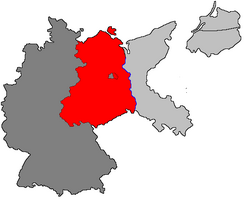
On the basis of the Potsdam Conference, the Allies jointly occupied Germany west of the Oder–Neisse line. This territory later became two independent countries.Light grey: territories annexed by Poland and the Soviet Union.Dark grey: West Germany (formed from the US, UK, and French occupation zones, including West Berlin).Red: East Germany (formed from the Soviet occupation zone, including East Berlin).

Key Facts

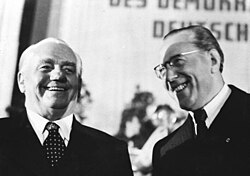
GDR leaders: President Wilhelm Pieck and Prime Minister Otto Grotewohl, 1949
  • Duration: 1949 to 1990.
  • Political Status: Satellite state of the Soviet Union and member of the Warsaw Pact and Comecon.
  • Capital: East Berlin.
  • Government: Unitary communist state led primarily by the Socialist Unity Party (SED).
  • Key Leaders: Walter Ulbricht (1949–1971) and Erich Honecker (1971–1989).
  • Defining Event: The construction and eventual fall of the Berlin Wall.

The Formation and Partition of Germany
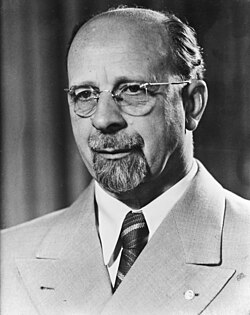
SED First Secretary, Walter Ulbricht, 1960

Following the Potsdam Conference, the Allies occupied Germany west of the Oder–Neisse line. The territory was split into zones of occupation. The Soviet occupation zone eventually formed the basis for the GDR, while the US, UK, and French zones merged to form the Federal Republic of Germany (West Germany).
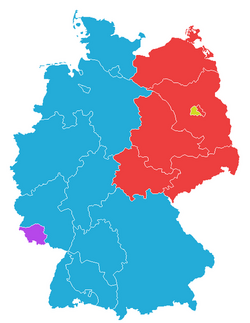
West Germany (blue) comprised the Western Allies' zones, excluding disputed Saarland (purple); the Soviet zone, East Germany (red) surrounded West Berlin (yellow).

The partition was most visible in Berlin. Although located deep within the Soviet zone, the city was also divided. This tension culminated in the 1961 Berlin Crisis and the construction of the Berlin Wall, which physically bisected the city to prevent East Germans from fleeing to the West.
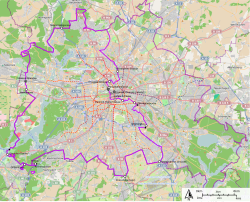
Map of West and East Berlin bisected by the Berlin Wall

Government, Politics, and Social Control
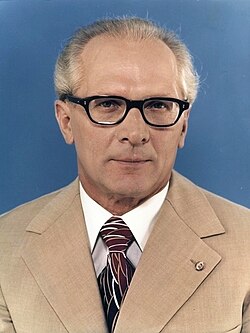
Erich Honecker, head of state (1971–1989)

The GDR was a unitary communist state. The Socialist Unity Party (SED), formed in 1946 through the merger of the Communist and Social Democrat parties, held the real power. The state's legislature was the Volkskammer (People's Chamber), and the Länderkammer served as an upper house.
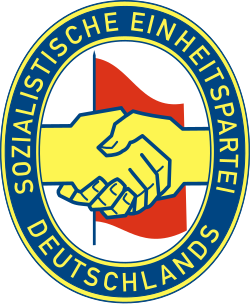
SED logotype: the Communist–Social Democrat handshake of Wilhelm Pieck and Otto Grotewohl, establishing the SED in 1946

To maintain order and ideological purity, the state employed the Stasi (Ministry for State Security), one of the most effective and repressive intelligence services in history. Social control also extended to youth through state-run organizations like the Ernst Thälmann Pioneer Organisation for children and the Free German Youth (FDJ) for adolescents.
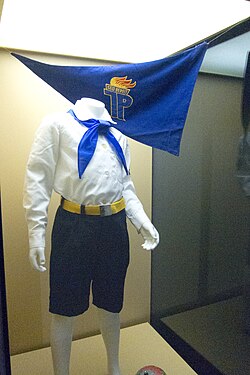
Ernst Thälmann Pioneer Organisation uniform
Freie Deutsche Jugend (FDJ) was founded on 7 March 1946 under the leadership of Erich Honecker.[98]

Military and Border Security

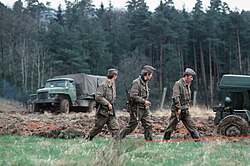
The GDR maintained a robust military presence through the National People's Army (NVA), the People's Navy, and the Air Forces. A critical component of state security was the Grenztruppen (Border Troops), who guarded the inner German border with lethal force to prevent unauthorized exits.
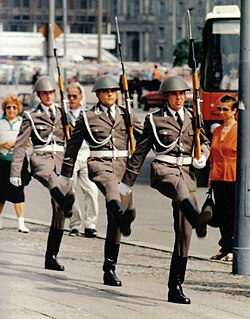
East German National People's Army changing-of-the-guard ceremony in East Berlin
Grenztruppen members guarding maintenance workers on the western side of the inner German border fence. The red tape in the foreground, the so-called "death cord", marked the area the work detail was permitted to operate, and workers stepping beyond the tape would be shot

Economy and Daily Life

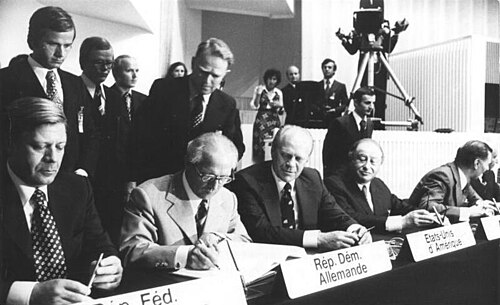
Chancellor of the Federal Republic of Germany (West Germany) Helmut Schmidt, Chairman of the State Council of the German Democratic Republic (East Germany) Erich Honecker, U.S. president Gerald Ford and Austrian chancellor Bruno Kreisky signing the Helsinki Act

The East German economy was centrally planned. While it achieved a high Human Development Index (HDI) of 0.953 by 1990 and maintained low income inequality (Gini coefficient of 18.5), it struggled to keep pace with the West's economic growth.

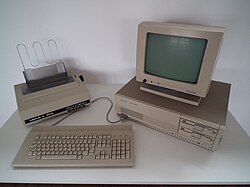
The state produced iconic goods, such as the Trabant automobile and the Robotron EC 1834 personal computer. Despite the limitations of a planned economy, the GDR implemented policies to encourage births among educated women to stabilize the population.
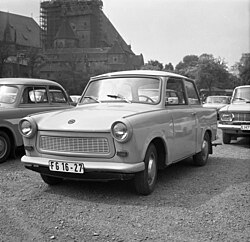
The Trabant automobile was a profitable product made in the German Democratic Republic.
A VEB Robotron EC 1834 personal computer, first introduced in 1986.
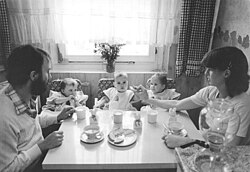
A woman and her husband, both medical students, and their triplets in East Germany in 1984. The GDR had state policies to encourage births among educated women.

Culture and Education

Culture was often subject to state censorship, yet the GDR fostered significant achievements in theatre, cinema, and sports. The state emphasized a rigorous school system and provided extensive childcare. Religion played a secondary role, with a high percentage of the population becoming unaffiliated due to state atheism, though Protestantism remained the largest denomination.
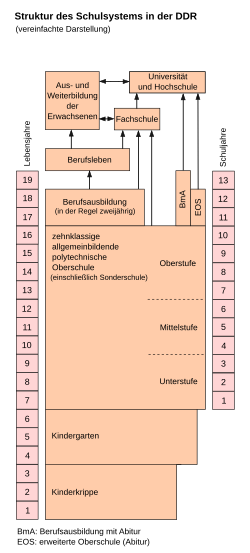
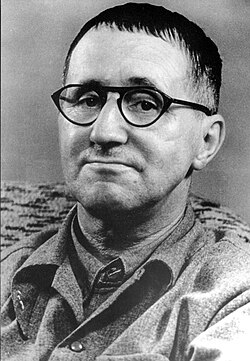
Diagram of East German school system (in German)
Playwright Bertolt Brecht (1898–1956)

The Path to Reunification

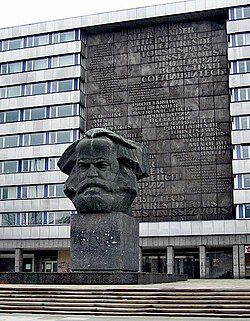
Karl Marx Monument in Chemnitz (renamed Karl-Marx-Stadt from 1953 to 1990)

By the late 1980s, economic stagnation and political unrest led to the Peaceful Revolution. Mass demonstrations, such as those at Alexanderplatz in November 1989, pressured the government for reform. The symbolic climax occurred on November 9, 1989, with the fall of the Berlin Wall.
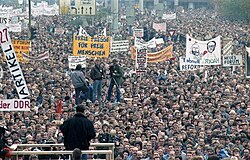
Demonstration on Alexanderplatz in East Berlin on 4 November 1989

Following the collapse of the SED's monopoly on power, the GDR held its first free elections, led by the Alliance for Germany coalition. This paved the way for the Final Settlement on September 12, 1990, and official reunification on October 3, 1990.
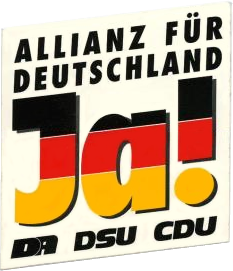
Logo of the Alliance for Germany coalition, which was led by the Christian Democratic Union (East Germany)

Summary of the German Democratic Republic
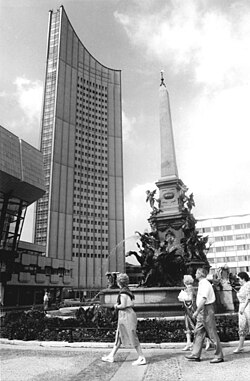
Uni-Riese ("University Giant") in 1982. Built in 1972, it was once part of the Karl-Marx-University and is Leipzig's tallest building.
Overview of GDR State Statistics and Data
Category Details
Official Name Deutsche Demokratische Republik (GDR)
Capital East Berlin
Population (1950) 18,388,000
Population (1990) 16,111,000
Total Area 108,333 km²
GDP (PPP, 1989) $160 billion
Currency East German mark (until July 1, 1990)

Frequently Asked Questions
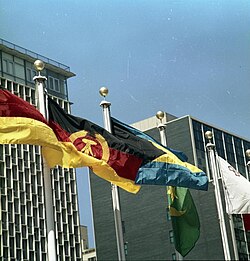
GDR flag at the United Nations headquarters, New York City, 1973
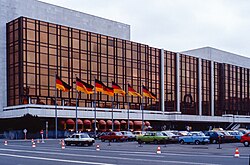
The Palast der Republik, seat of the Volkskammer
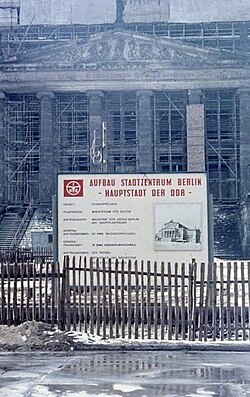
Poster with the inscription "Berlin – Hauptstadt der DDR", 1967
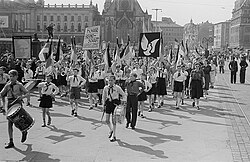
Ernst Thälmann Pioneer Organisation parade in 1953
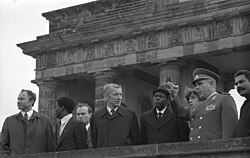
Angola's José Eduardo dos Santos during his visit to East Berlin
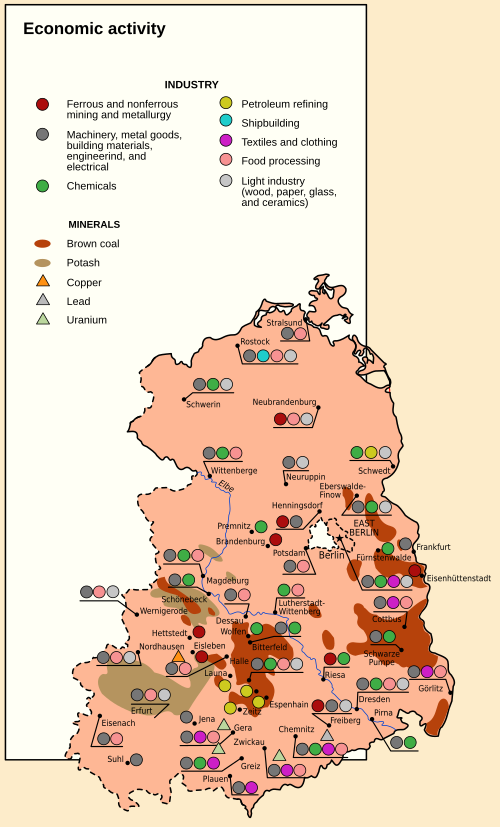
Map of the East German economy (August 1990)
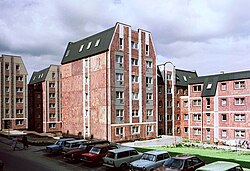
Hanseatic-themed panel blocks in Rostock's city center in September 1986, at the time East Germany's largest coastal and port city, and the sixth largest city in the country
A 1980 meeting between representatives of the BEK and Erich Honecker
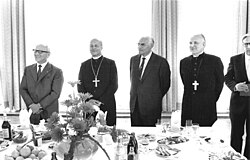
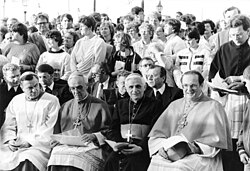
Katholikentag, Dresden, 1987(left to right) Bishop Karl Lehmann and Cardinals Gerhard Schaffran, Joseph Ratzinger (the future Pope Benedict XVI) and Joachim Meisner
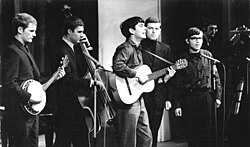
Oktoberklub in 1967
Oktoberklub in 1967
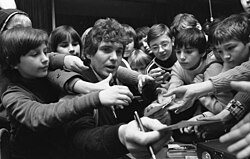
Pop singer Frank Schöbel (center) giving autographs in 1980.
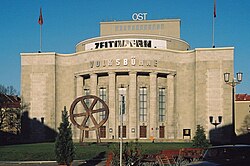
Volksbühne
Volksbühne
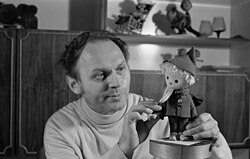
Gerhard Behrendt with character from the stop-animation series Sandmännchen, in 1979
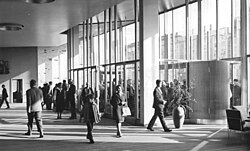
The foyer of the Kino Kosmos (Cosmos Cinema) in Karl Marx Alley, Berlin in 1962
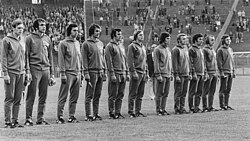
The East German football team lining up before a match against Australia on 15 June 1974
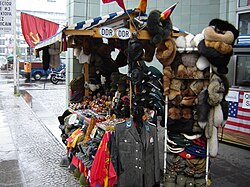
A booth selling East German and communist-themed memorabilia in Berlin
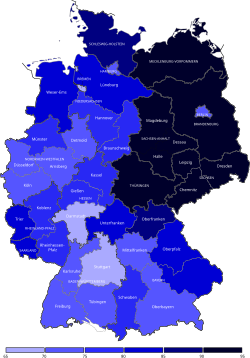
Proportion of Germans without a migrant background (2016)

What was the role of the SED in East Germany?

The Socialist Unity Party (SED) was the ruling communist party that exercised de facto control over the government, economy, and social life of the GDR, ensuring the state remained a satellite of the Soviet Union.

Why was the Berlin Wall built?

The Berlin Wall was constructed in 1961 to stop the mass emigration of East Germans to West Berlin, which was seen as a threat to the stability and economic viability of the GDR.

What was the Stasi?

The Stasi was the Ministry for State Security, the GDR's secret police and intelligence agency, responsible for monitoring citizens and suppressing political dissent through surveillance and repression.

How did the GDR end?

The GDR ended through a combination of the Peaceful Revolution, the fall of the Berlin Wall in 1989, and subsequent diplomatic agreements that led to the official reunification with West Germany on October 3, 1990.

What was the Trabant?

The Trabant was a mass-produced automobile in the GDR, becoming a symbol of East German industry and daily life due to its ubiquity and the long waiting lists required to purchase one.