U.S. European Command: A History of Strategic Defense and Global Operations
The U.S. European Command (EUCOM) serves as the primary mechanism for United States military authority and coordination across Europe and surrounding regions. From its origins as a single-service Army command to its evolution into a unified joint-service powerhouse, EUCOM has played a pivotal role in maintaining Western security, deterring aggression during the Cold War, and managing complex geopolitical crises in the 21st century.
Key Facts
- Established: August 1, 1952, as a unified command to oversee all U.S. forces in Europe.
- Core Mission: Providing unified command and authority to deter threats and support NATO allies.
- Historical Peak: U.S. personnel in Europe grew from 120,000 in 1950 to over 400,000 by 1953.
- Key Alliances: Central to the North Atlantic Treaty Organization (NATO) framework.
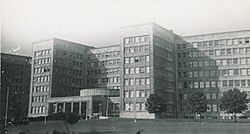
- Headquarters Evolution: Moved from Frankfurt to Paris, and finally to Patch Barracks in Stuttgart, Germany.
The Foundation of Unified Command (1942–1959)
Before the formal establishment of EUCOM as a unified command, U.S. military presence in Europe was fragmented. Between 1942 and 1952, the senior Army administrative command underwent several name changes, including the European Theater of Operations United States Army (ETOUSA) and United States Forces European Theater (USFET). During this era, the Army, Navy, and Air Force operated under separate commands reporting directly to the Joint Chiefs of Staff.
The shift toward a unified command occurred on August 1, 1952. This reorganization was driven by the end of the German occupation in 1949 and the urgent need to defend Western Europe against the Soviet Union (USSR), particularly following the 1948–49 Berlin Crisis. The creation of NATO in 1949 further solidified the need for a cohesive command structure.
Under the leadership of General Dwight D. Eisenhower—the first Supreme Allied Commander Europe (SACEUR)—the U.S. massively reinforced its presence. By 1953, the U.S. Air Forces in Europe had expanded to eleven wings, and the Sixth Fleet in the Mediterranean doubled its warship count. The Army activated the Seventh Army in Stuttgart and deployed the 10th Special Forces Group to Bad Tölz for unconventional warfare missions.
Cold War Pressures and Strategic Shifts (1960–1989)
The 1960s were marked by volatility, including the 1961 Berlin Crisis, which saw the call-up of 148,000 reserve personnel. EUCOM also managed contingency operations outside Europe, such as Operation Blue Bat in response to the 1958 Lebanon crisis.
A significant logistical shift occurred in 1967. Following disagreements between France and NATO, President Charles de Gaulle required all foreign forces to leave French territory. Consequently, the Supreme Headquarters Allied Powers Europe (SHAPE) moved to Belgium, and EUCOM headquarters relocated to Patch Barracks in Stuttgart, Germany.
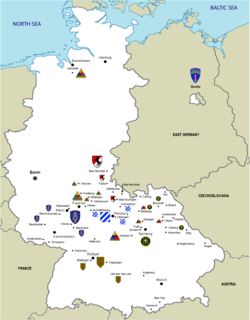
Throughout the 1970s and 80s, EUCOM faced evolving threats. The 1970s saw a rise in terrorism from groups like the Red Army Faction and the Red Brigades. Simultaneously, EUCOM provided humanitarian aid and peacekeeping in Africa, including operations in the Congo. By the 1980s, the deployment of Soviet SS-20 missiles led the U.S. to deploy Pershing II and Ground Launched Cruise Missiles (GLCM) as a countermeasure.
The 1986 Goldwater-Nichols Act further strengthened the authority of combatant commanders and led to the activation of the Special Operations Command, Europe. The era concluded with the signing of the Intermediate-Range Nuclear Forces (INF) Treaty in 1987 and the fall of the Berlin Wall in 1989.
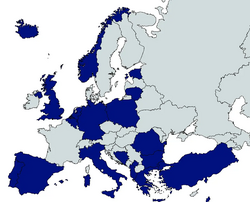
![An Euler diagram of European alliances, partners, and competitors, denoted by their national flags,[7] in EUCOM's Area of Responsibility. The alliances and agreements include the following supranational bodies: PESCO, Schengen Area, EU, and NATO.](/images/9e/0c/9e0cd56b2093a8c482d794e234273122637c41f5ec214497dafbd5e010a41f84.jpg)
Post-Cold War Transition and Modern Era (1990–Present)
With the collapse of the Soviet Bloc, EUCOM transitioned from a posture of containment to one of cooperation and stability. The command supported the NATO Partnership for Peace and engaged in critical operations in the Balkans, including Bosnia, Macedonia, and Kosovo.
The 21st century brought new challenges. Following the September 11 attacks, EUCOM provided forces for operations in Afghanistan and launched Operation Enduring Freedom Trans-Sahara in 2007 to combat terrorism in Africa. The command's Area of Responsibility (AOR) shifted several times, eventually transferring most African responsibilities to the newly created U.S. Africa Command (AFRICOM) in 2008.
Recent years have seen further adjustments. In 2021, coordination for military activities in Israel was transferred to CENTCOM. Most recently, in June 2025, the AOR for Greenland was shifted from EUCOM to USNORTHCOM.
EUCOM Historical Summary
| Era | Primary Focus | Key Headquarters/Location | Major Milestone |
|---|---|---|---|
| 1942–1952 | Post-WWII Administration | Frankfurt, Germany | Transition from ETOUSA to EUCOM |
| 1952–1967 | Cold War Containment | Camp des Loges, France | Establishment of Unified Command |
| 1967–1989 | NATO Integration & Deterrence | Patch Barracks, Germany | REFORGER Exercises & INF Treaty |
| 1990–2008 | Post-Cold War Stability | Patch Barracks, Germany | Balkans Operations & AFRICOM Split |
| 2008–Present | Counter-Terrorism & Modern Security | Patch Barracks, Germany | Shift of Israel/Greenland AORs |
Frequently Asked Questions
Why was the unified command structure created in 1952?
It was established to provide unified command and authority over all U.S. forces in Europe, replacing the separate reporting lines of the Army, Navy, and Air Force to the Joint Chiefs of Staff. This was necessary to address the Soviet threat and the end of the German occupation.
What was the purpose of the REFORGER exercises?
REFORGER, or "Return of Forces to Germany," was a series of annual exercises starting in 1967 designed to demonstrate the U.S. ability to rapidly reinforce its military presence in Europe during the Cold War.
How did the relationship with France affect EUCOM?
In 1966, President Charles de Gaulle demanded that all foreign forces come under French control. This forced EUCOM to move its headquarters from France to Patch Barracks in Stuttgart, Germany, in 1967.
What is the relationship between EUCOM and SACEUR?
Historically, the position of Commander-in-Chief Europe (USCINCEUR) was "dual hatted" with the Supreme Allied Commander Europe (SACEUR), meaning one individual held both the U.S. national command and the NATO allied command roles.
Which regions have been removed from EUCOM's responsibility recently?
Responsibility for military activities in Israel was transferred to CENTCOM in 2021, and the area of responsibility for Greenland was shifted to USNORTHCOM in June 2025.